Huawei OceanStor Dorado All-Flash Storage and Commvault 11
Interoperability Test Report

Axians Global
Executive Summary
Axians Global (“Axians”) assessed the interoperability of Commvault with Huawei OceanStor Dorado All-Flash Storage. The goal of the assessment is to validate that Commvault is interoperable with Huawei OceanStor Dorado All-Flash Storage.
During the assessment, all interoperability test cases were successfully completed. Commvault can integrate the snapshots of Huawei OceanStor Dorado All-Flash Storage to implement IntelliSnap in VMware backup scenario. It can also use Huawei OceanStor Dorado All-Flash Storage as Immutable Cloud Storage for VMware backup and recovery.
Axians has determined that Commvault backup and restore jobs will function with Huawei OceanStor Dorado All-Flash Storage for the following scenarios:
Test Scenario | Software Involved | Storage Involved | Protocol Tested | Result |
Integrated storage snapshot for IntelliSnap in VMware backup scenario | Commvault 11 | Huawei OceanStor Dorado All-Flash Storage | FC / iSCSI | Passed |
Used as Immutable Cloud Storage for storing backup objects in VMware backup scenario | Commvault 11 | Huawei OceanStor Dorado All-Flash Storage | S3 | Passed |
Tips:All test results are also applicable to Huawei OceanStor Capacity Flash Storage and Huawei OceanStor Hybrid Flash Storage.
1. Environment Configuration
1.1 Network Diagram
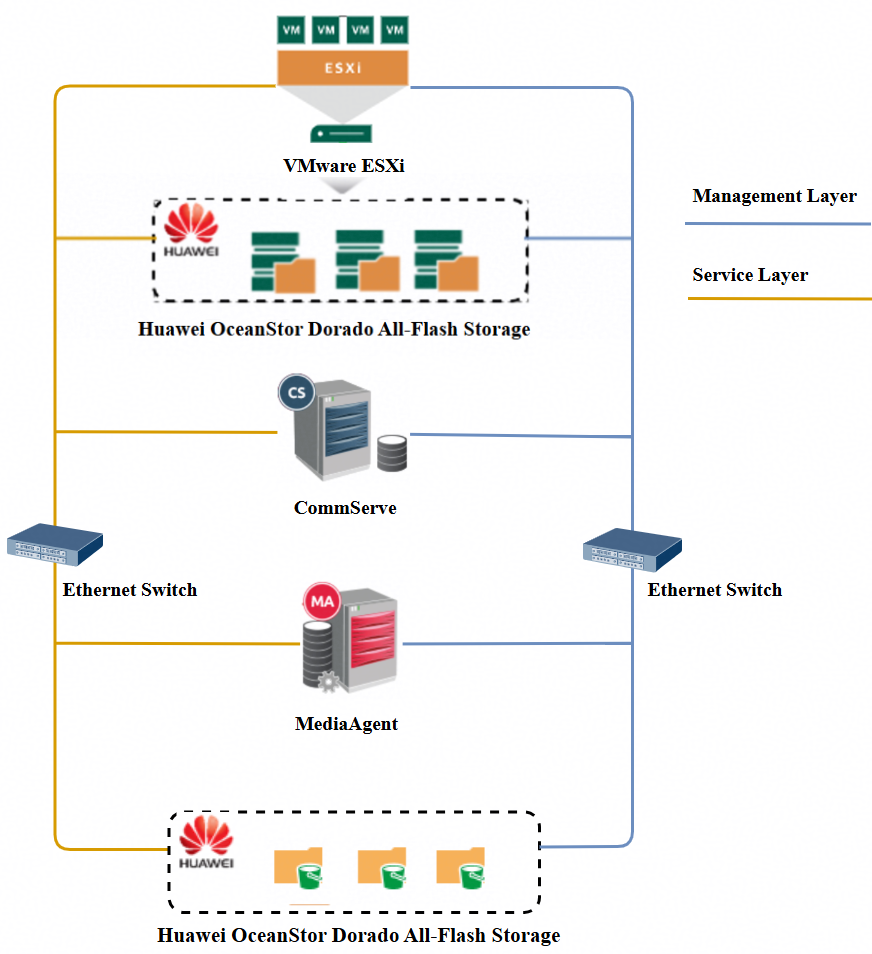
In the VMware backup scenario, the Commvault backup server integrate the snapshots of Huawei OceanStor Dorado All-Flash Storage to implement IntelliSnap, and backs up VMs to the Cloud Storage. Figure 1.1 below illustrates the network architecture.
Figure 1.1 Huawei OceanStor Dorado All-Flash Storage serves as Cloud Storage network diagram
1.2 Hardware and Software Configuration
1.2.1 Hardware Configuration
Table 1-1 Hardware Configuration table
Hardware Name | Configuration | Usage | Quantity |
Storage |
| Production Storage : Used as the VMware datastore. Backup Storage : Used as the Commvault Cloud Storage for storing backup objects. | 2 |
VMWare ESXi Server |
| Deploy VMware software. | 1 |
Commvault Backup Server |
| Deploy Commvault software. Tips: In this test, Commvault CommServe (CS) and MediaAgent (MA) are the same host. | 1 |
Ethernet switch |
| The CE6855 Ethernet switch connects the management layer network and service layer network between the backup server, VMware ESXi, Storage. | 2 |
1.2.2 Software and Tools
Table 1-2 Software and Tool table
Software Name | Usage | Version | Quantity |
OceanStor Dorado Software | Deploy and manage Huawei OceanStor Dorado 5000 storage. | V700 | 1 |
VMware vSphere Client | Manage VMware ESXi for backup and Recovery. | 8.0 | 1 |
VMware ESXi Software | Manage VMs used for backup and Recovery. | 7.0 | 1 |
Commvault Software | Manage backup and recovery tasks. | 11 | 1 |
Operation System | Deploy the Linux Hosts for Commvault. | RHEL 10 | 1 |
S3 Browser | Used to check bucket data. | 12.2.9 | 1 |
2.Test Preparation
2.1 Huawei OceanStor Dorado All-Flash Storage Pre-configuration (Production Storage)
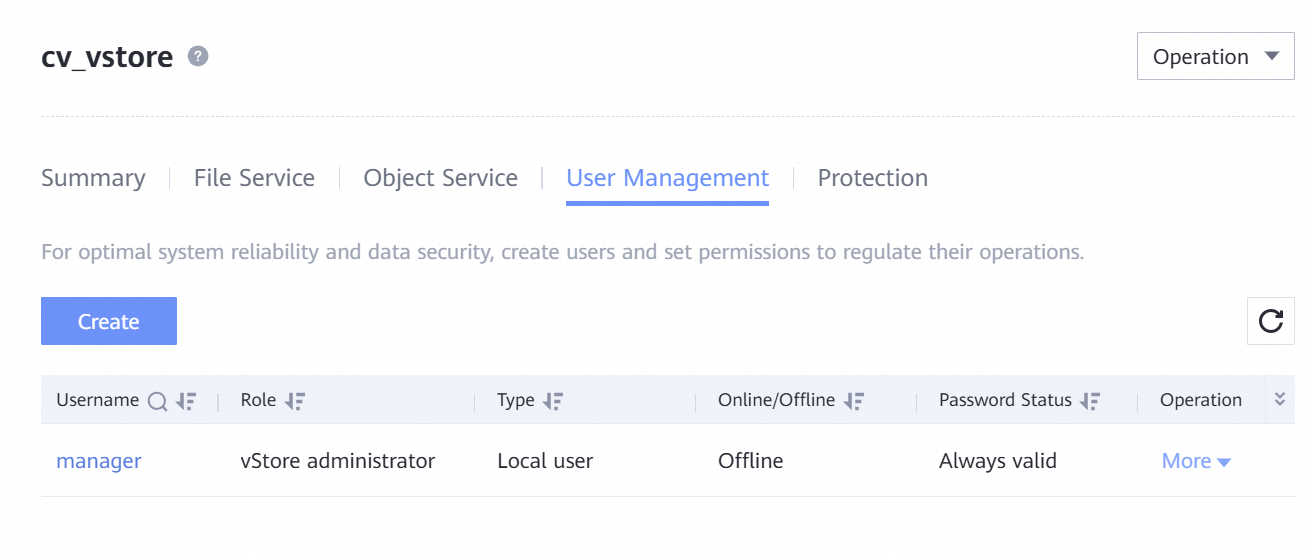
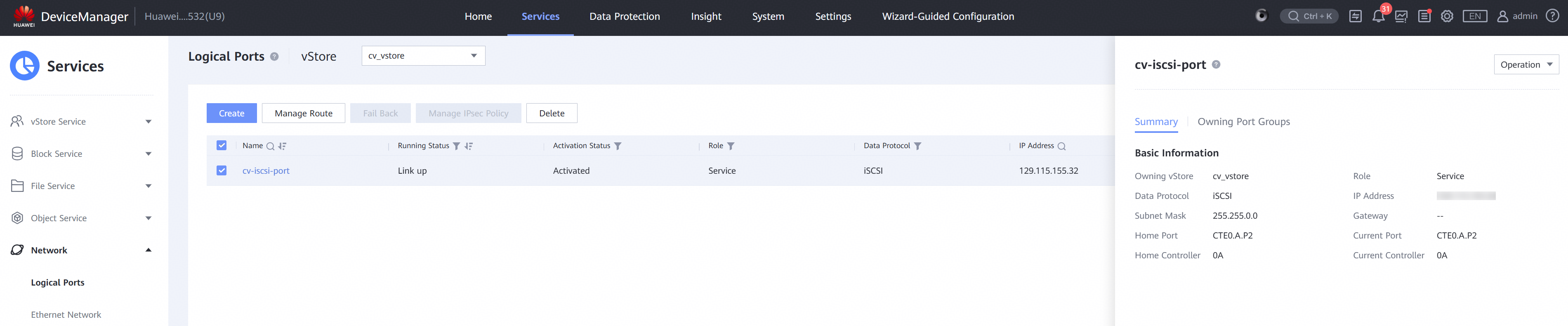
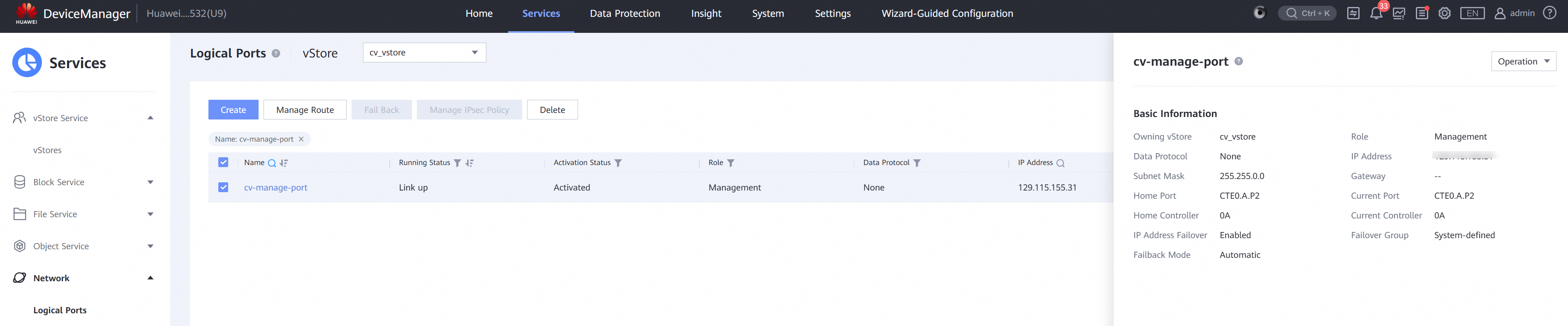
2.1.1 Create the vStore, vStore administrator, Logical Port
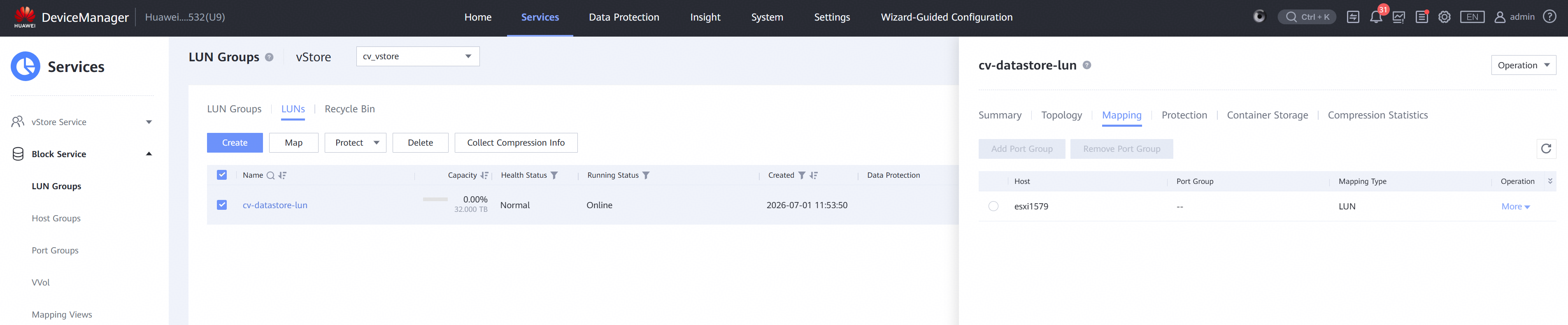
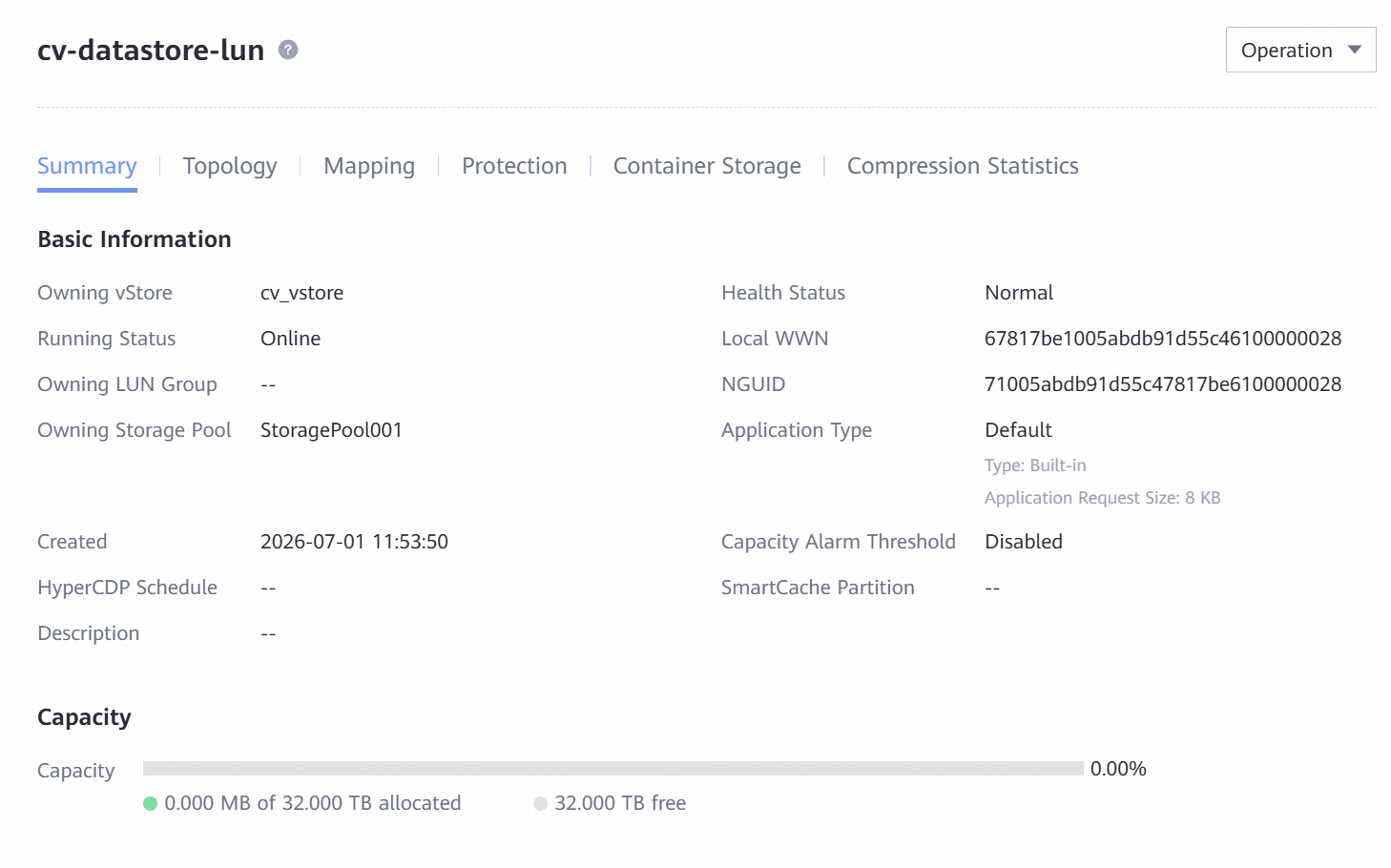
2.1.2 Create the LUN, host and mapping view for VMware Datastore
2.2 VMware ESXi Pre-configuration
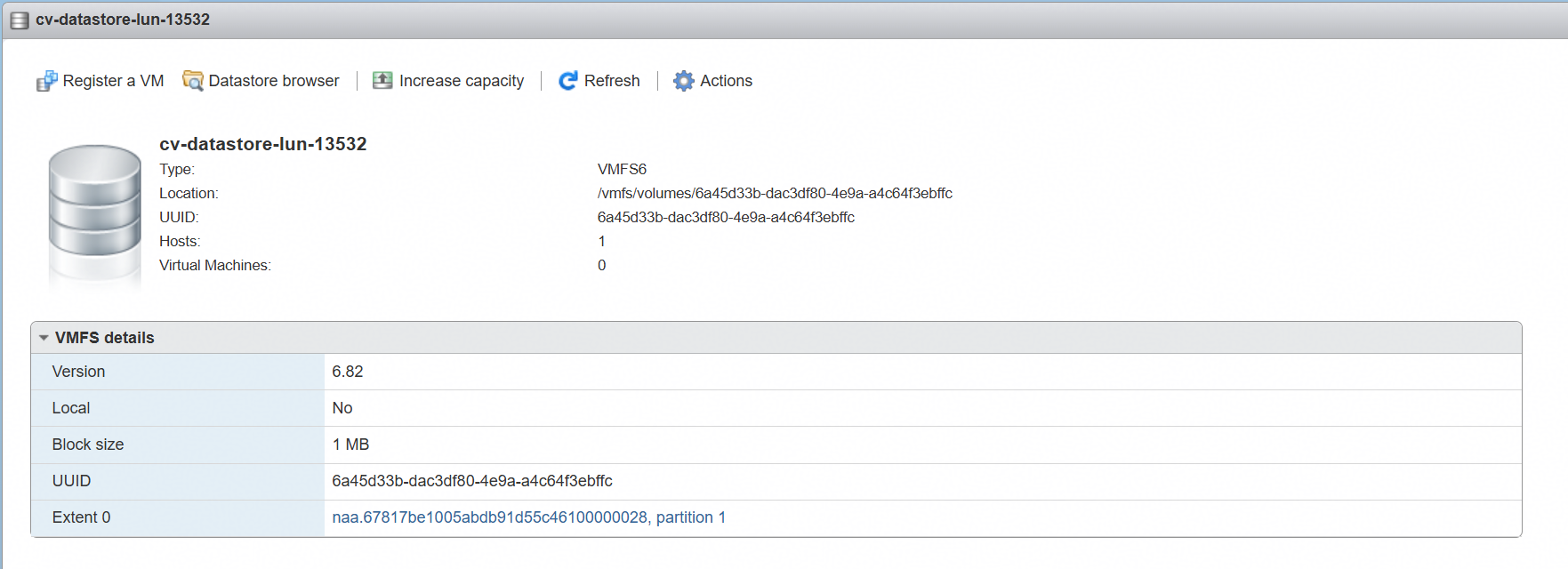
2.2.1 Create the VMFS datastore
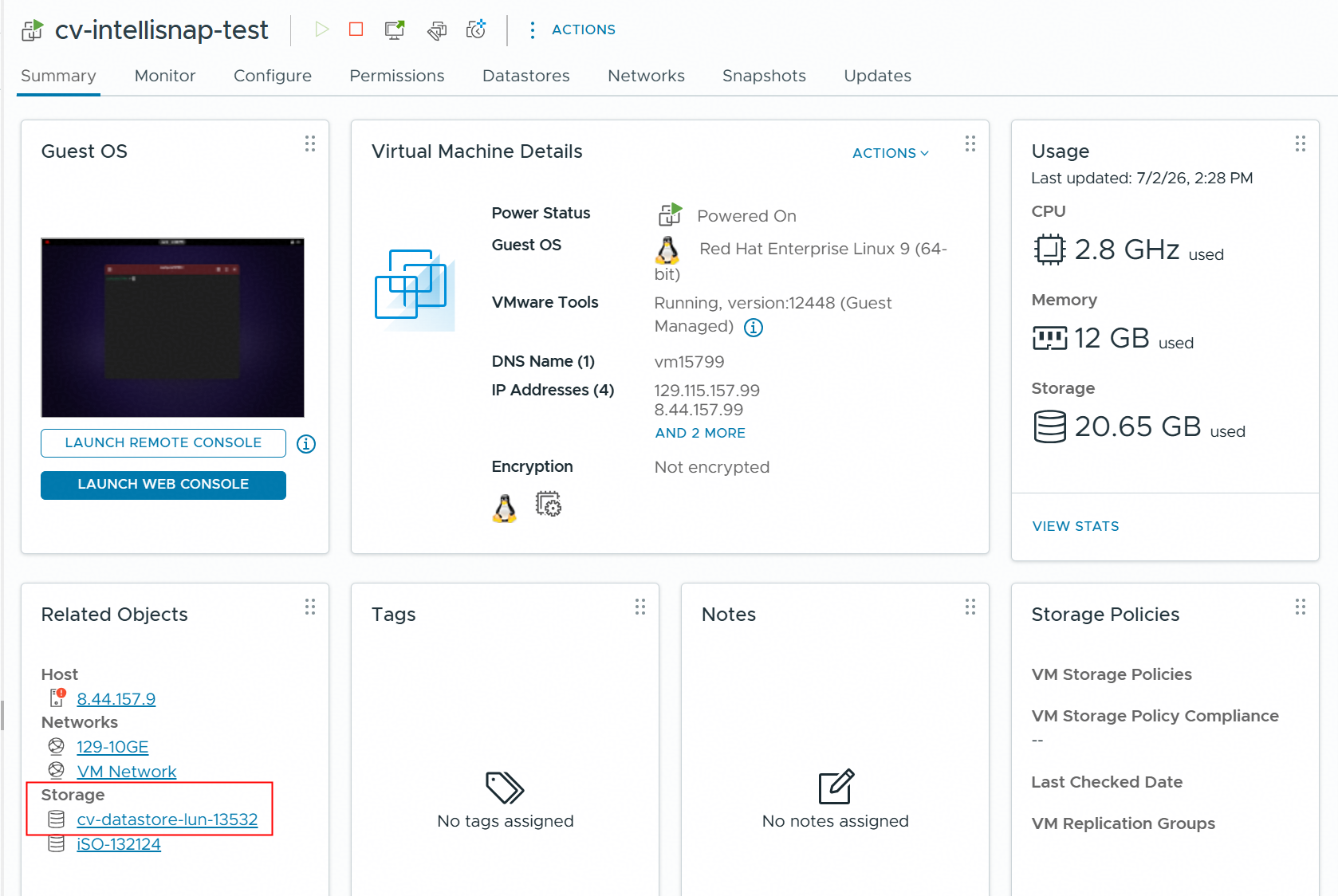
2.2.2 Create VMs for backup and recovery
2.3 Huawei OceanStor Dorado All-Flash Storage Pre-configuration (Backup Storage)
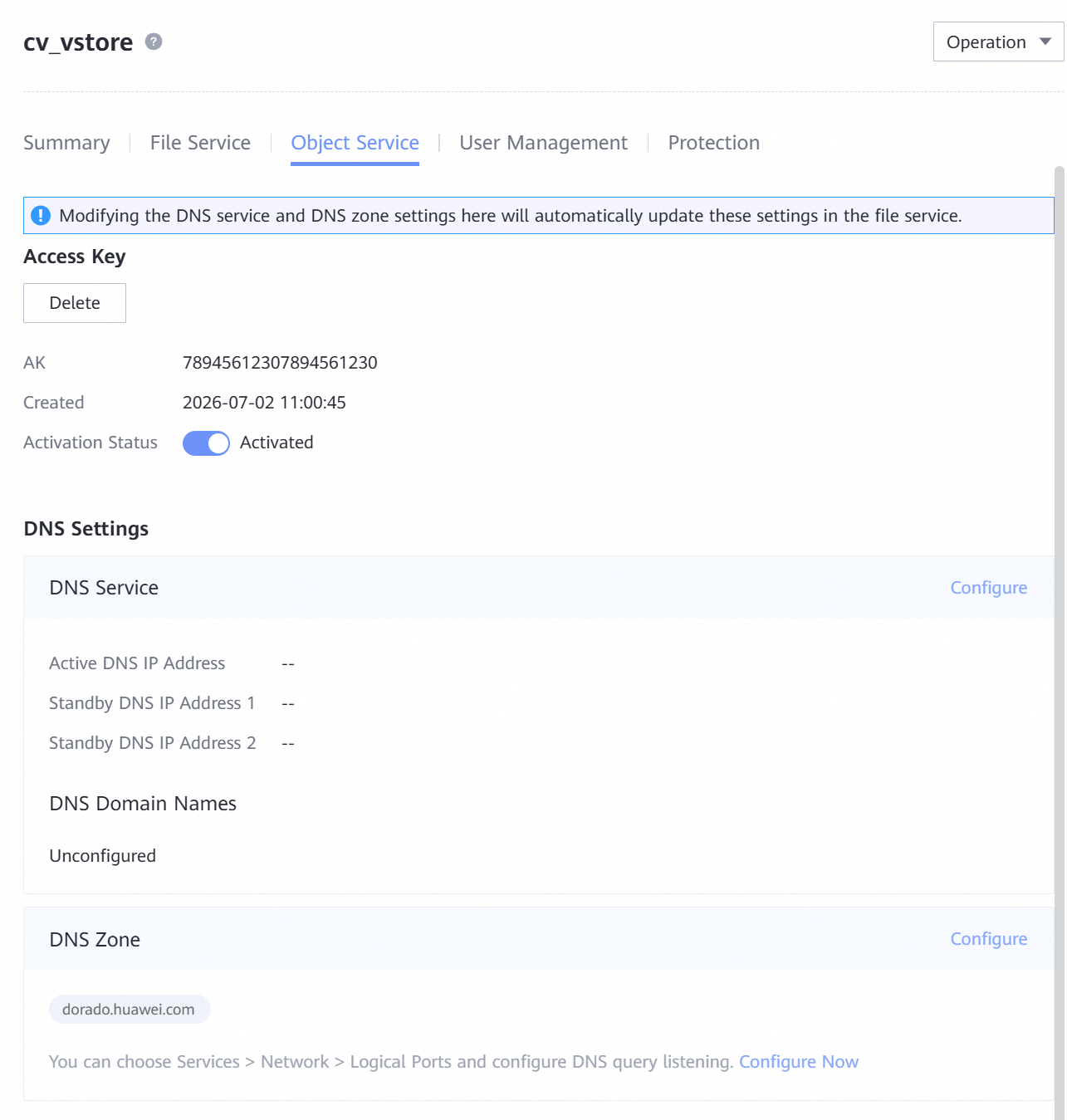
2.3.1 Create the vStore, AK, SK, DNS Zone
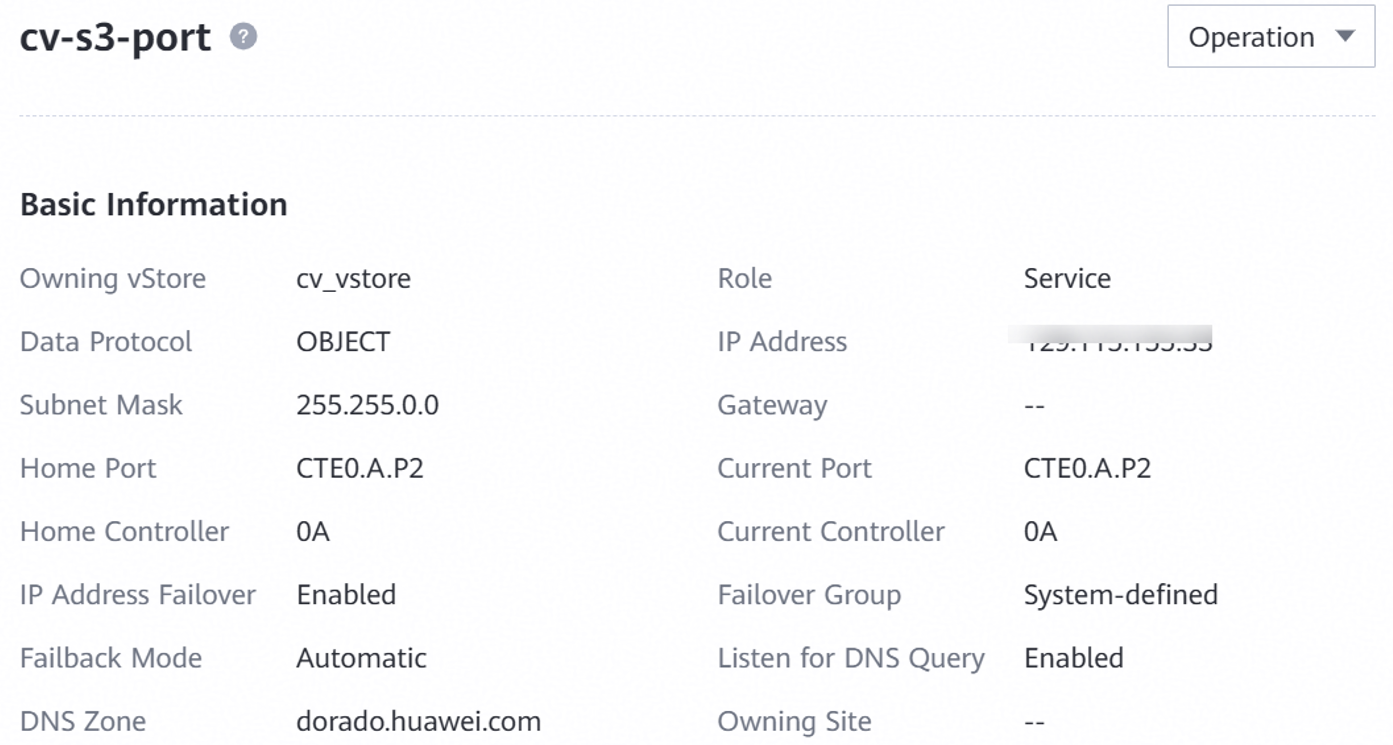
2.3.2 Create the Logical Port
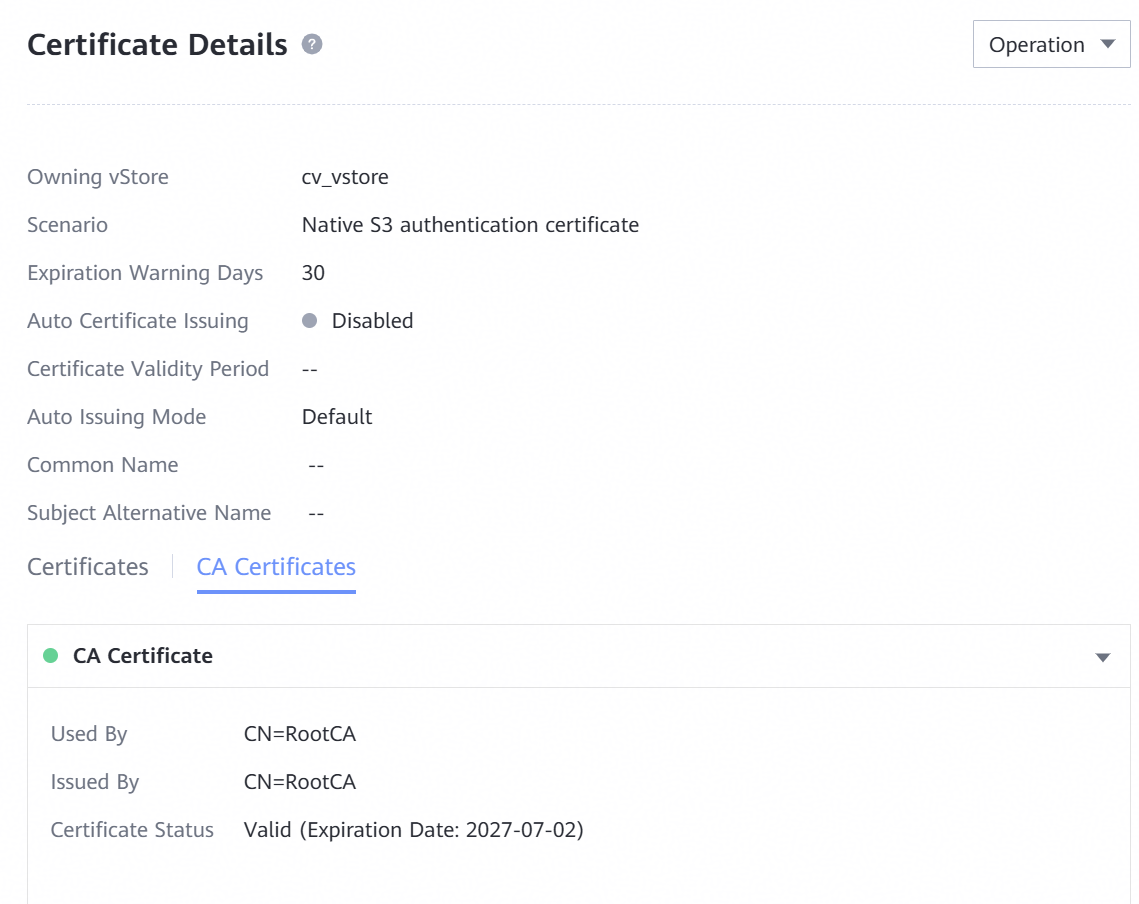
2.3.3 Configure the Native S3 authentication certificate
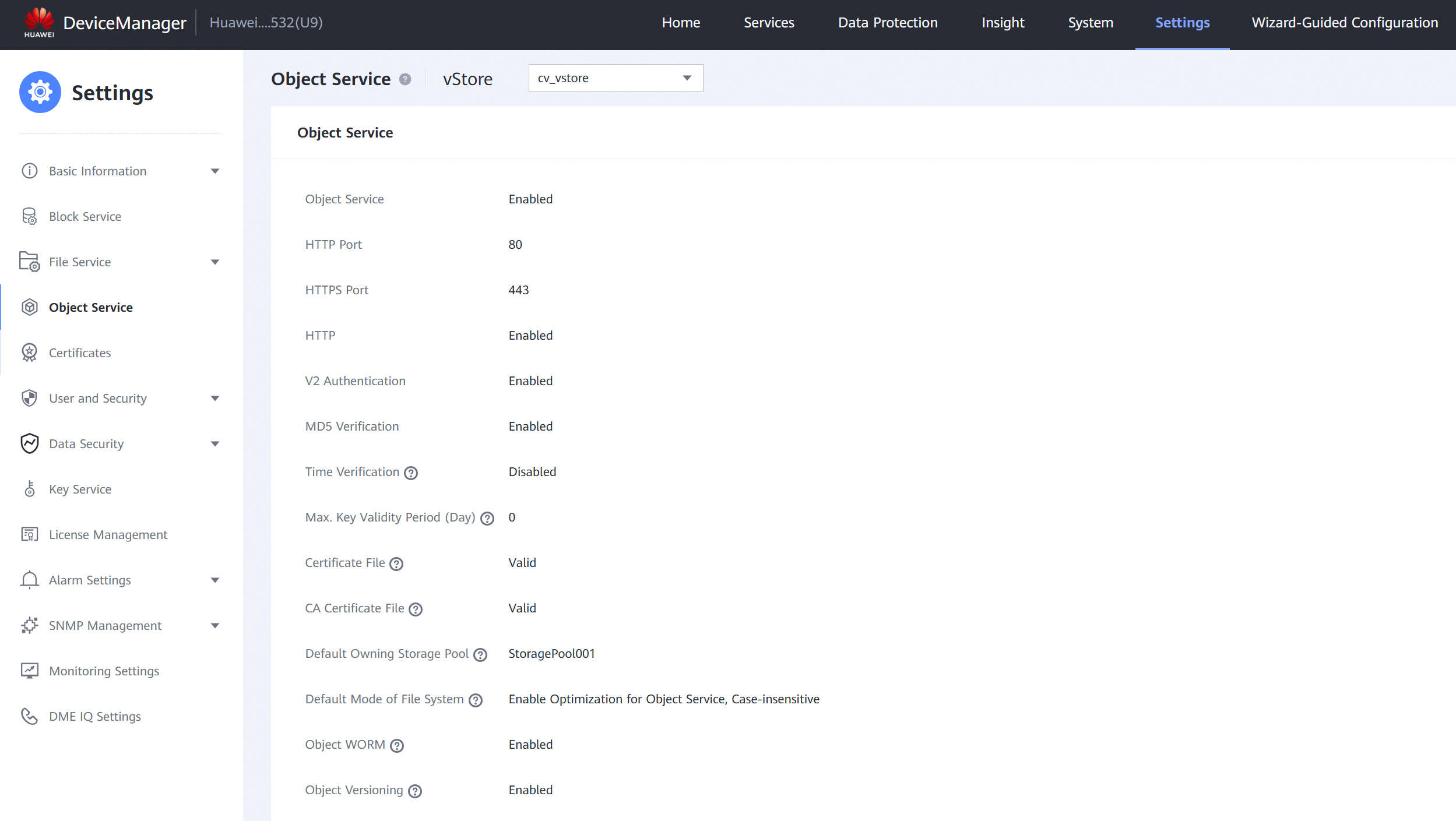
2.3.4 Configure the Object Service
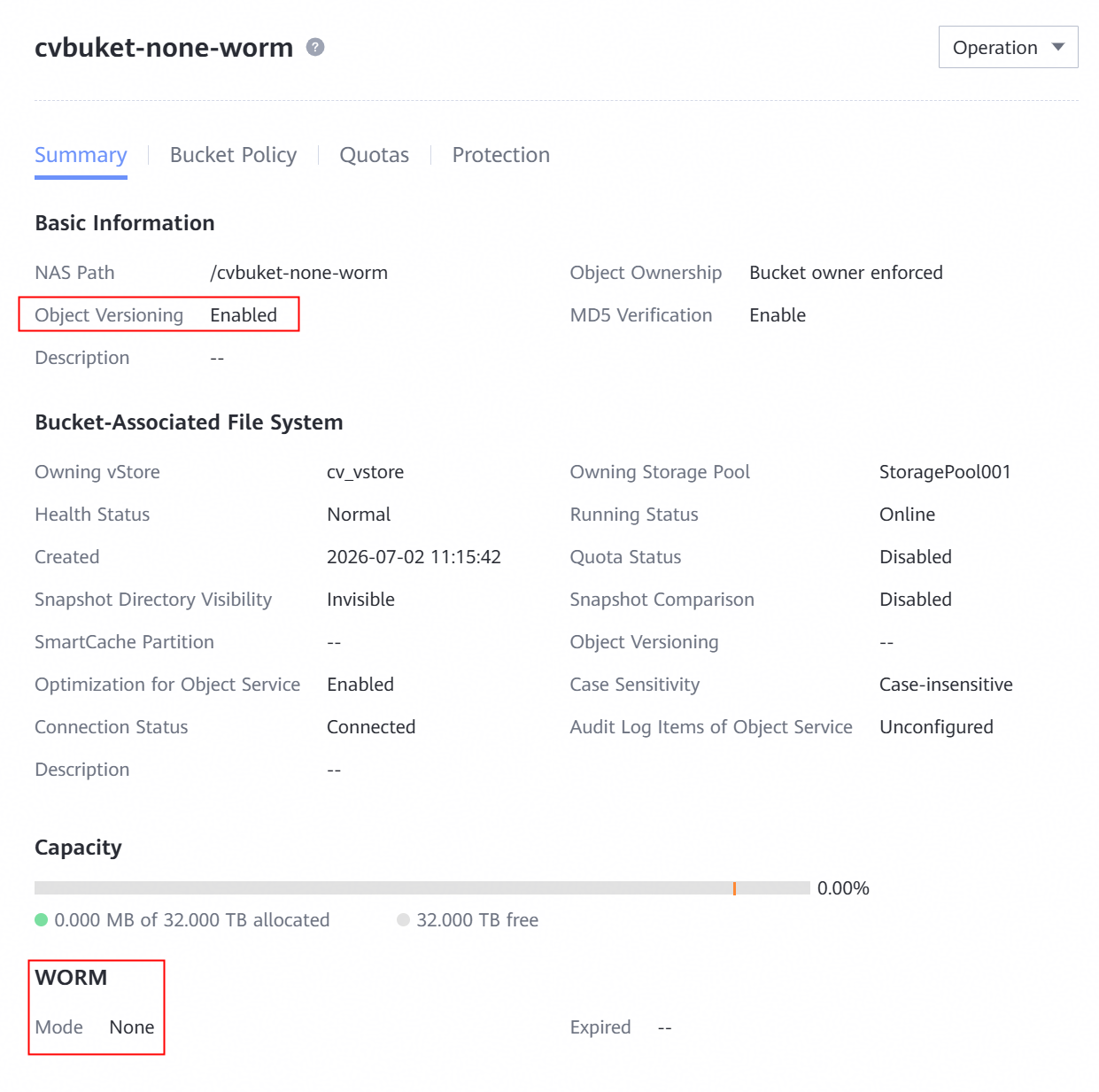
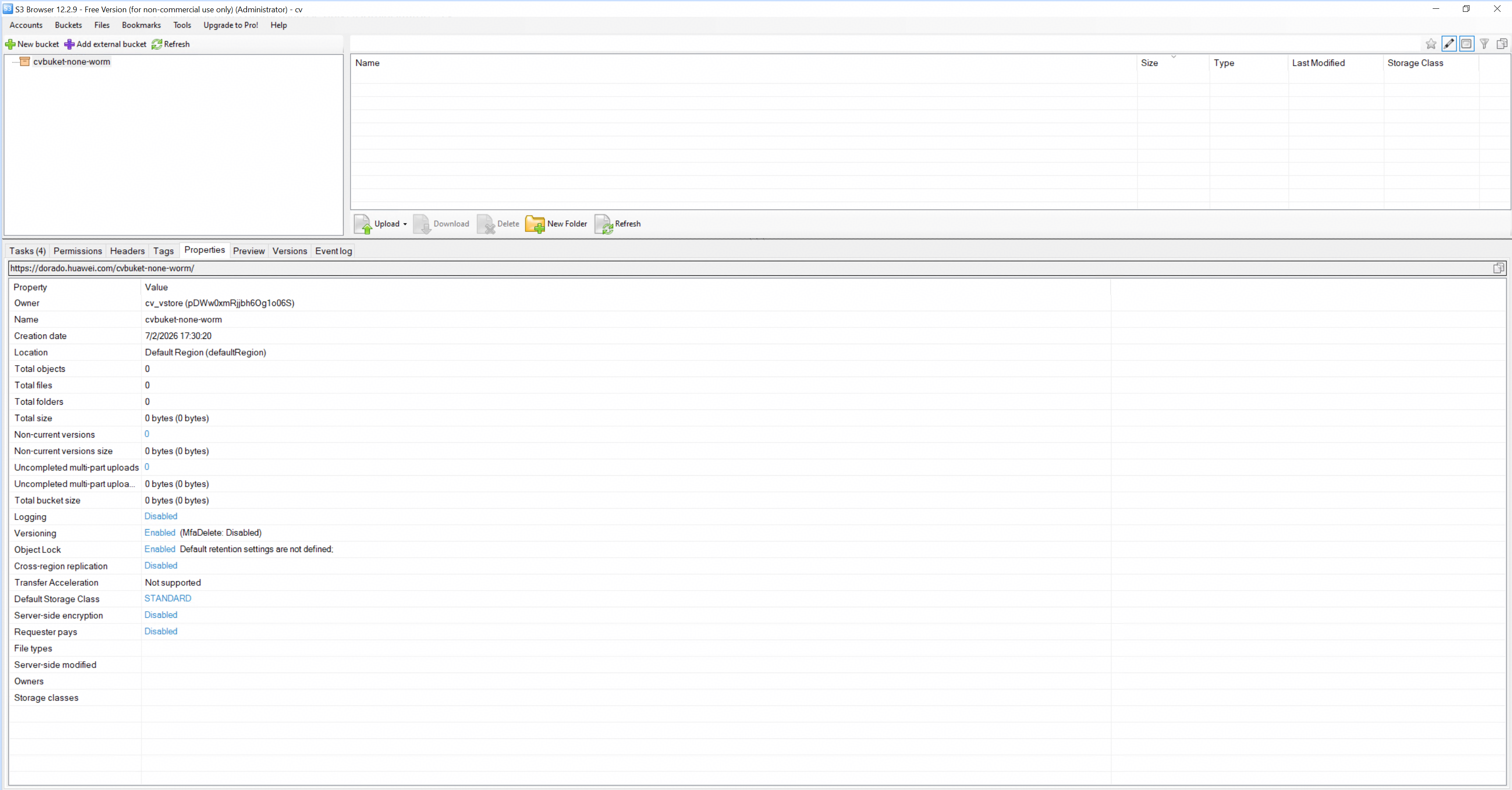
2.3.5 Create the Bucket
Enable the Object Versioning and configure the WORM mode of None type.
2.4 Backup Server Pre-configuration
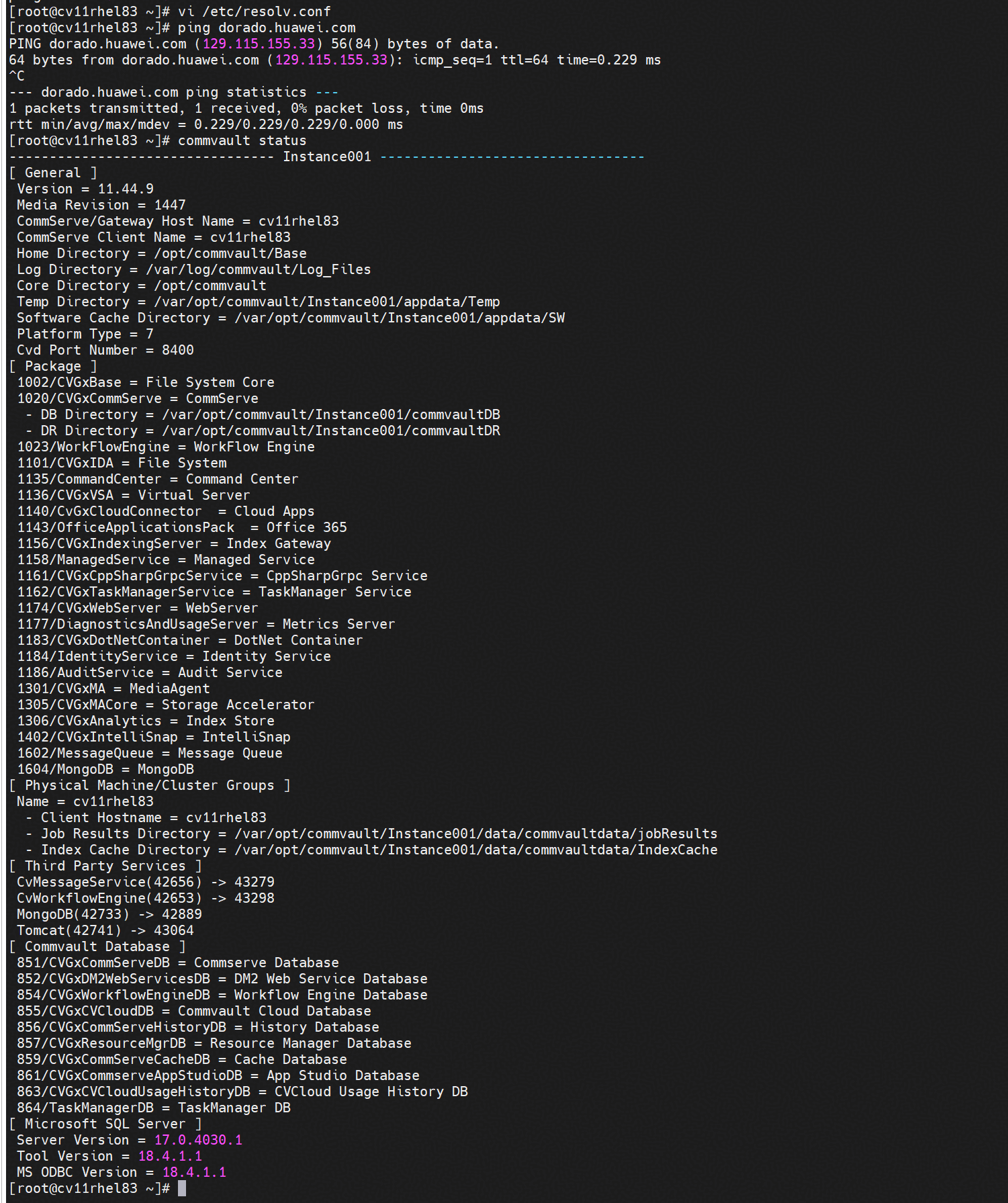
2.4.1 Configure the network of DNS server
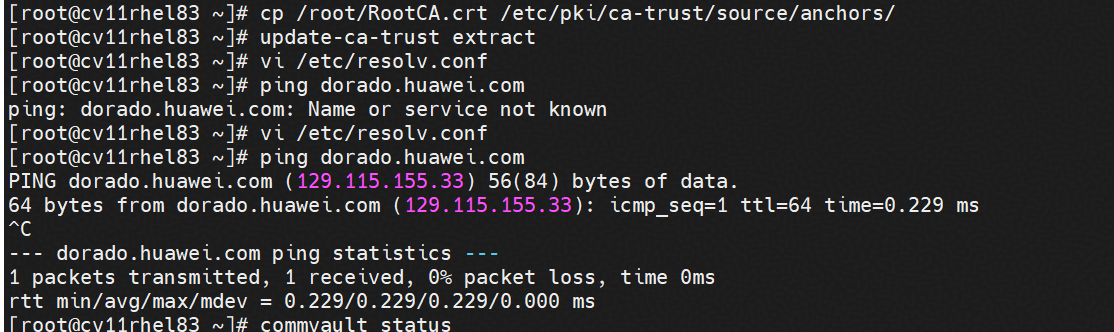
2.4.2 Import the RootCA certificate
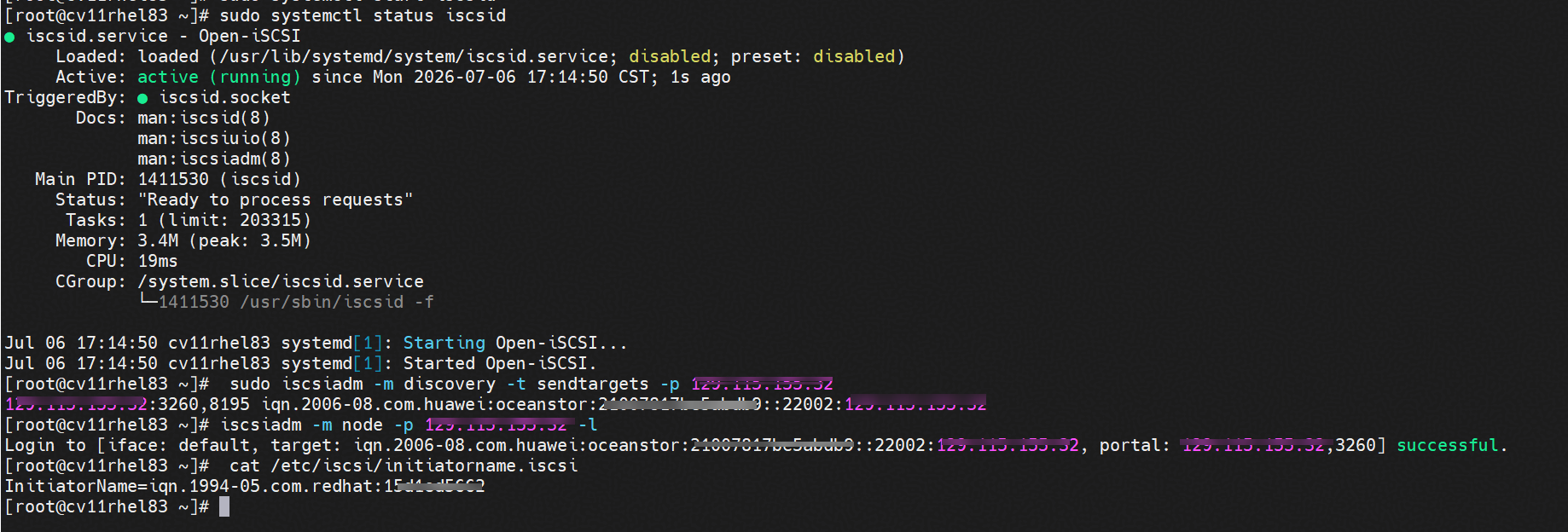
2.4.3 Establish iSCSI Connection
Establish iSCSI Connection with Huawei OceanStor Dorado All-Flash Storage (Production Storage)
3. Test Scenario and Results
3.1 Add the Huawei OceanStor Dorado All-Flash Storage as cloud storage for storing backup object
Test Purpose | To verify that the Huawei OceanStor Dorado All-Flash Storage can be added to the backup server as cloud storage. |
Network Diagram | Reference to Figure 1.1 |
Prerequisites | The Huawei OceanStor Dorado All-Flash Storage, backup server, VMware ESXi have been deployed and configured successfully. The S3 services of the Huawei OceanStor Dorado All-Flash Storage have been configured successfully, including vStore, AK, SK, DNS Zone, Logical Port and Native S3 authentication certificate. Versioning has been enabled for the bucket, and the WORM mode of the None type has been configured. |
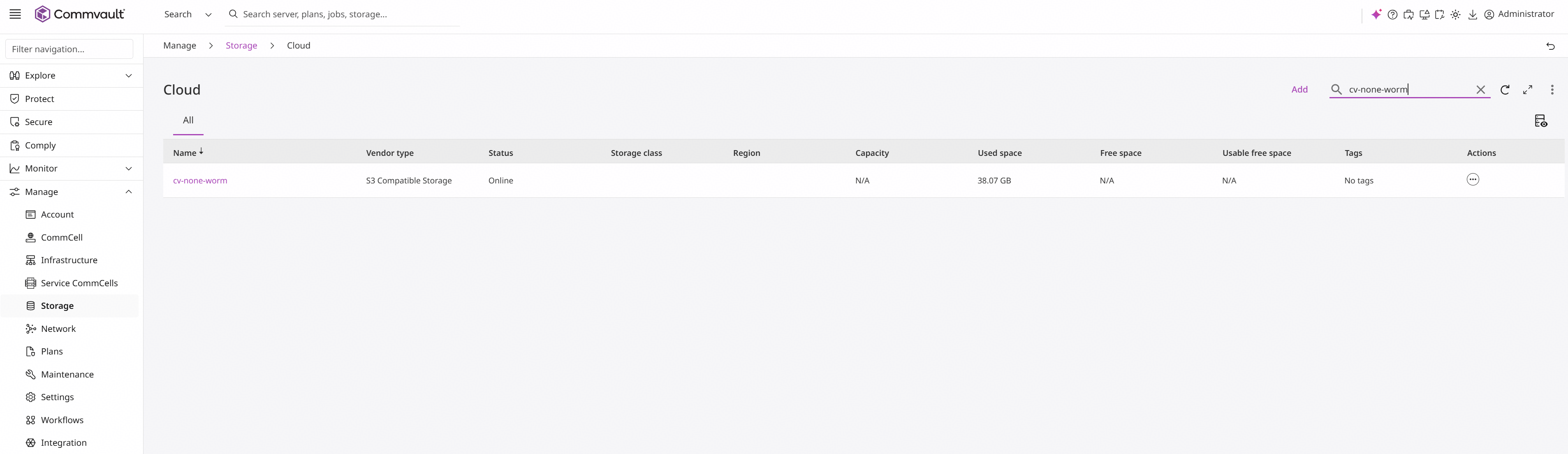
Test Procedures | Step 1: Login the Commvault Command Center, go to Manage > Storage > Cloud, click Add to add a cloud storage. Step 2: From the Type list, select the cloud service provider of the S3 Compatible Storage. Step 3: In the Name box, enter a unique name for the cloud storage. Step 4: In the Service Host box, type the name of the cloud server host. Step 5: From the MediaAgent list, select the MediaAgent that will access the cloud storage. Step 6: From the Credentials list, select a pre-defined credential (AK & SK). Step 7: Click Detect to verify the list of buckets. Step 8: Verify the Use Deduplication toggle is enabled. From the DDB MediaAgent list, select one or more MediaAgents to use for deduplication. Step 9: Click Save to complete the creation of cloud storage. Step 10: Check the bucket data through the S3 Browser. |
Expected Results |
|
Test Results |
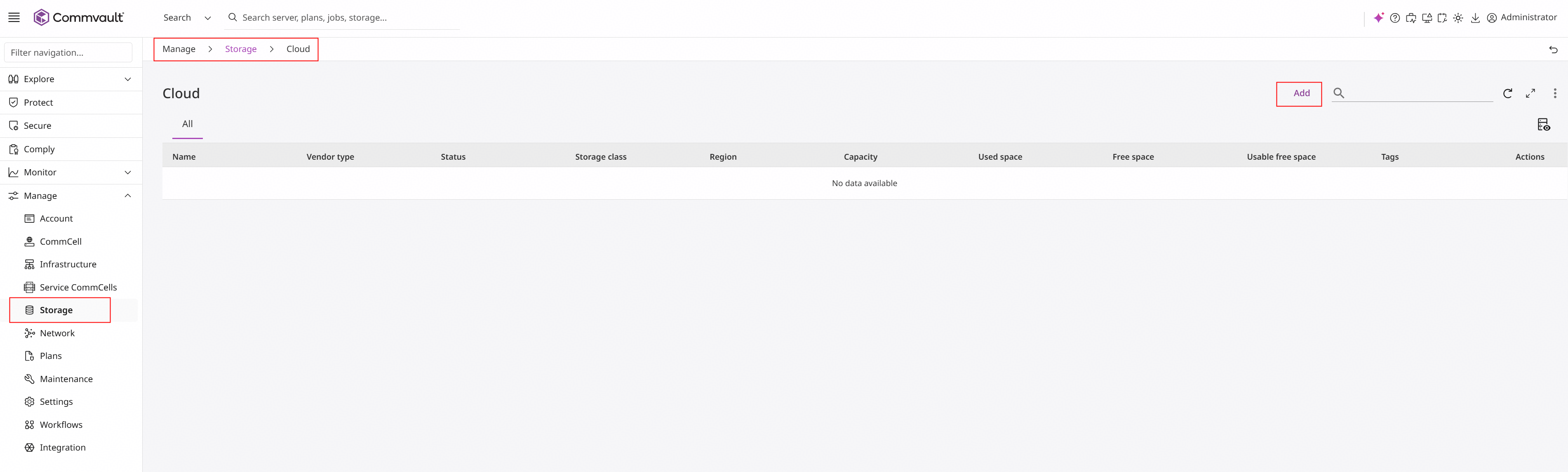 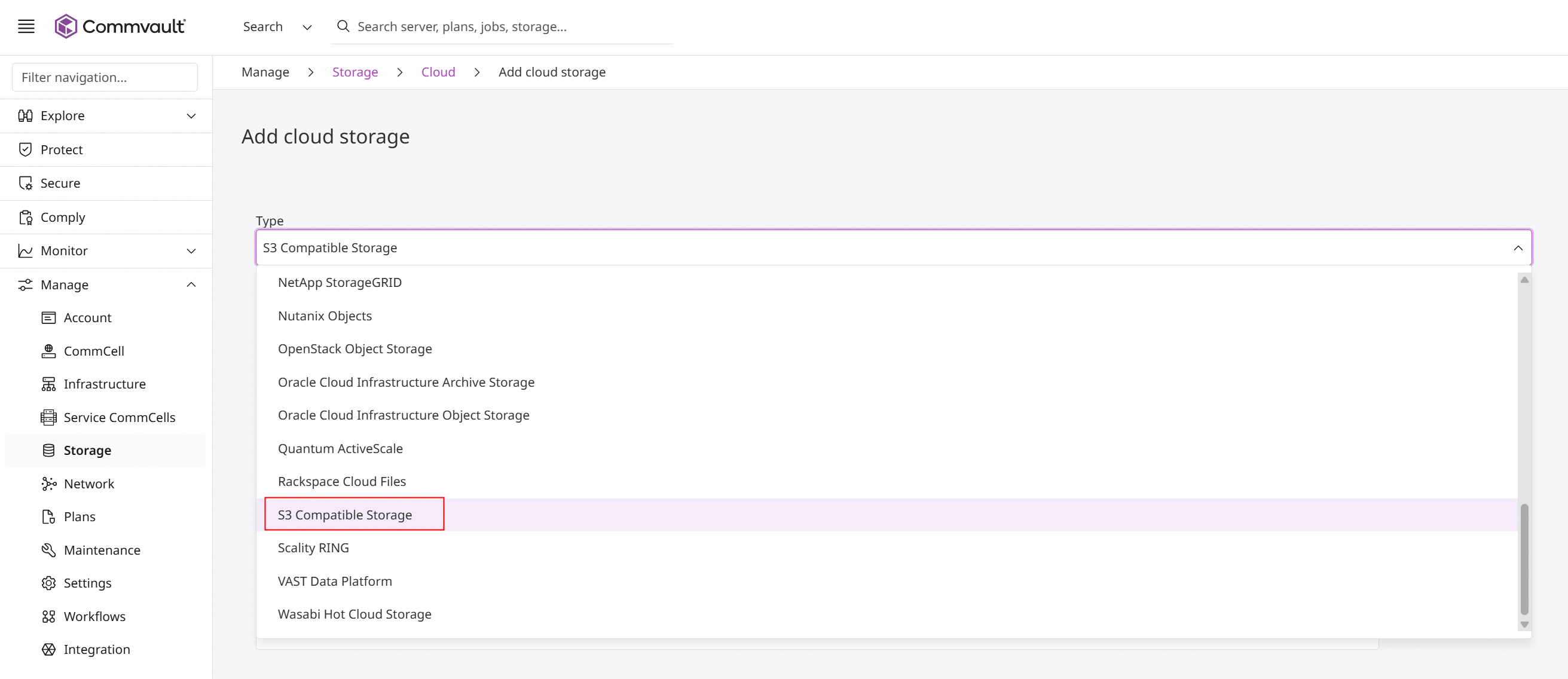 3. In the Name box, enter a unique name for the cloud storage. 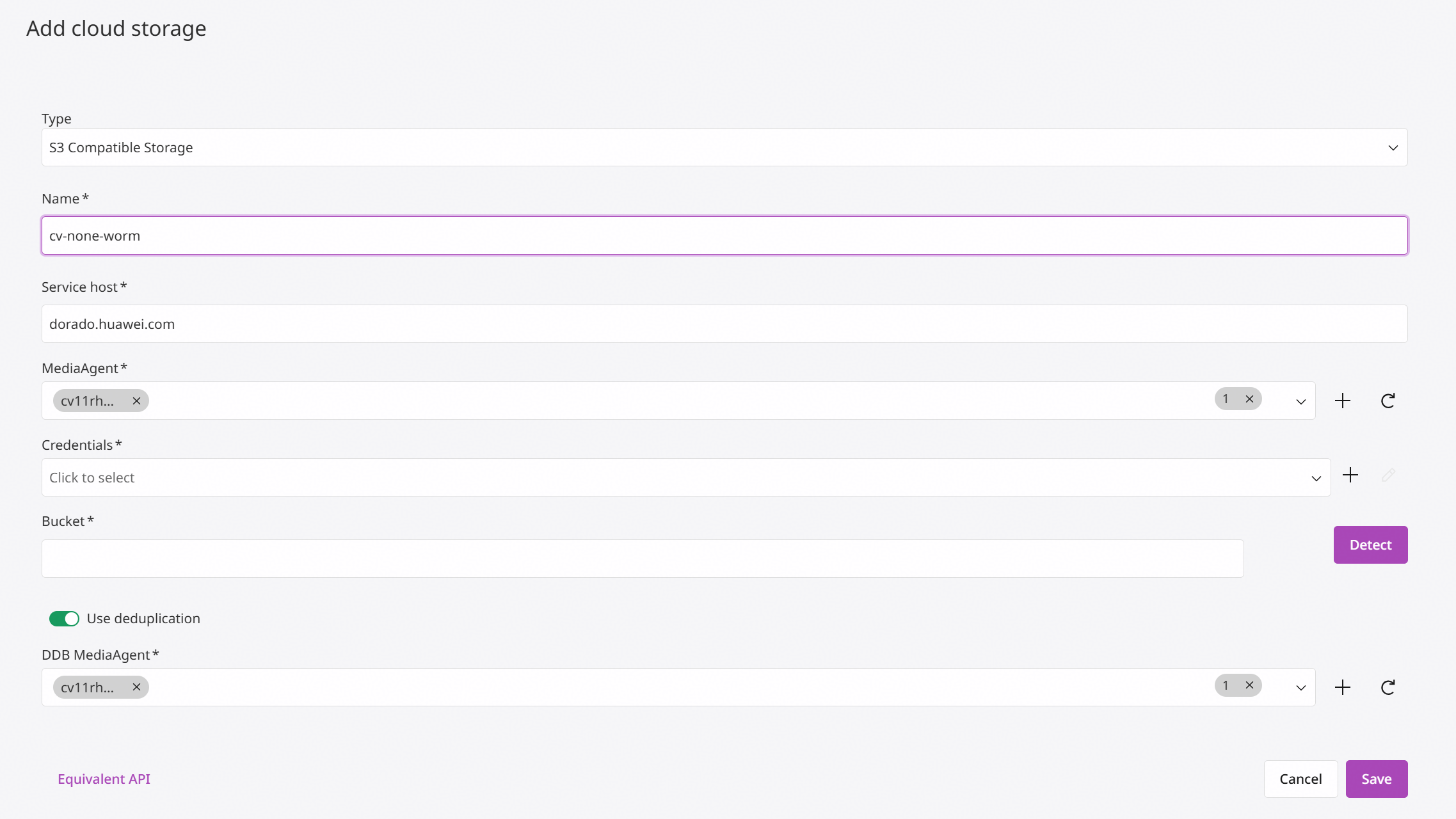 4. In the Service Host box, type the name of the cloud server host. 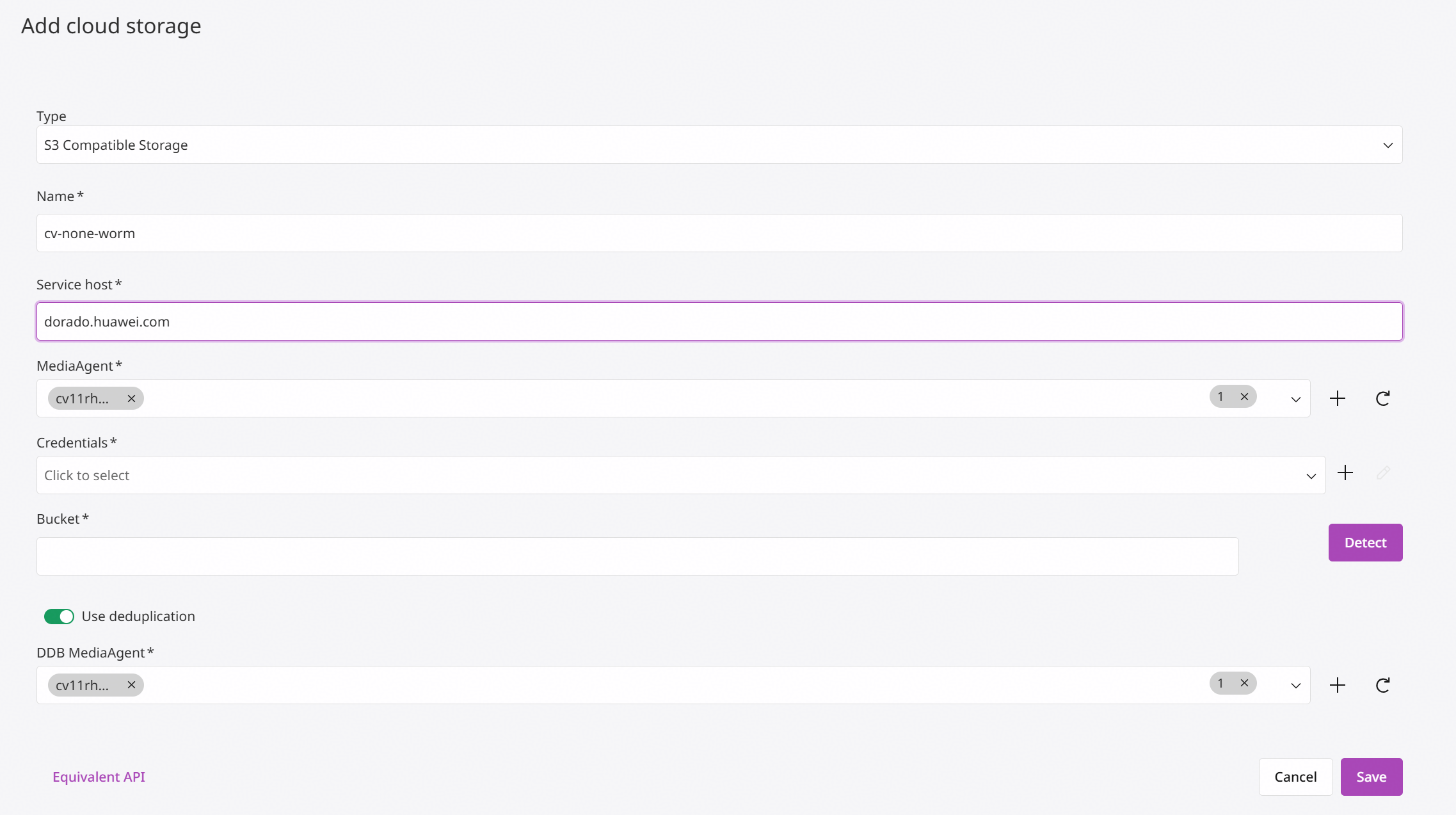 5. From the MediaAgent list, select the MediaAgent that will access the cloud storage. 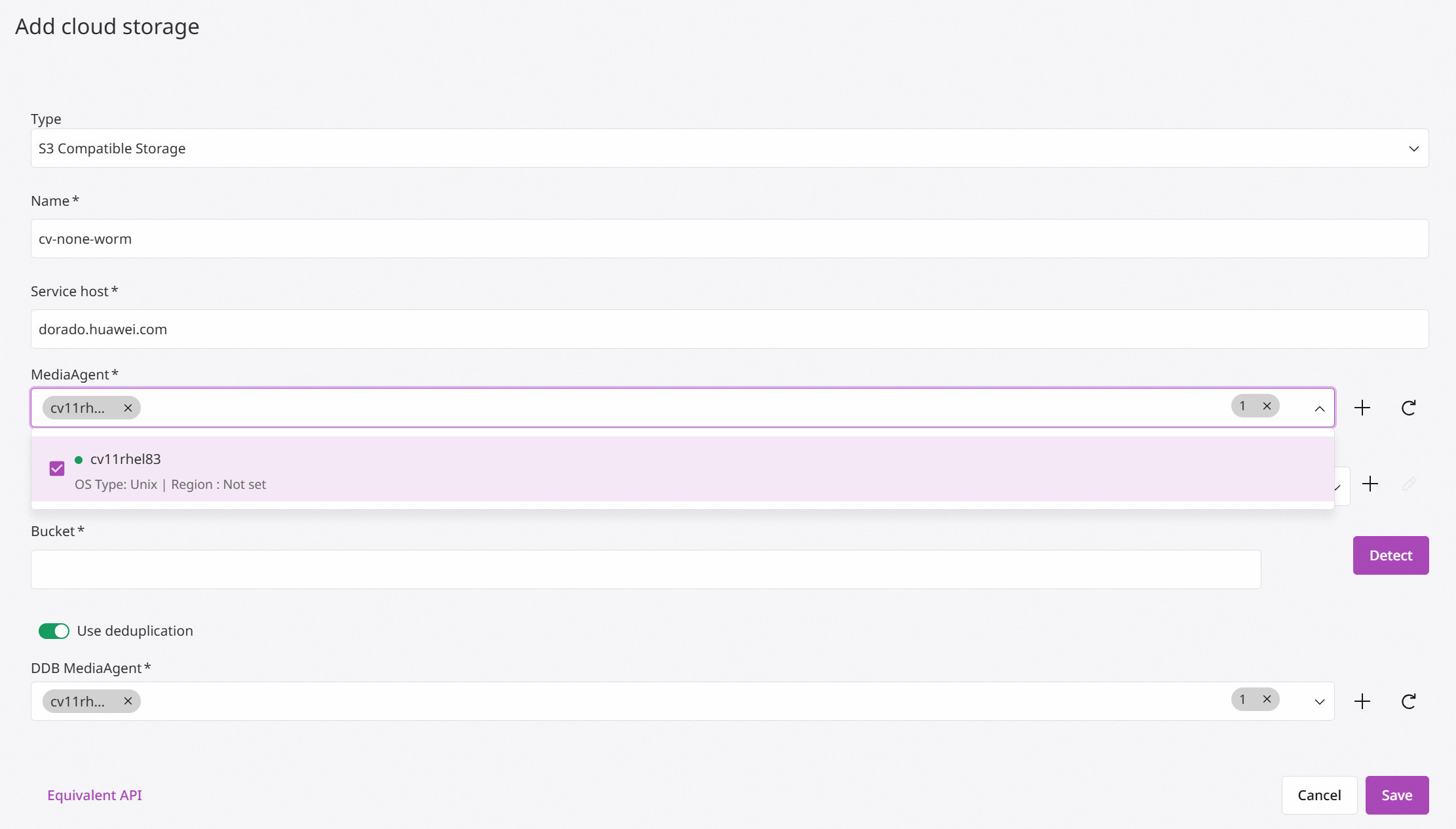 6. From the Credentials list, select a pre-defined credential (AK & SK). 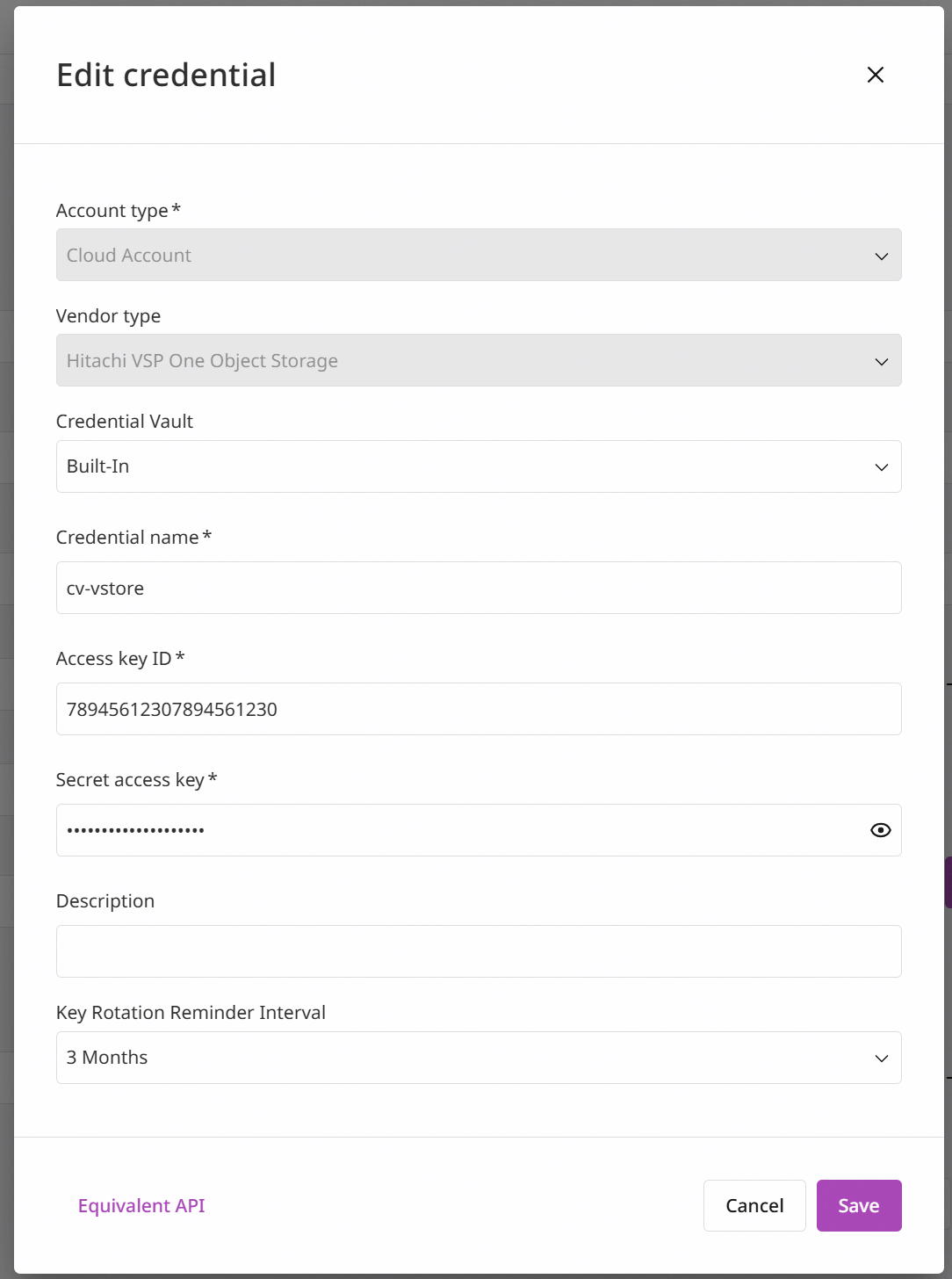 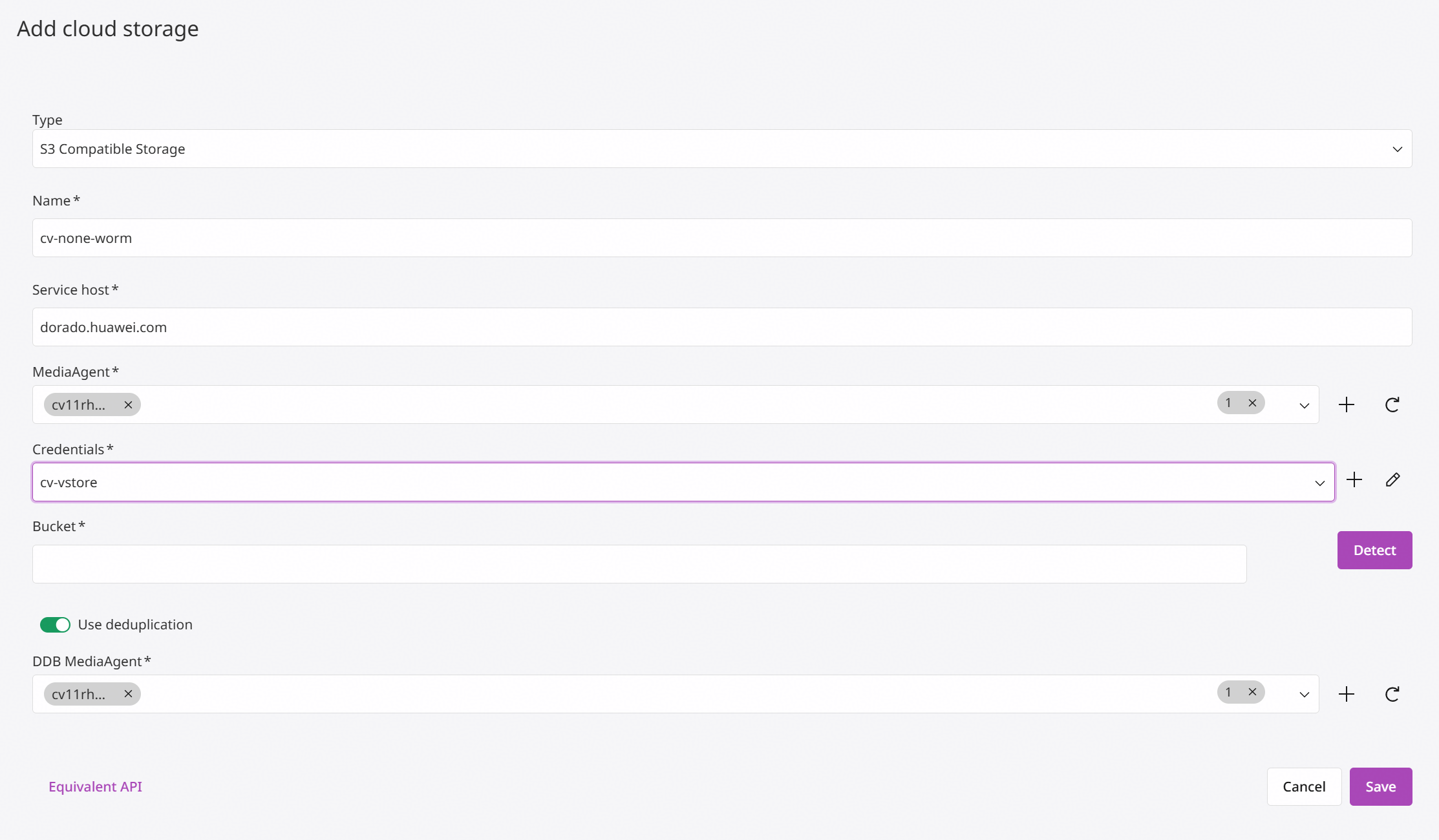 7. Click Detect to verify the list of buckets. 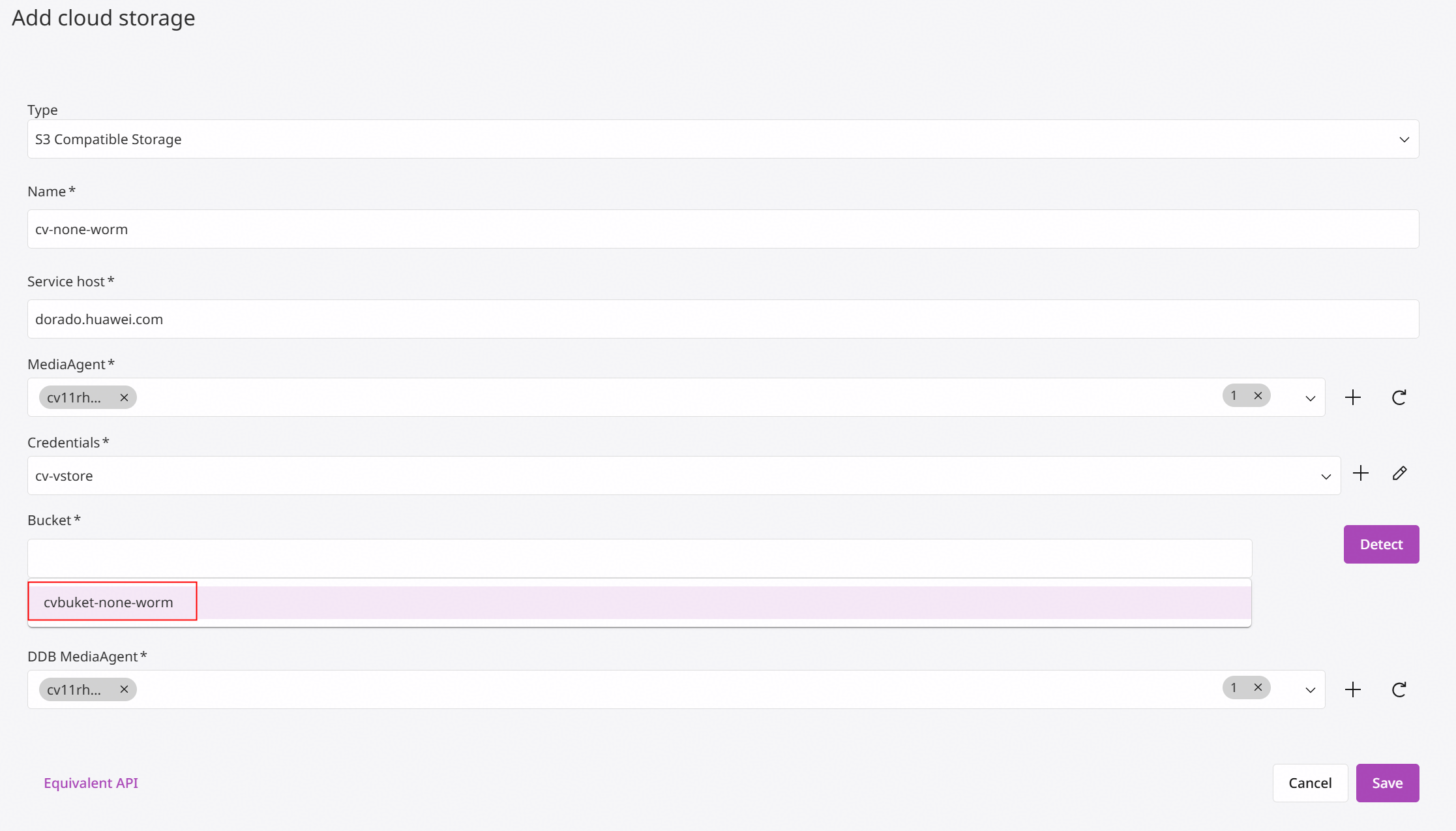 8. Verify the Use Deduplication toggle is enabled. From the DDB MediaAgent list, select one or more MediaAgents to use for deduplication. 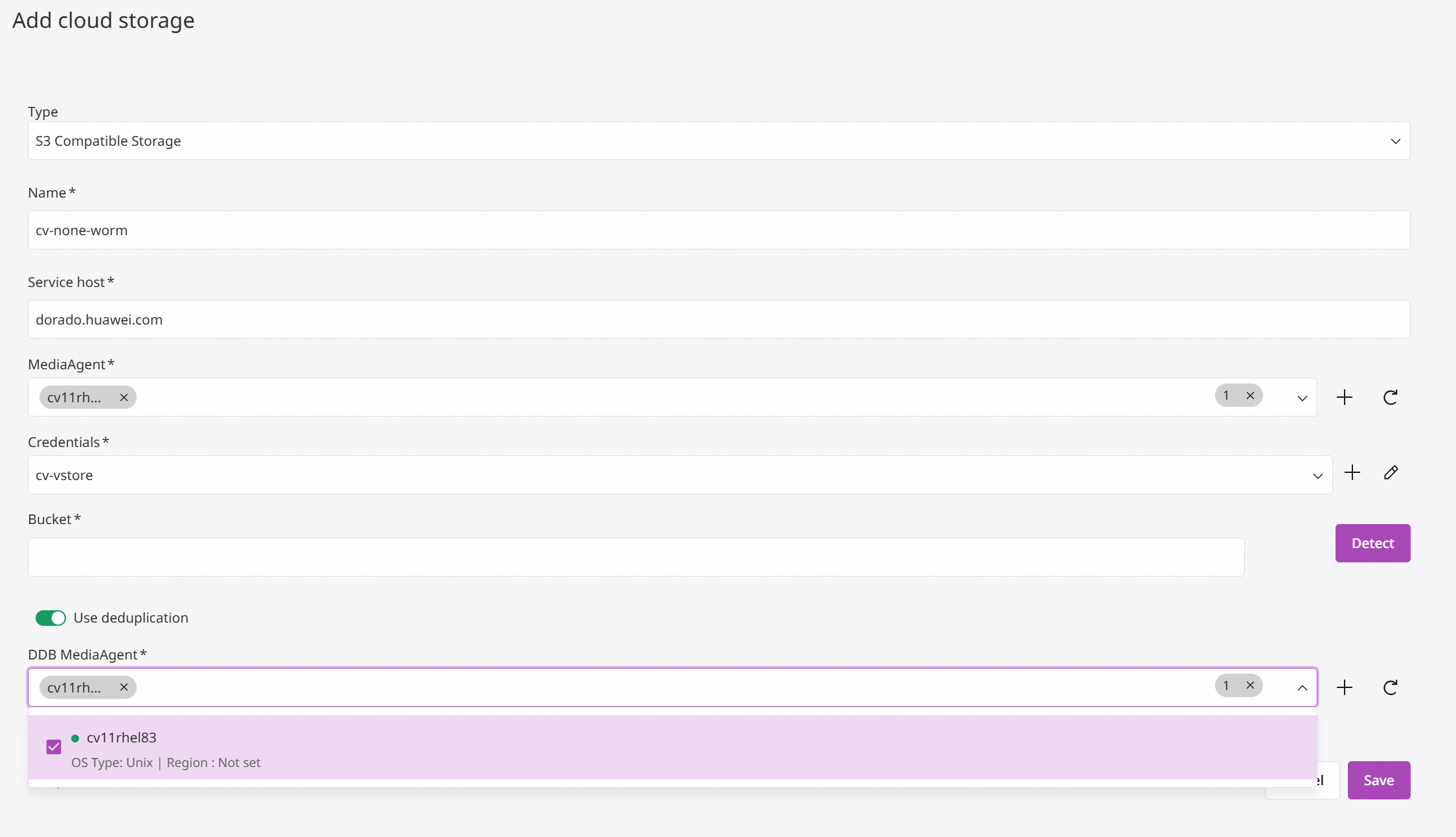 9. Click Save to complete the creation of cloud storage. 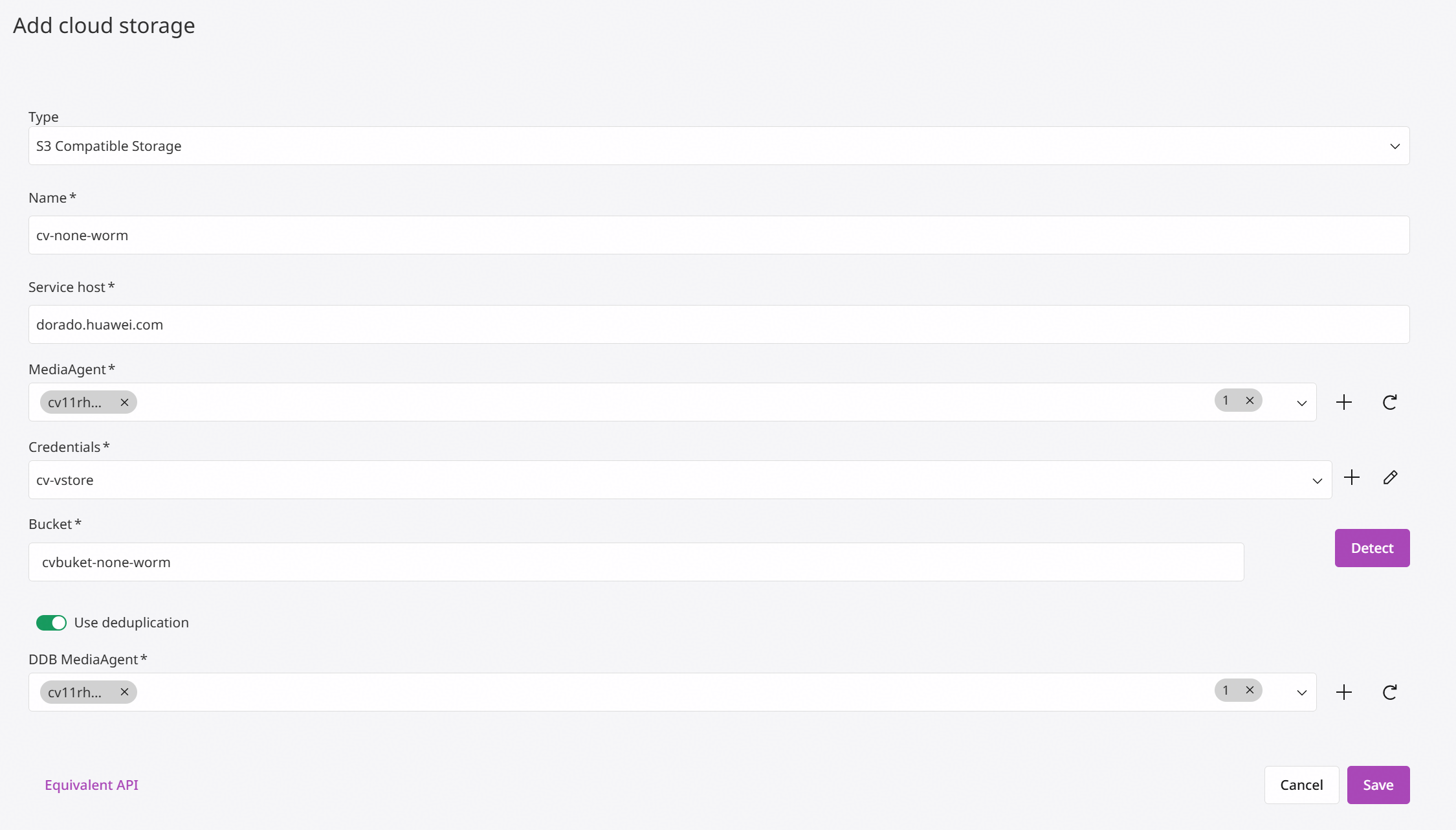  10. Check the bucket data through the S3 Browser. 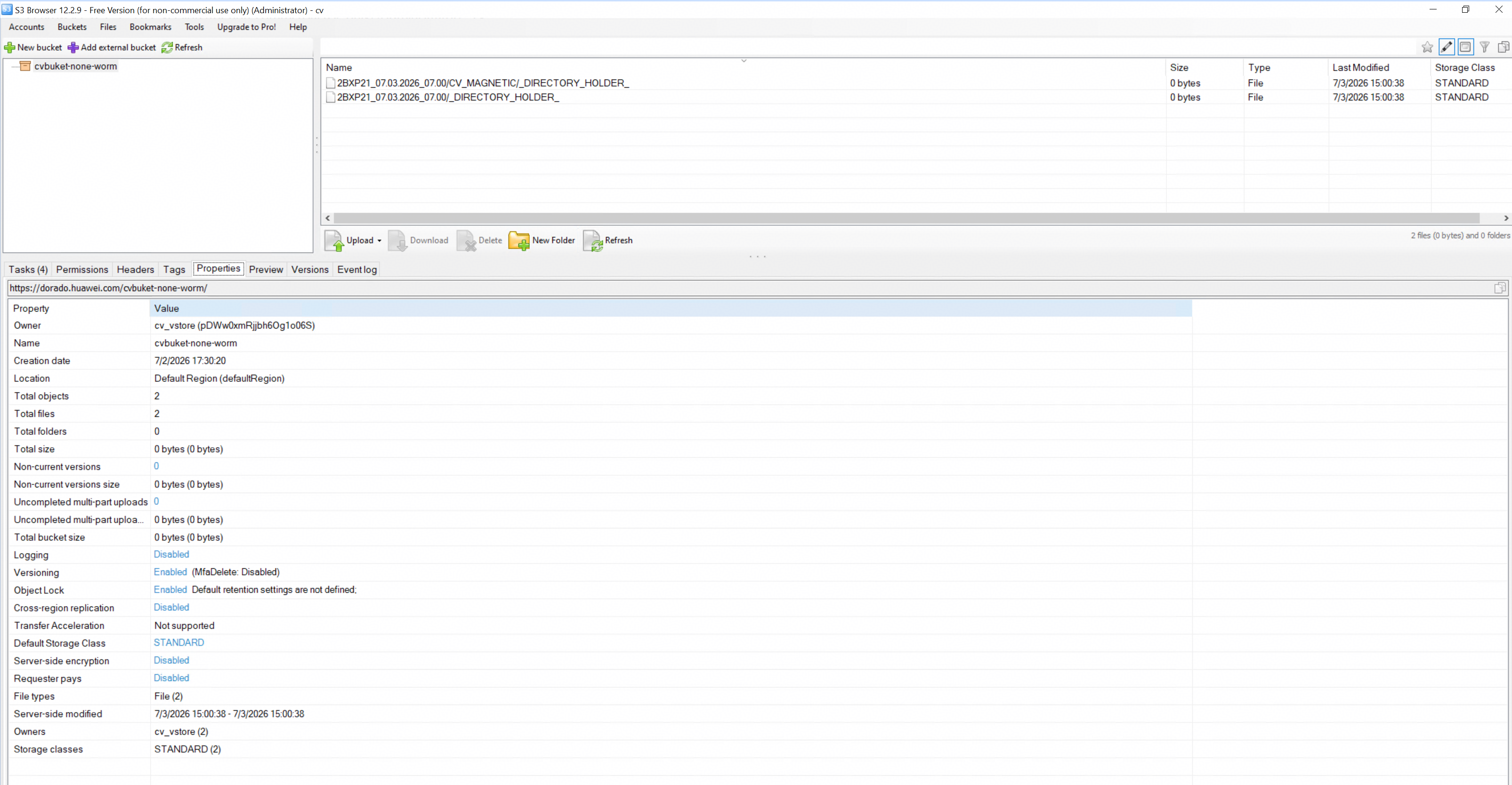 |
Test Conclusion | Passed |
3.2 Enable Immutability on the cloud storage
Test Purpose | To verify that the Huawei OceanStor Dorado All-Flash Storage can be enabled Storage Lock (Immutability). |
Network Diagram | Reference to Figure 1.1 |
Prerequisites |
3.Versioning has been enabled for the bucket, and the WORM mode of the None type has been configured. |
Test Procedures | Step 1: On the cloud storage Configuration tab, in the Immutability section, move the Storage lock toggle key to the right. Step 2: Select the Compliance mode and set Retention period to 1 Day(s). Step 3: Select the options to confirm your agreement, type Confirm in the confirmation box, and then click CONFIRM. Step 4: Check whether both Storage lock and Compliance lock are enabled, and verify that the Retention period matches the expected configuration. Step 5: Check the bucket data through the S3 Browser. |
Expected Results |
|
Test Results |
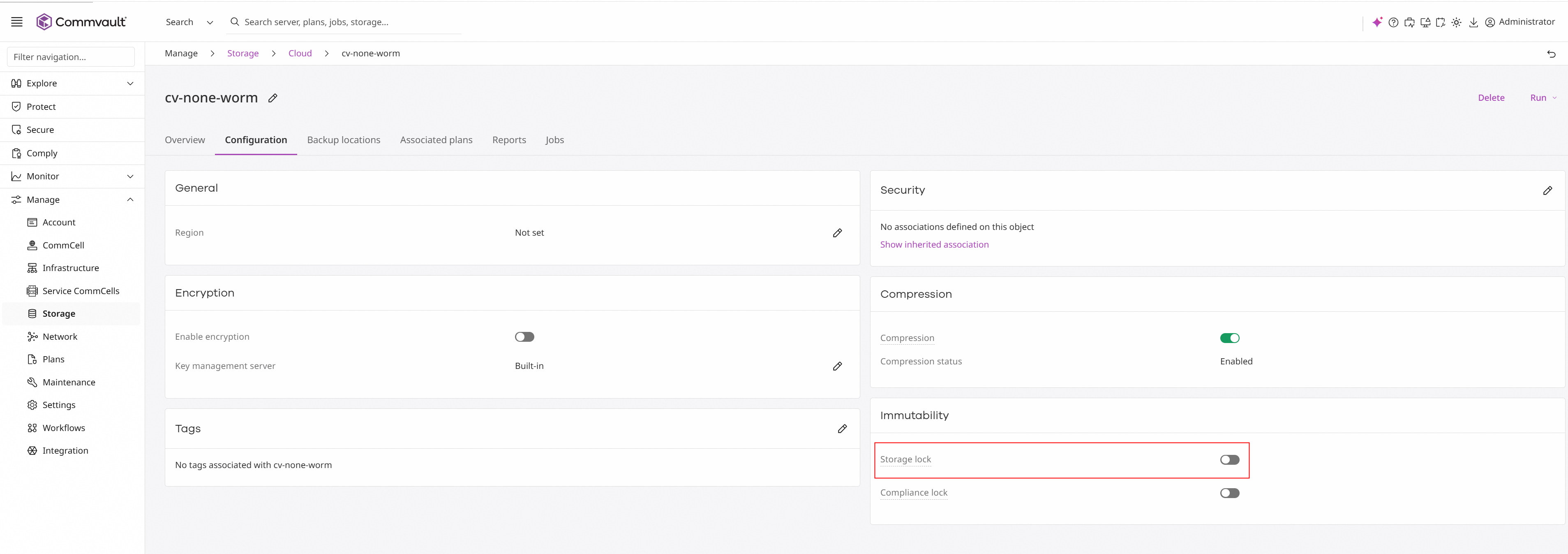
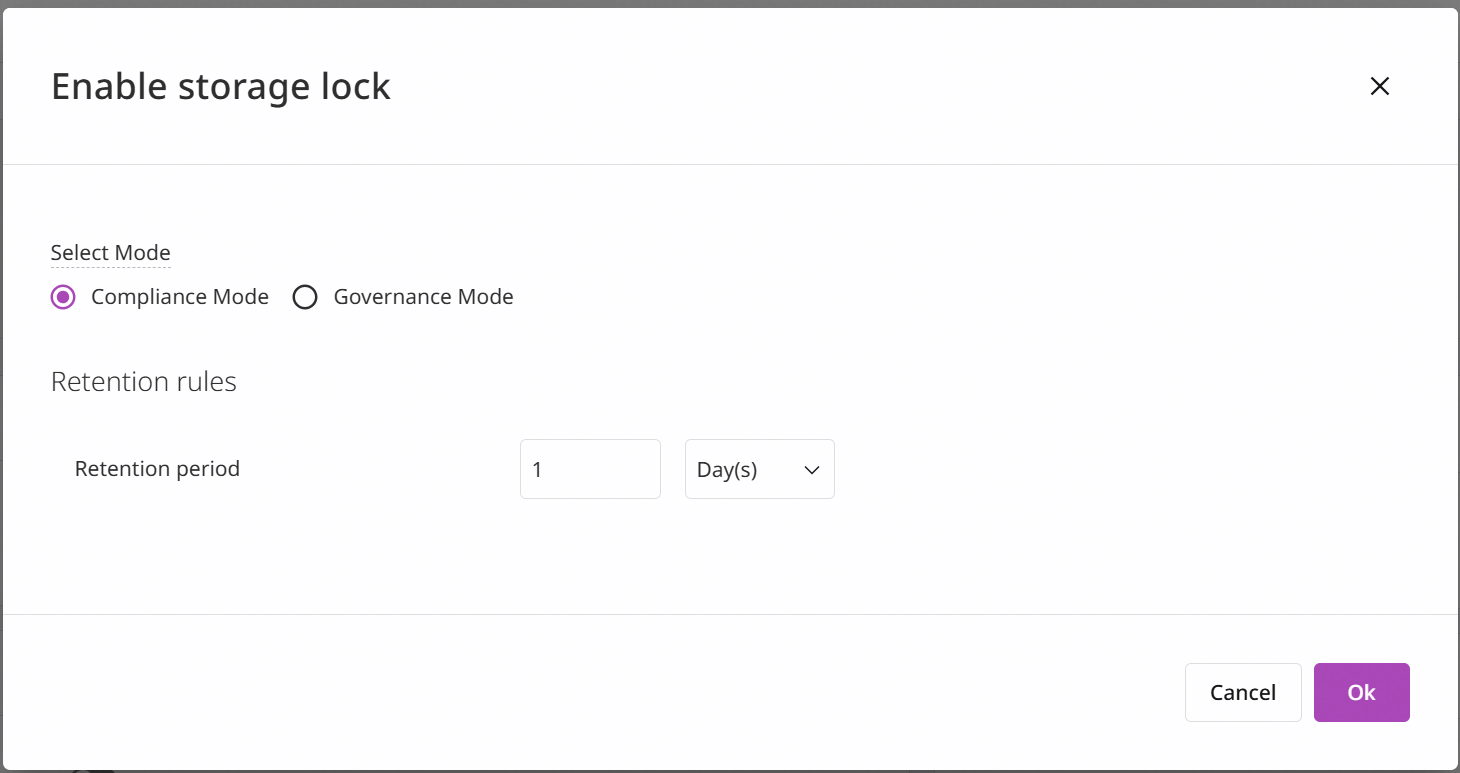
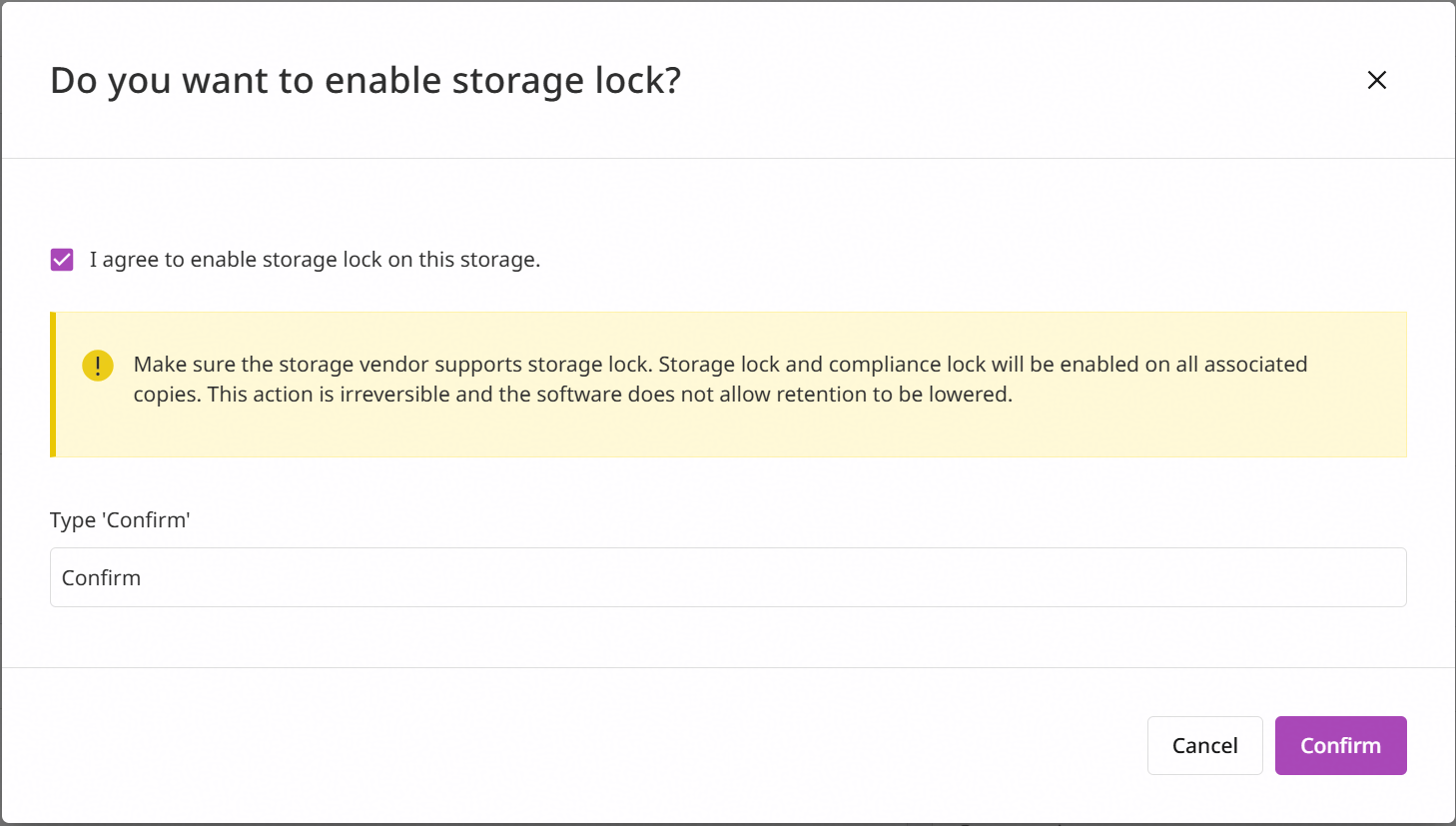
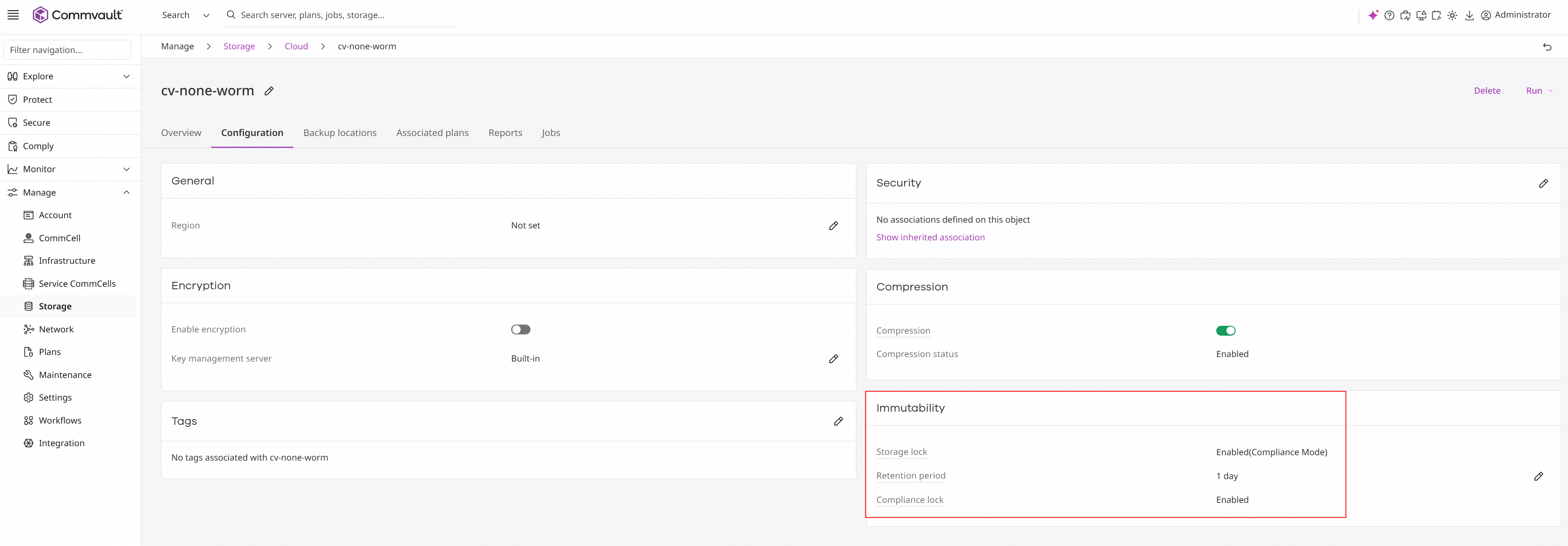
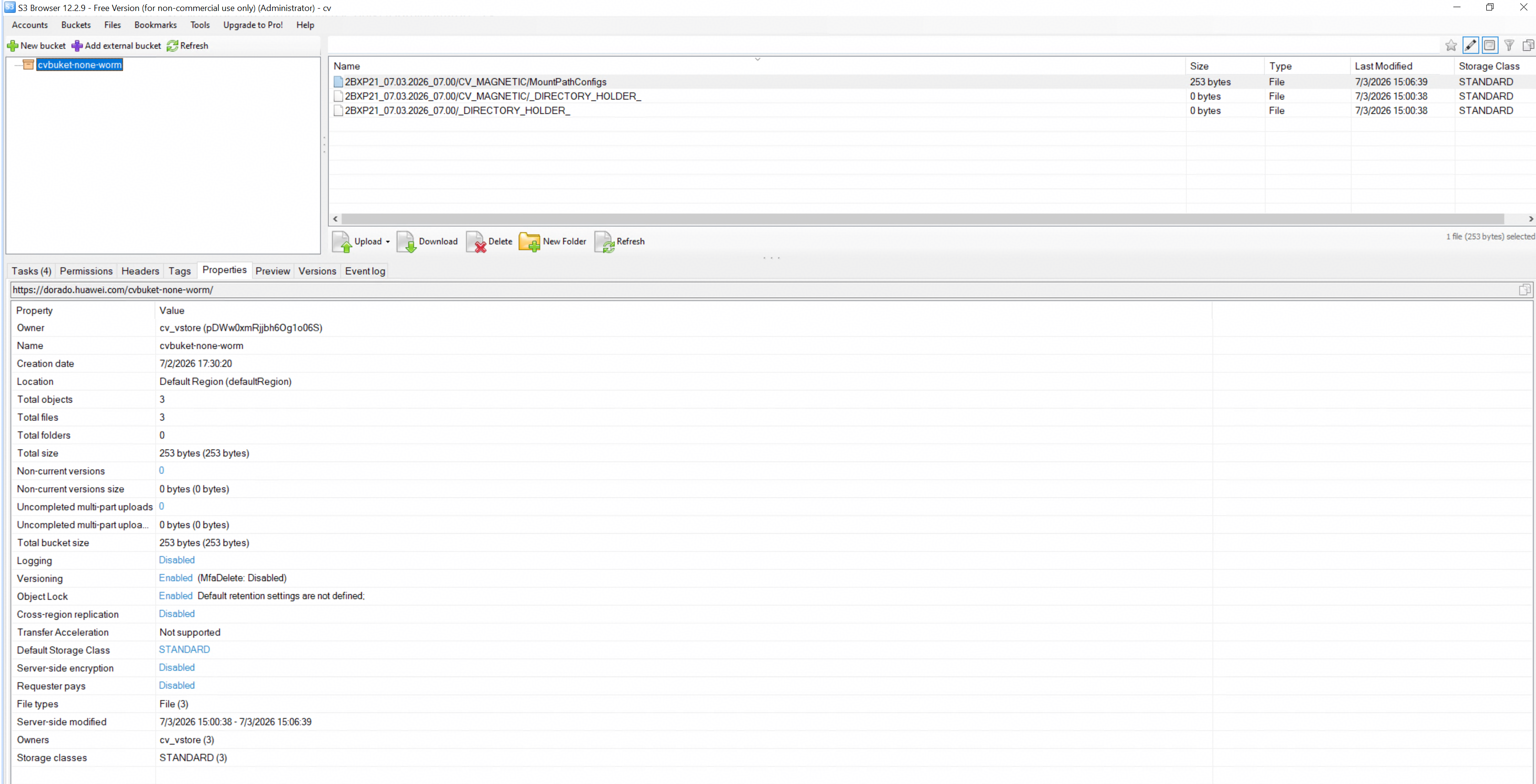 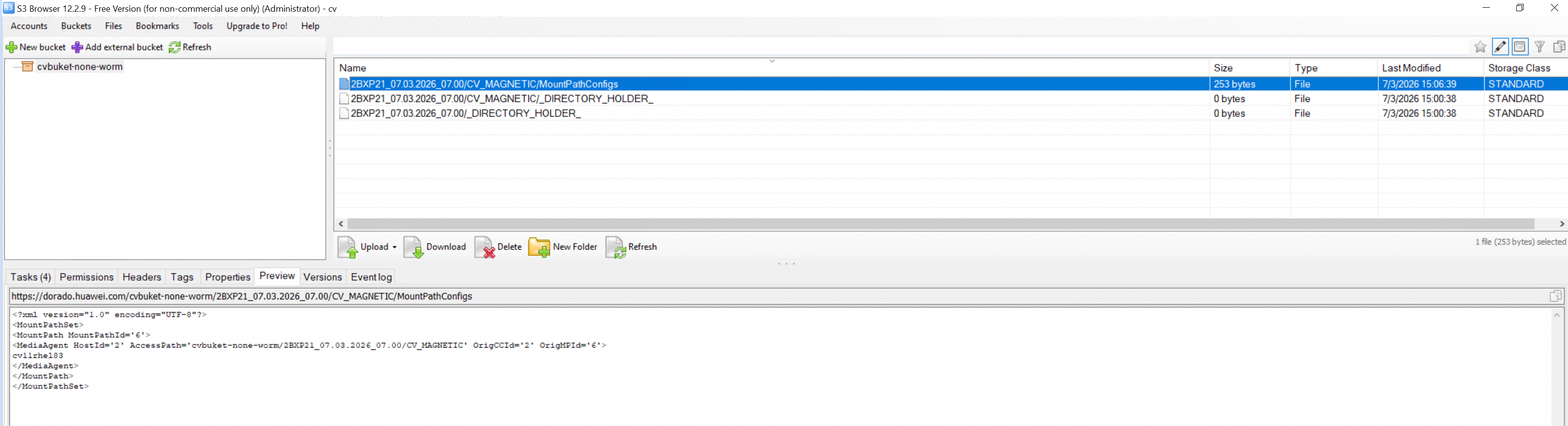
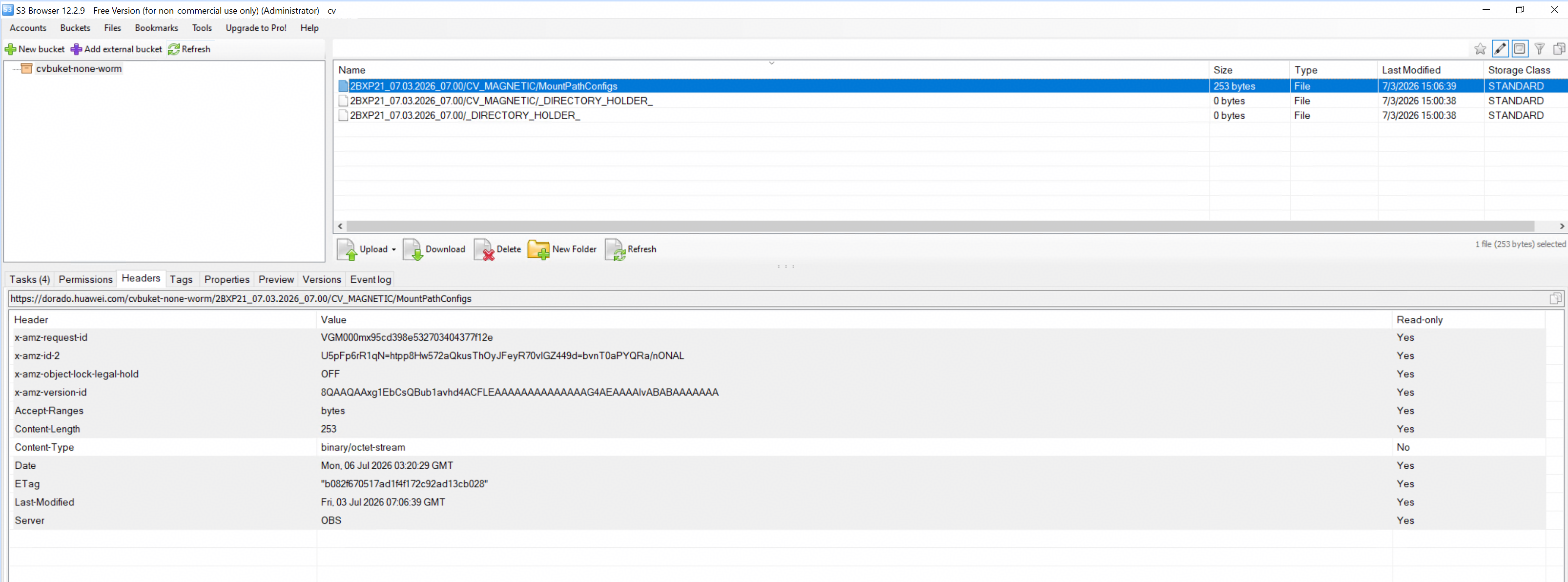
|
Test Conclusion | Passed |
3.3 Add Huawei OceanStor Dorado All-Flash Storage as Snap Array for IntelliSnap backup
Test Purpose | To verify that the Huawei OceanStor Dorado All-Flash Storage can be added as Snap Array for IntelliSnap backup. |
Network Diagram | Reference to Figure 1.1 |
Prerequisites |
|
Test Procedures |
|
Expected Results | In step 5, succeed to add the Huawei Snap Array for IntelliSnap backup. |
Test Results |
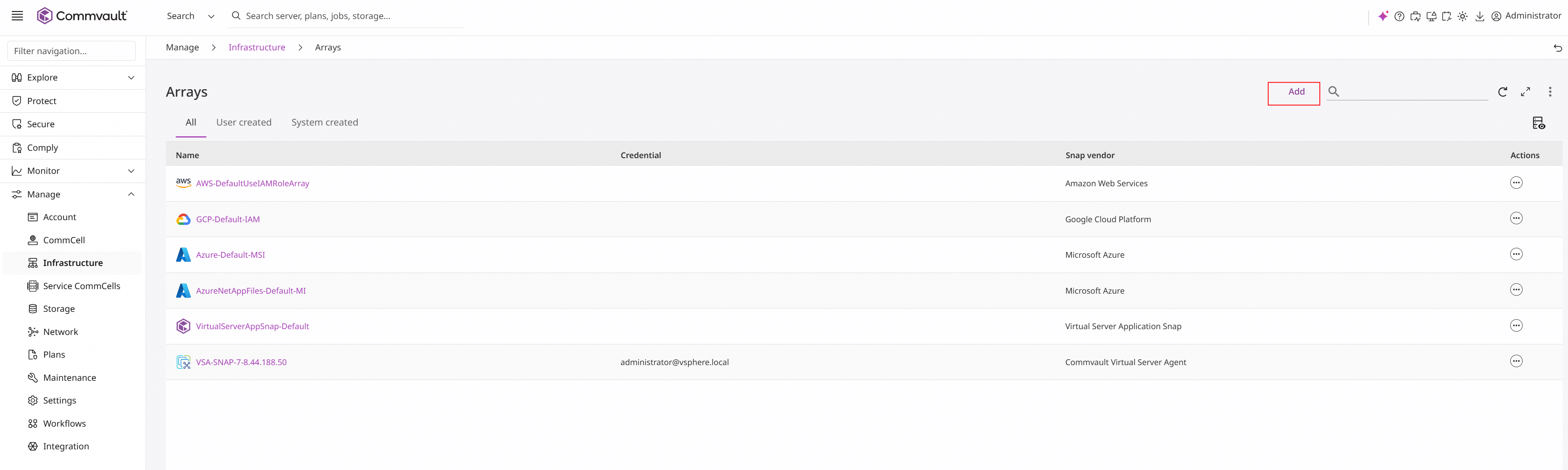
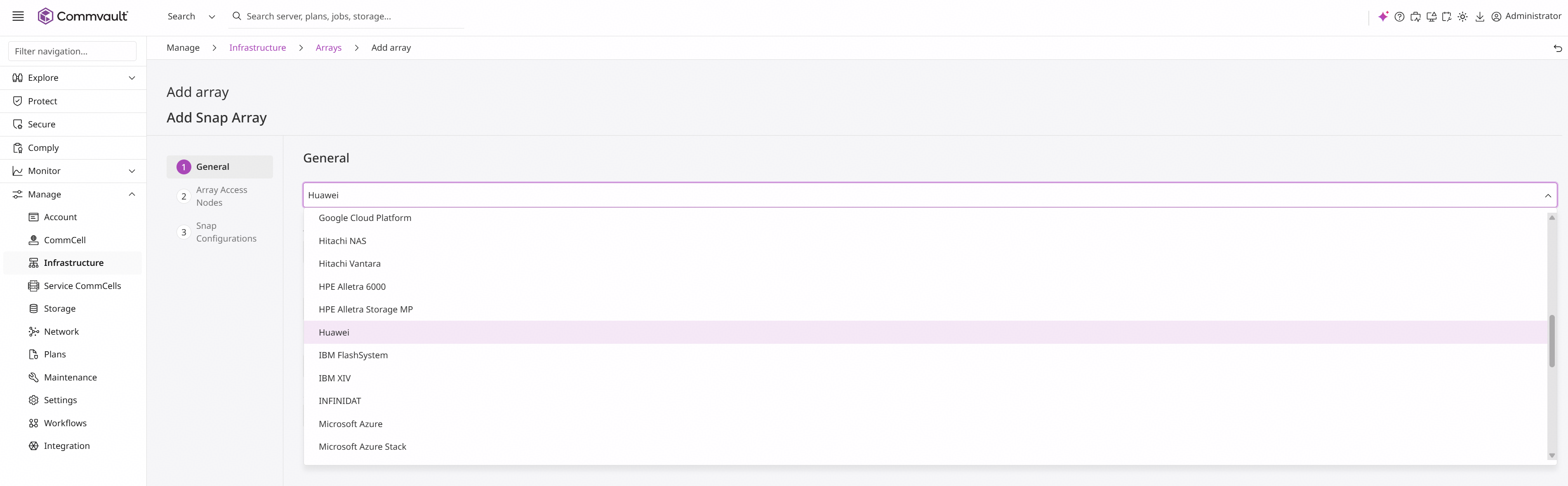 2.2 In the Array name box, type the vStore name. 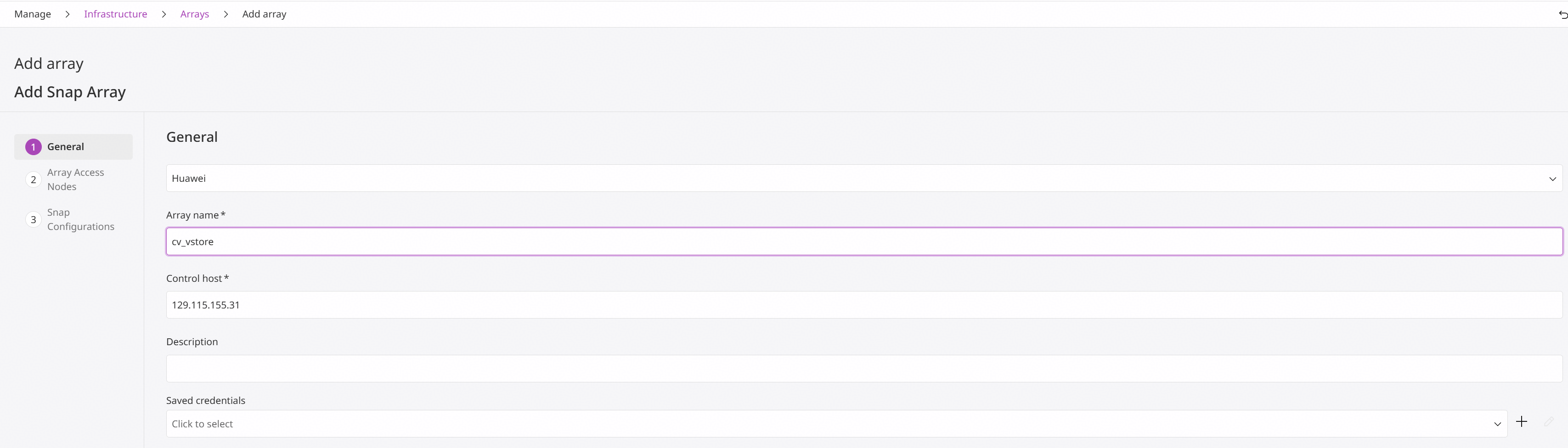 2.3 In the Control host box, type the management IP of vStore. 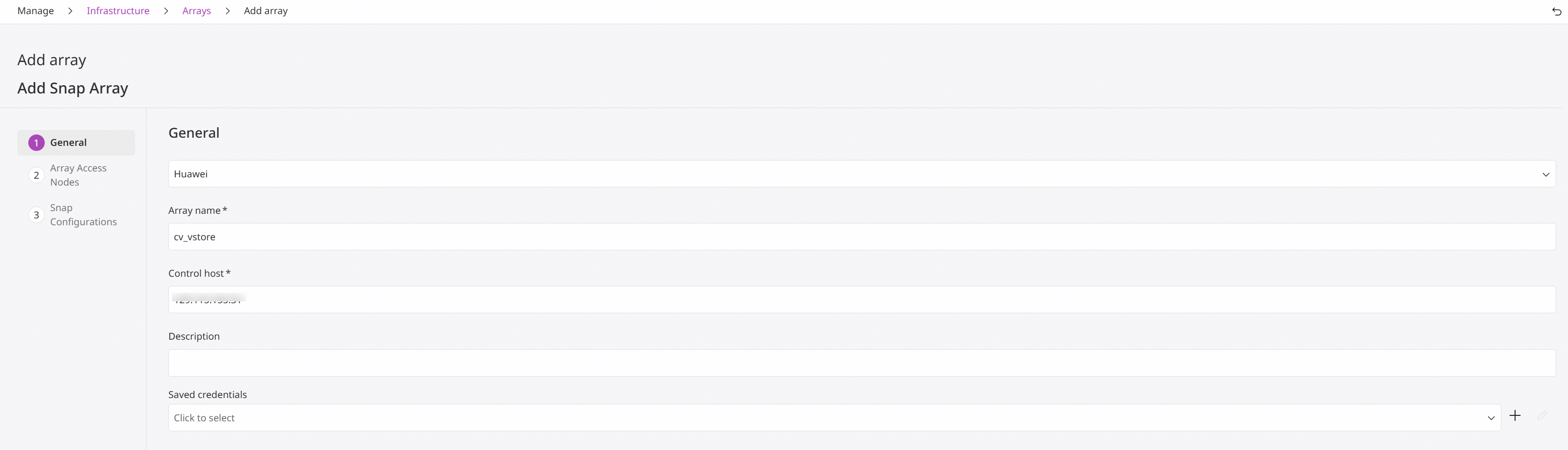 2.4 From the Saved credentials list, select the existing credentials or add new credentials you want to use. Note:the credential is the vStore administrator name and password. 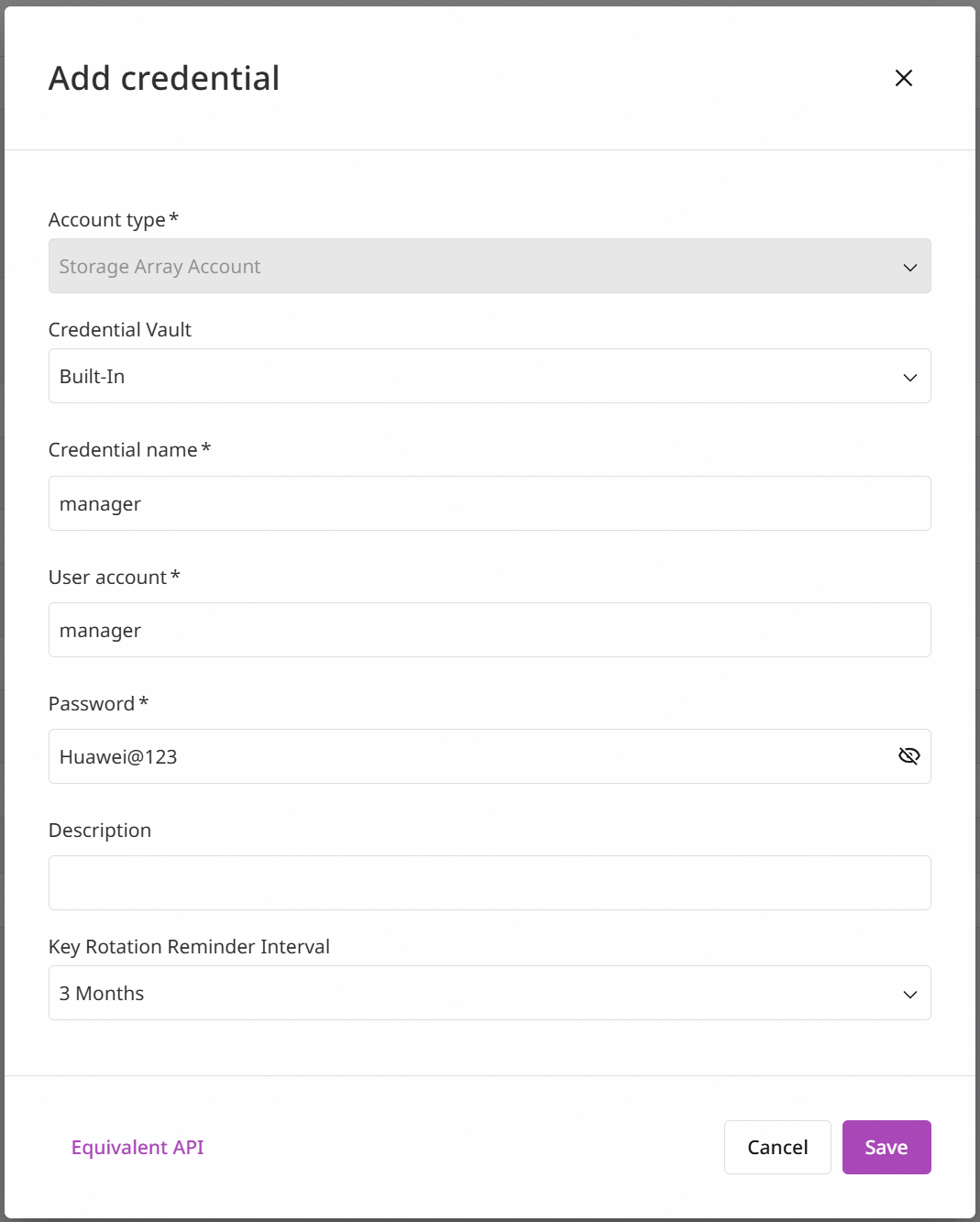 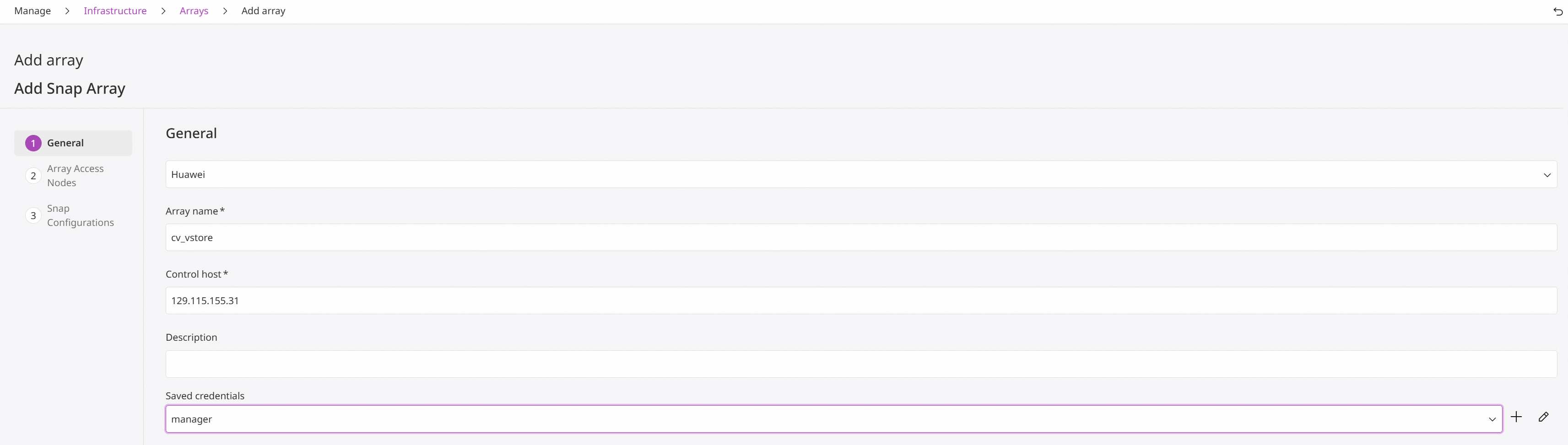 3. From the Available MediaAgents list, select one or more access nodes and then click OK. 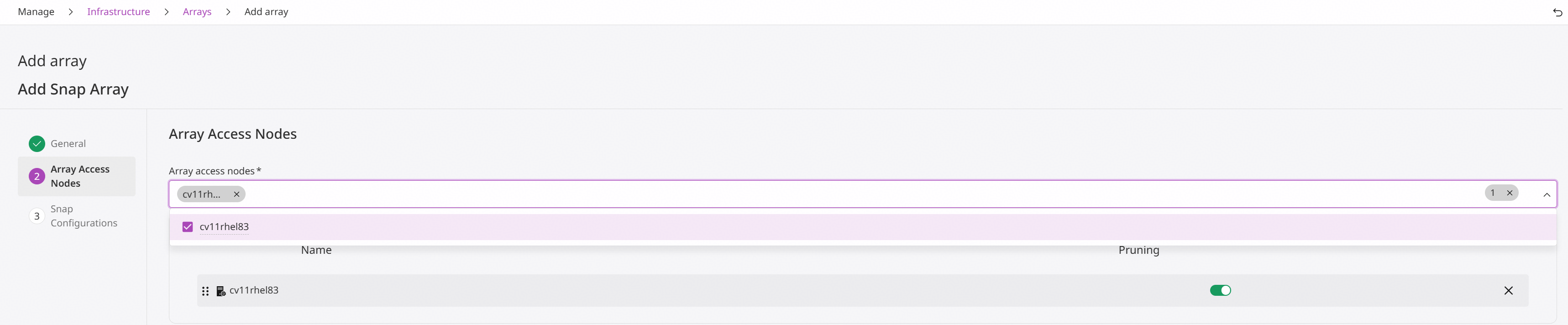 4. Configure Snap Configuration Properties according to your needs. Enable the Use iSCSI if available. 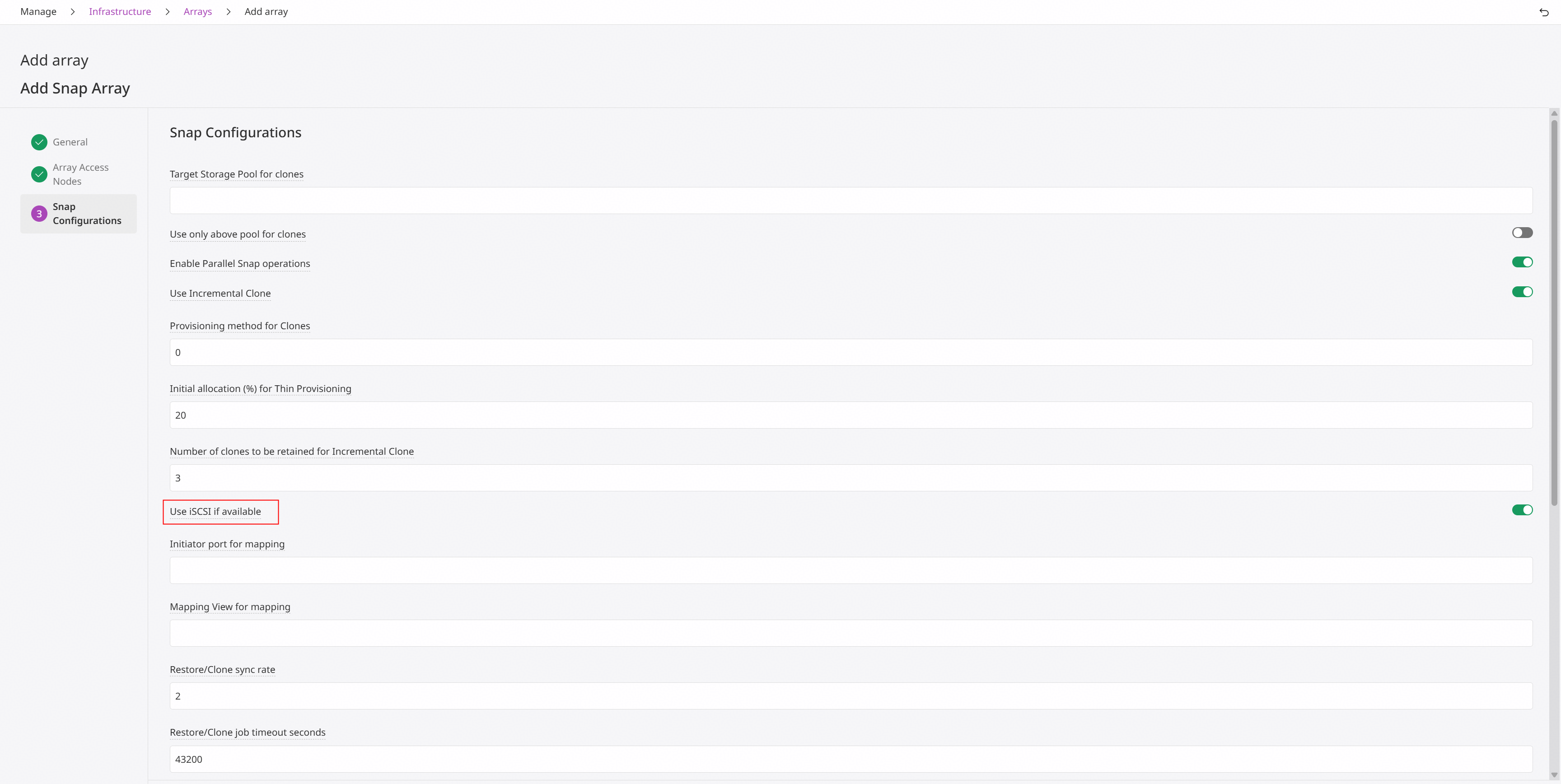 In the Array Host Aliases box, type the storage ESN. 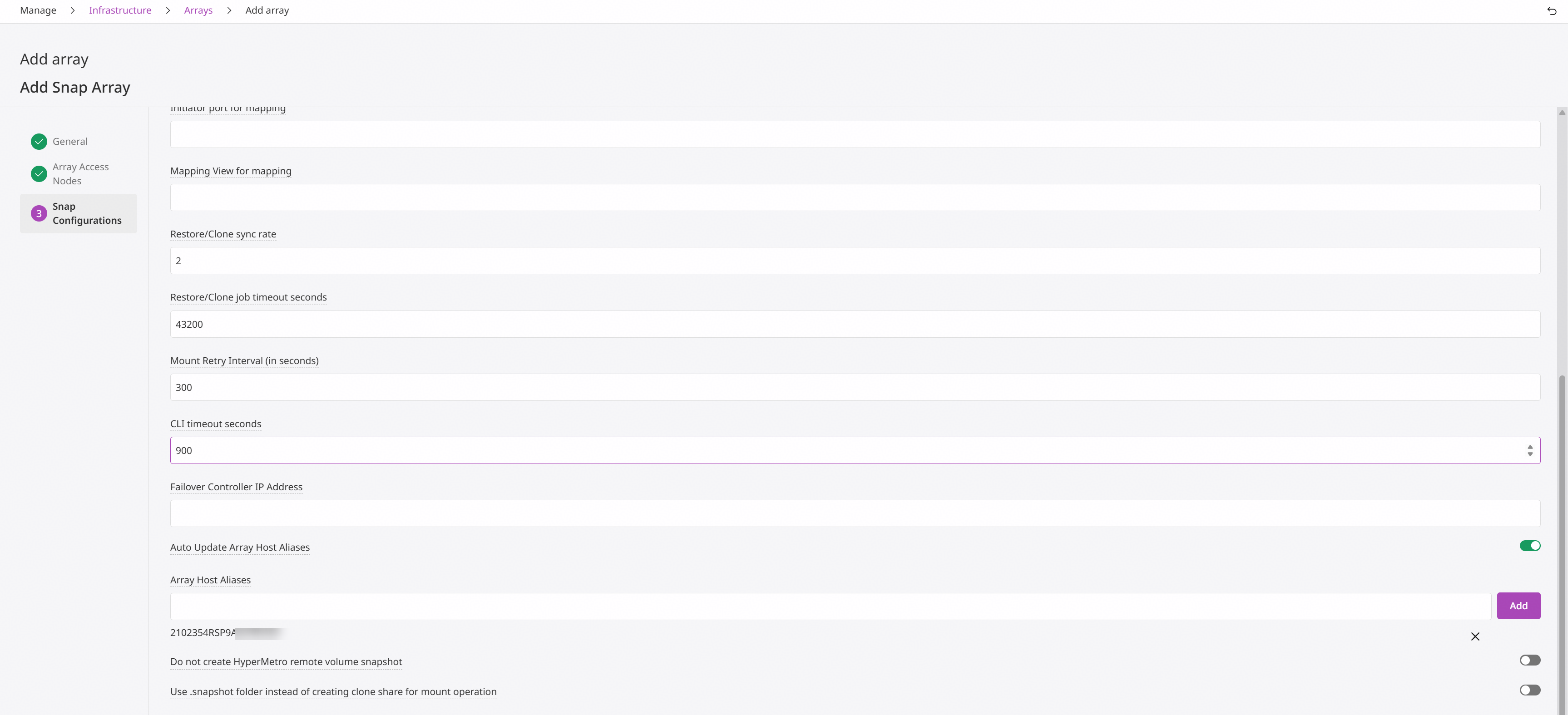 5. Click Submit to finish the adding. 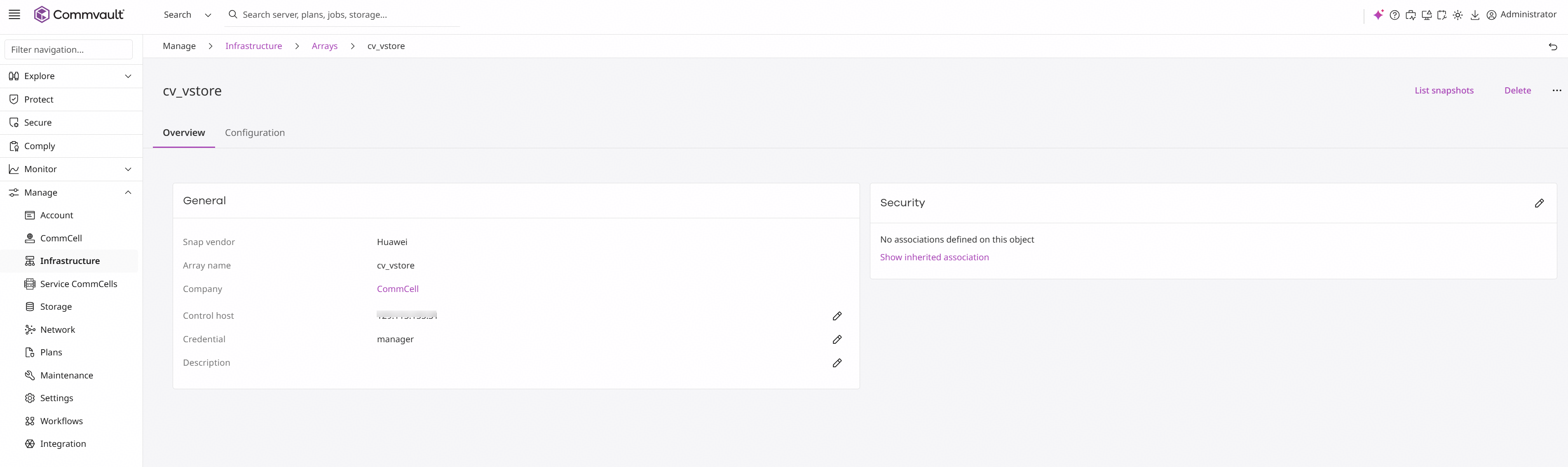 |
Test Conclusion | Passed |
3.4 Create a VMware backup plan with Huawei OceanStor Snap Engine
Test Purpose | To verify that the backup server can create a Virtual Machine backup plan with Huawei OceanStor Snap Engine. |
Network Diagram | Reference to Figure 1.1 |
Prerequisites |
|
Test Procedures | Step 1: From the Command Center navigation pane, go to Protect > Virtual machines >Add hypervisor > VMware vCenter, and next. Step 2: Configure VMware vCenter information. Step 3: Select the VM to be backed up and create a VM group. Step 4: Create a backup plan and assign the immutable cloud storage created in 3.2 as the Storage. Step 5: Add a Snapshot Copy for the backup plan. Step 6: Enable snap backup for Virtual Machines Client. Step 7: Enable snap backup and select the Huawei OceanStor Snap Engine for VM Group. |
Expected Results |
|
Test Results |
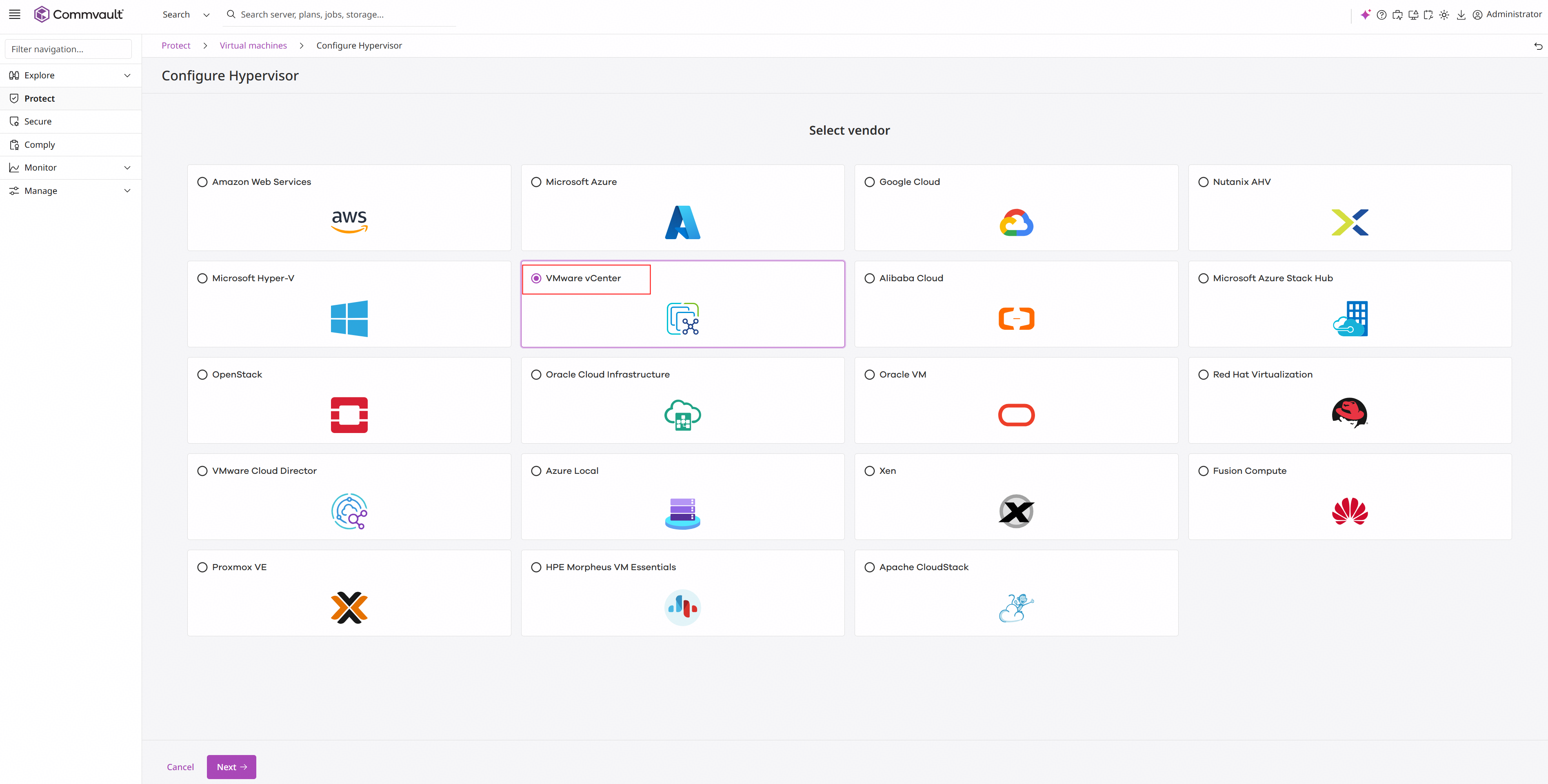 2. Configure VMware vCenter information. 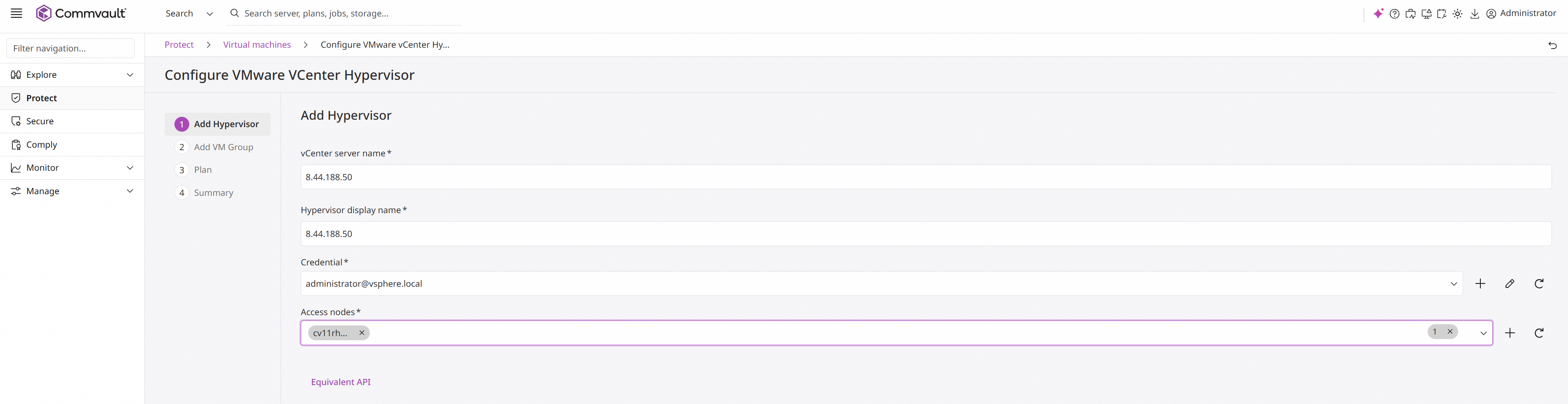 3. Select the VM to be backed up and create a VM group.  4. Create a backup plan and assign the immutable cloud storage created in 3.2 as the Storage. 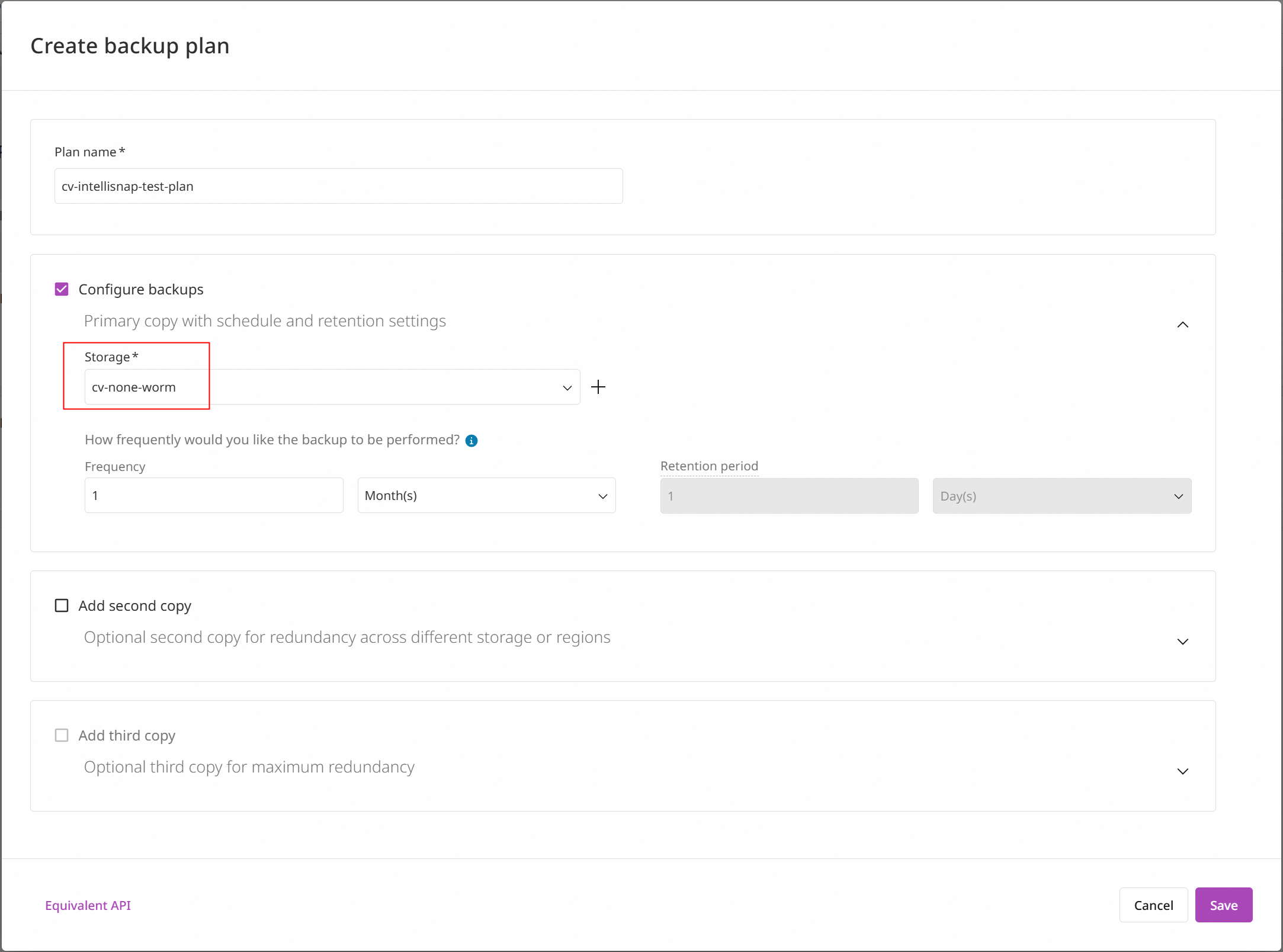 5. Add a Snap copy for the backup plan. 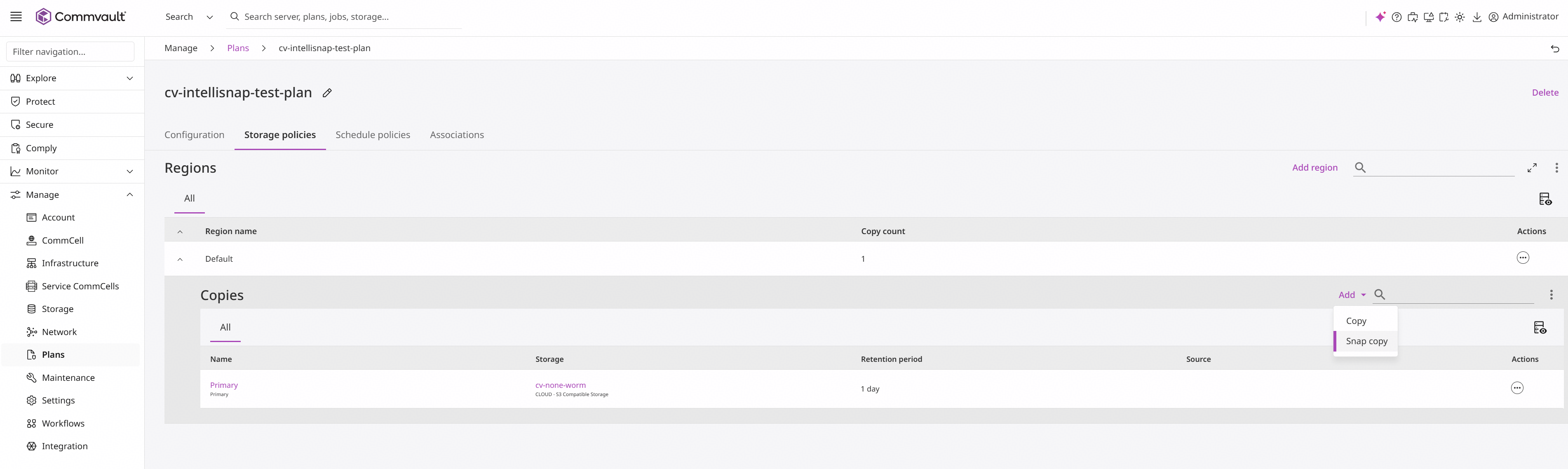 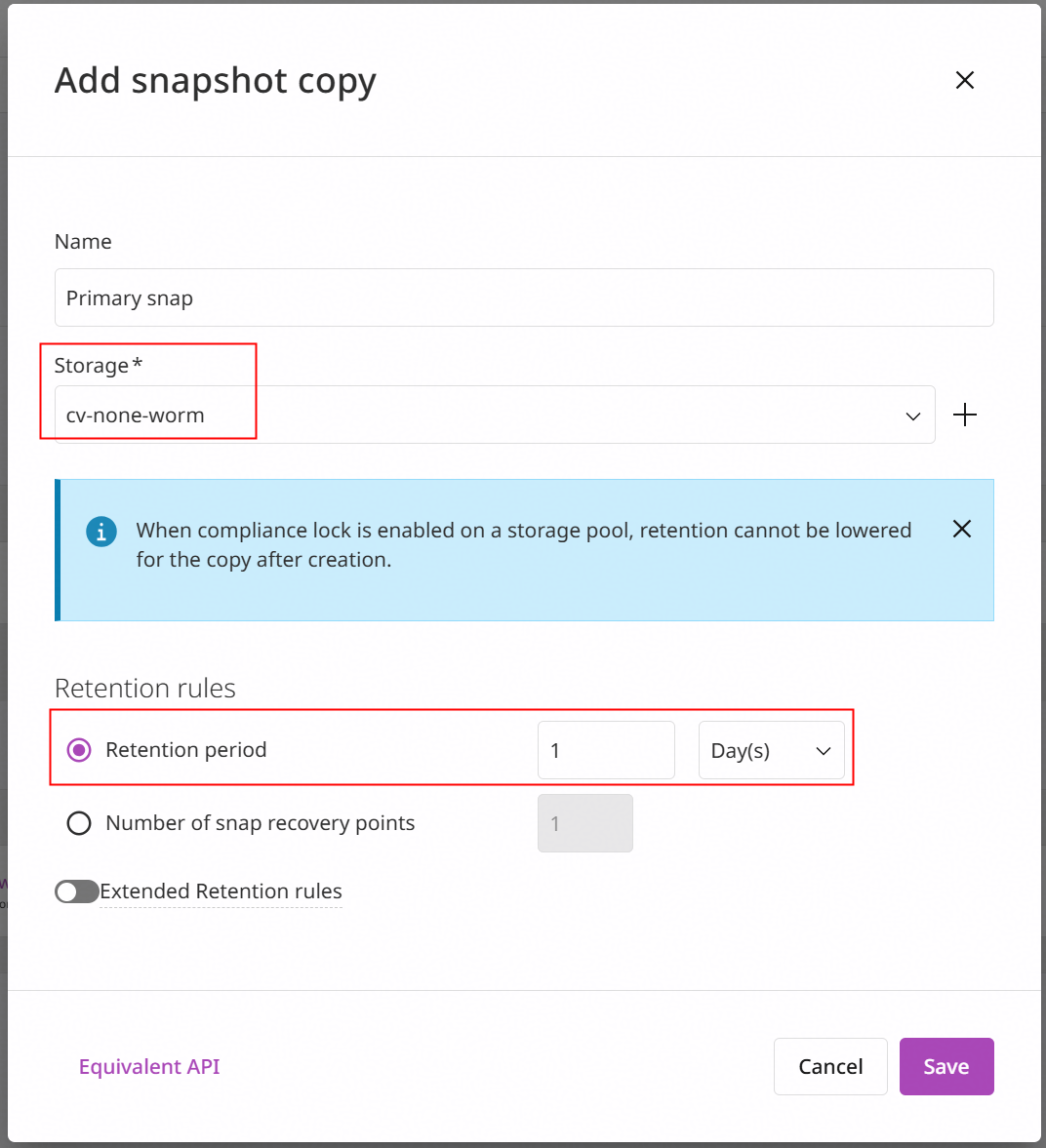 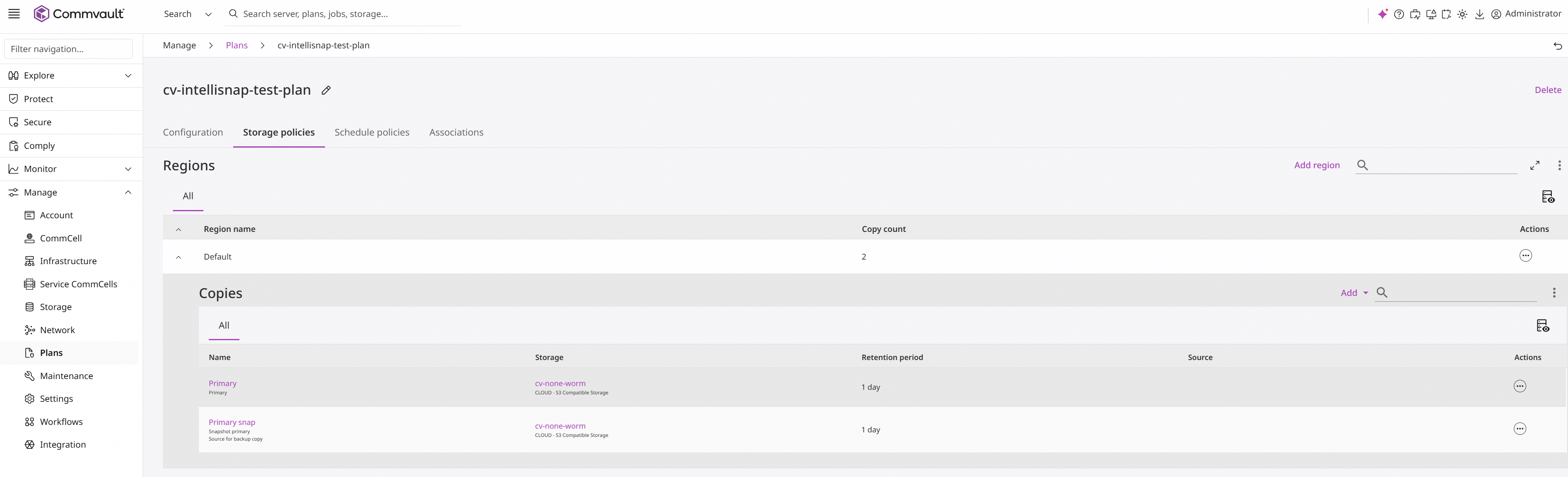 6. Enable snap backup for Virtual Machines Client. 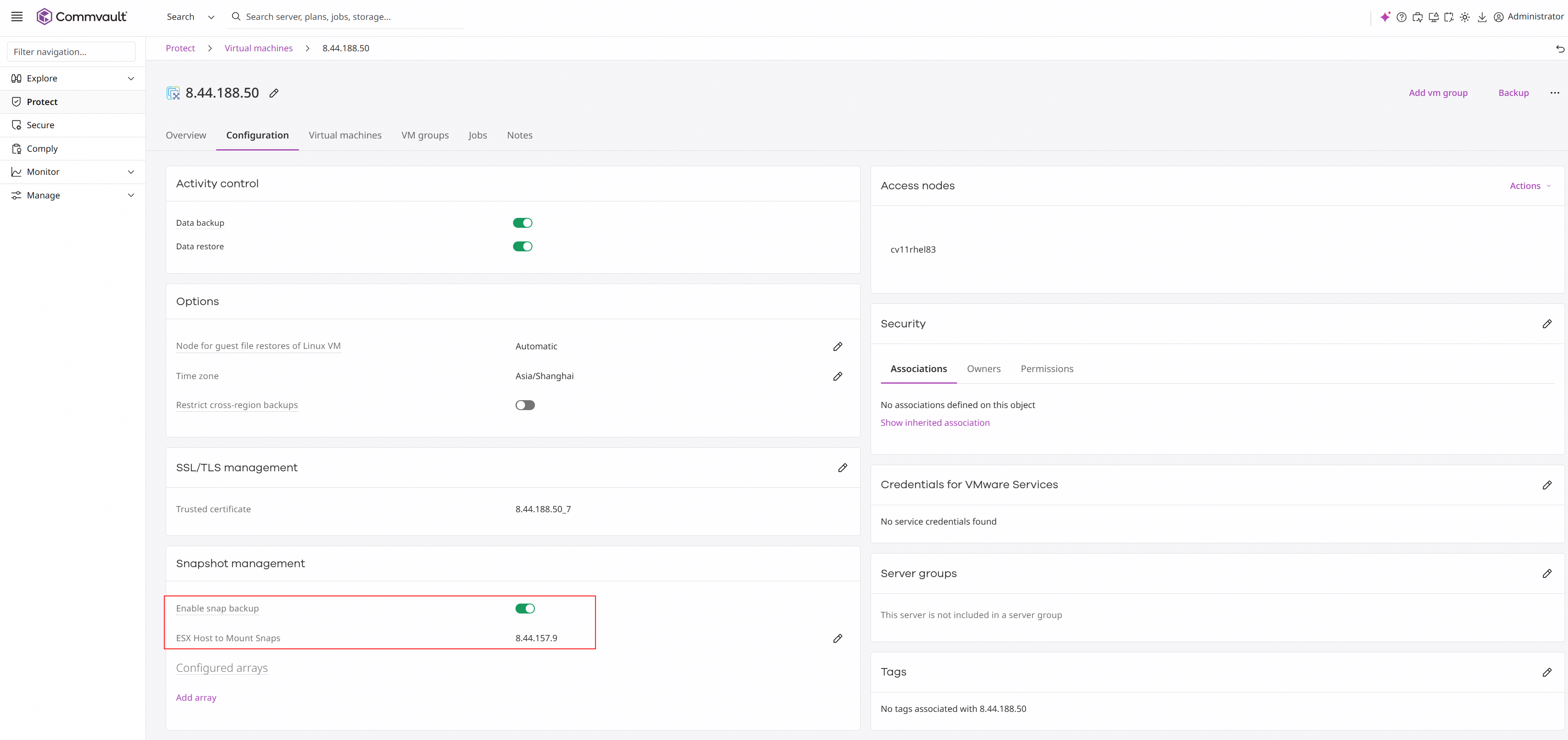 7. Enable snap backup and select the Huawei OceanStor Snap Engine for VM Group. 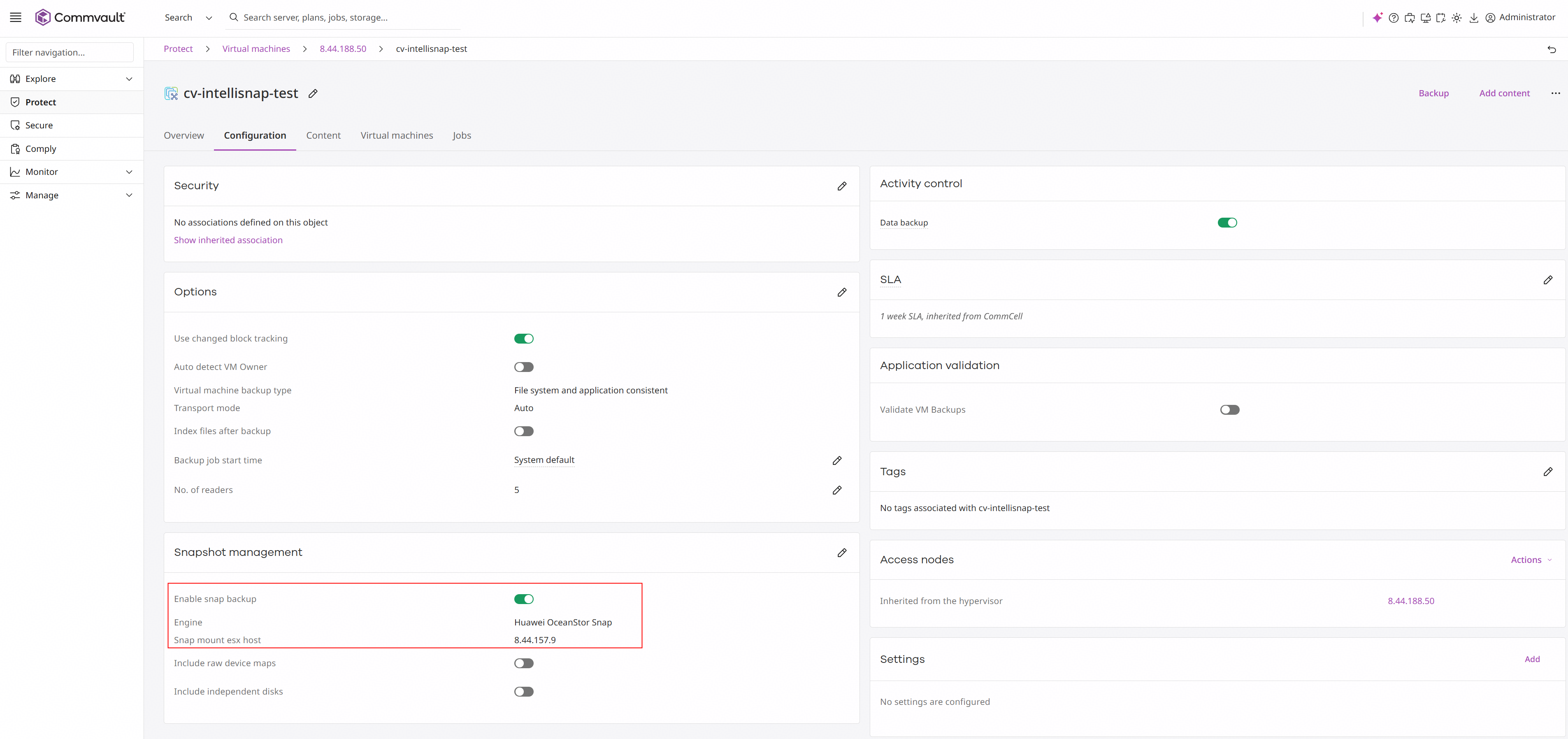 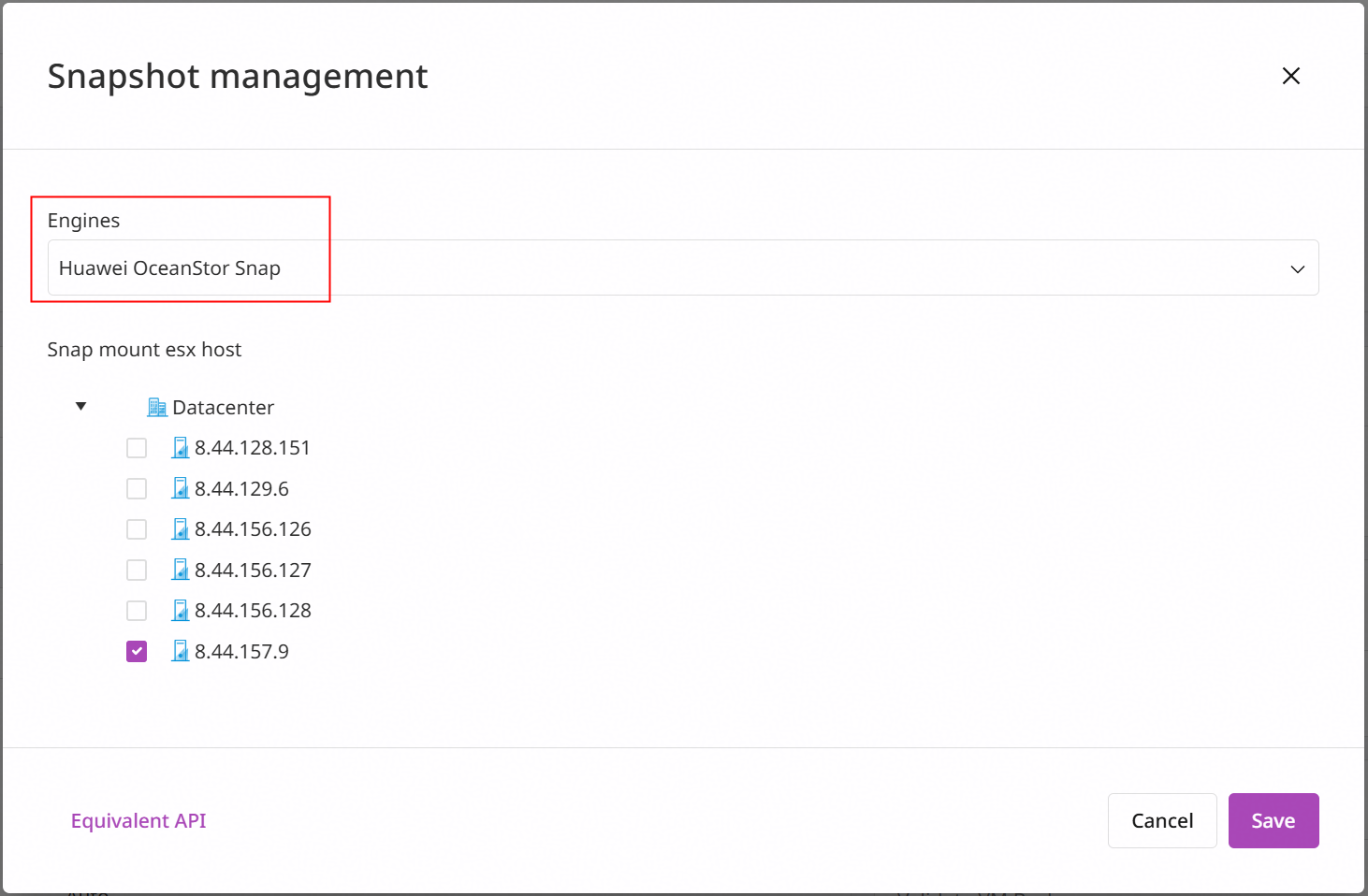 |
Test Conclusion | Passed |
3.5 Full Intellisnap back up VM to the immutable cloud storage
Test Purpose | To verify that the backup server can full Intellisnap back up the VM to the immutable cloud storage. |
Network Diagram | Reference to Figure 1.1 |
Prerequisites |
3.The VMware backup plan with Huawei OceanStor Snap Engine has been created in section 3.4. |
Test Procedures | Step 1: From the Command Center navigation pane, go to Protect > Virtual machines. Click the VM group. Click Back up. Step 2: Select Backup type of Full, and check the option of Create a backup copy immediately. Click Submit. Step 3: Check the full backup job status on the backup server. Step 4: Check the storage snapshot created by Commvault. Step 5: After the full backup job is complete, check the size of backup files through the S3 Browser. |
Expected Results |
|
Test Results |
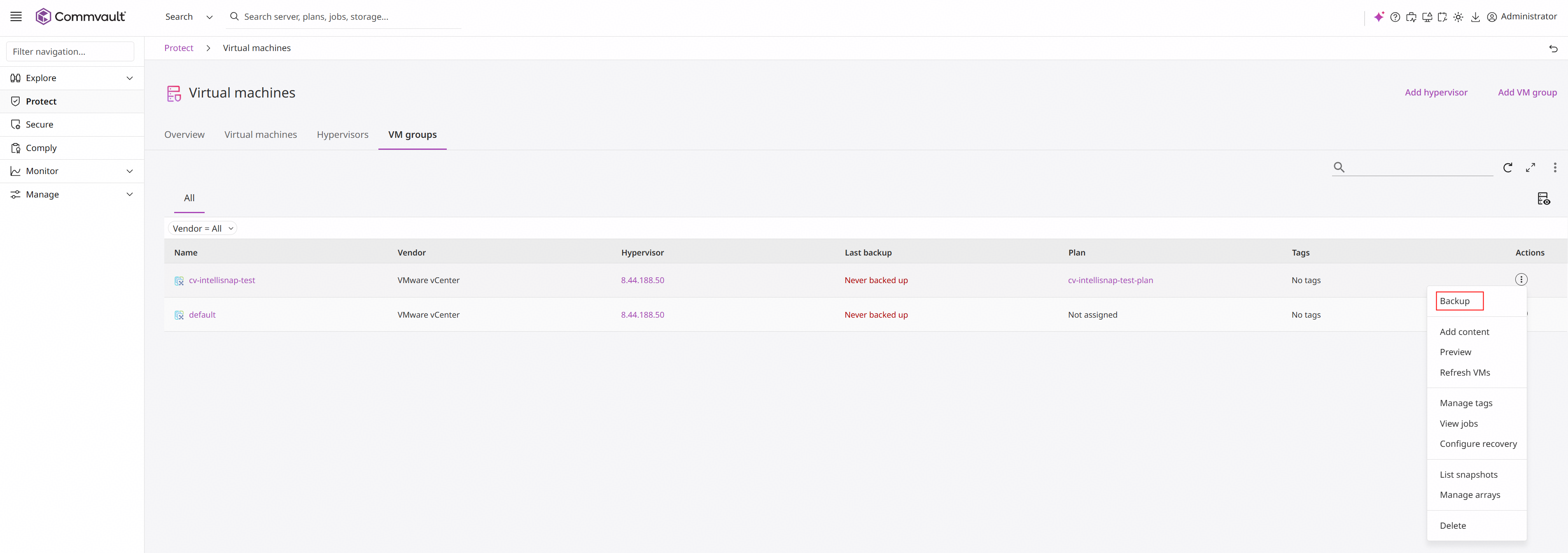
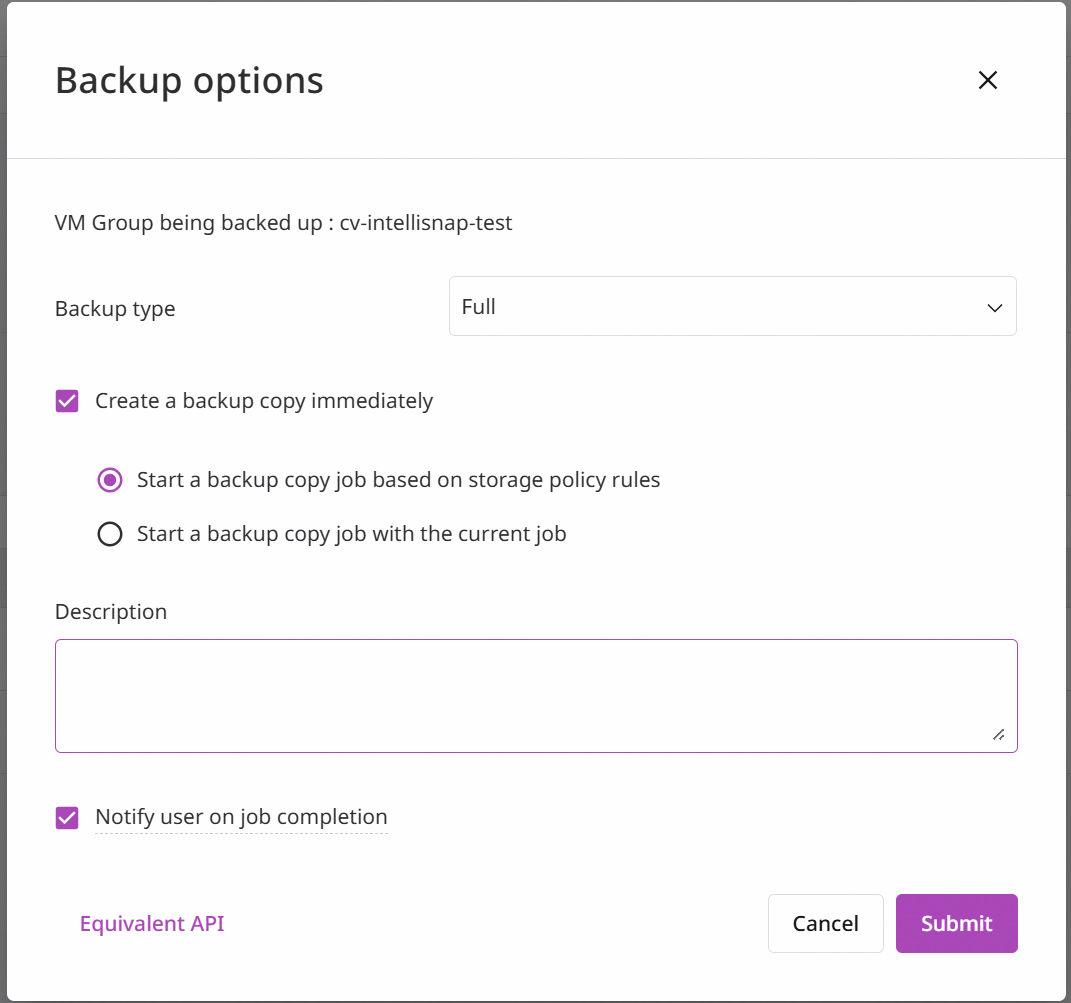
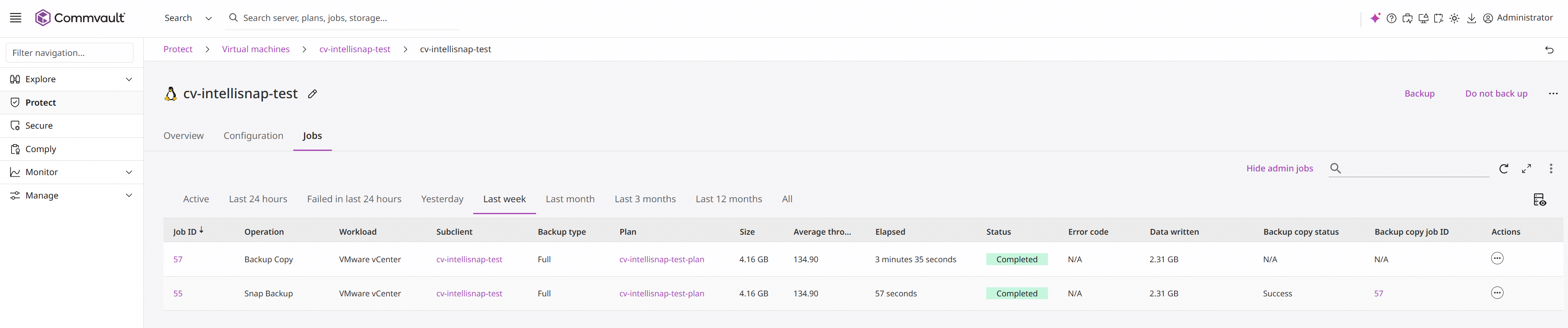
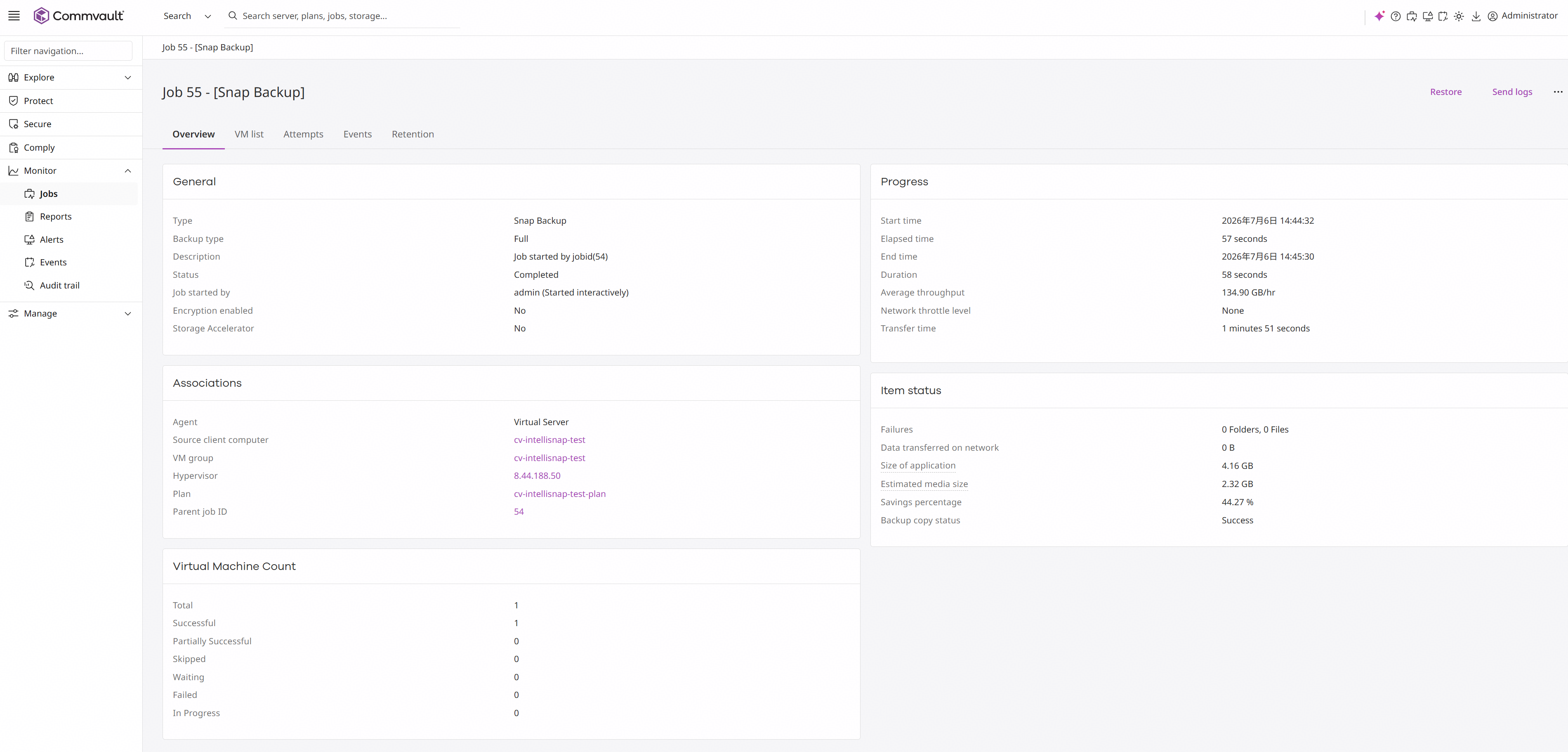
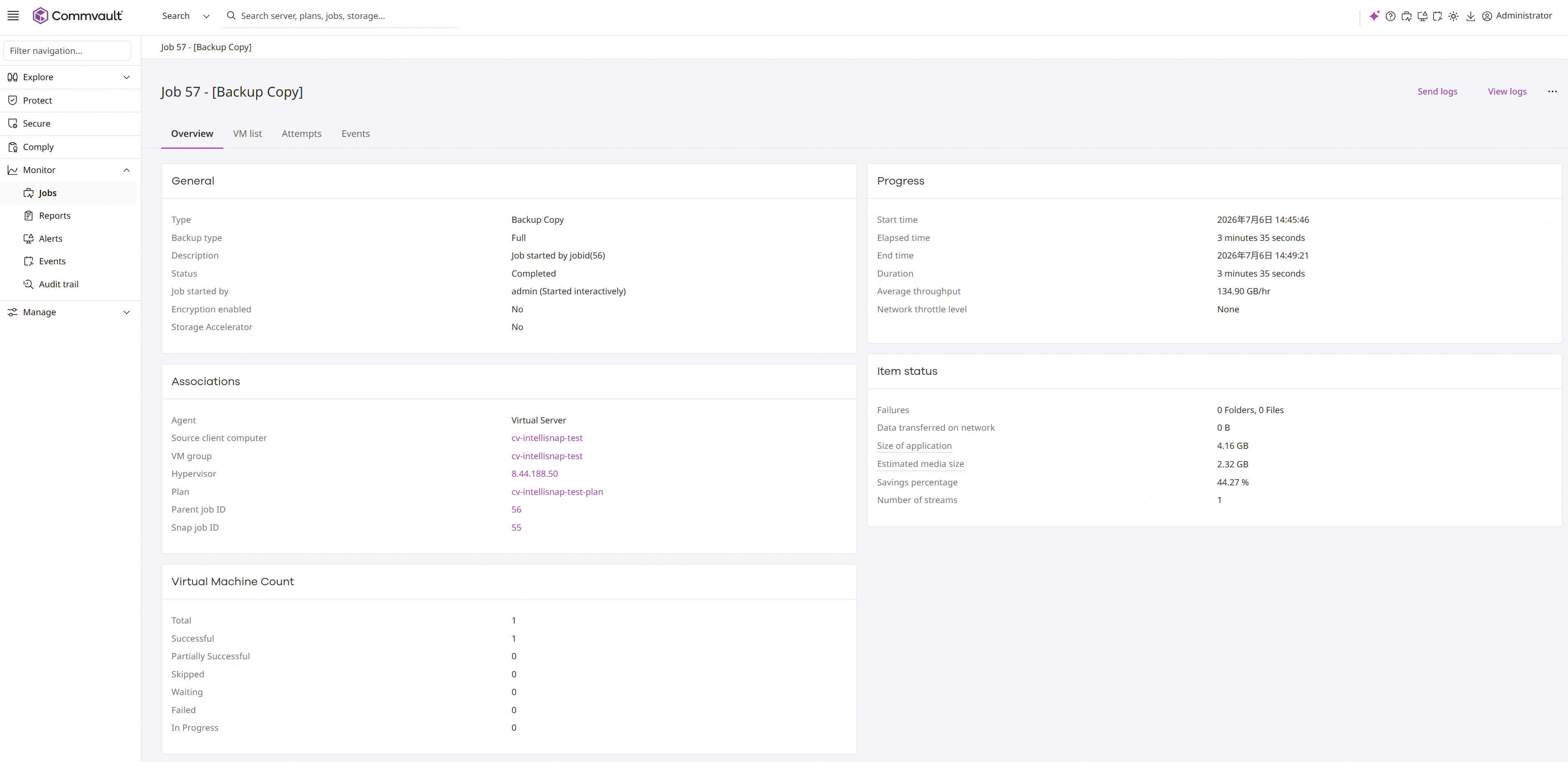
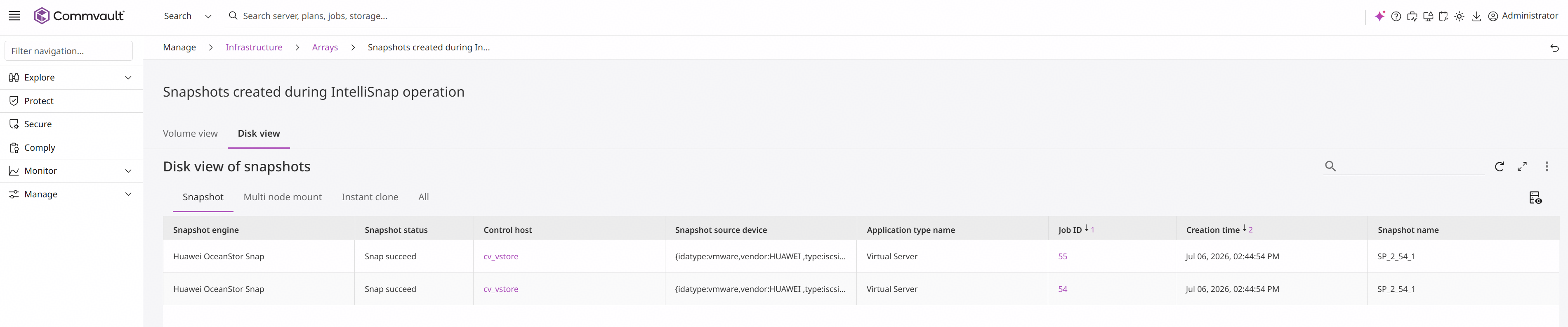

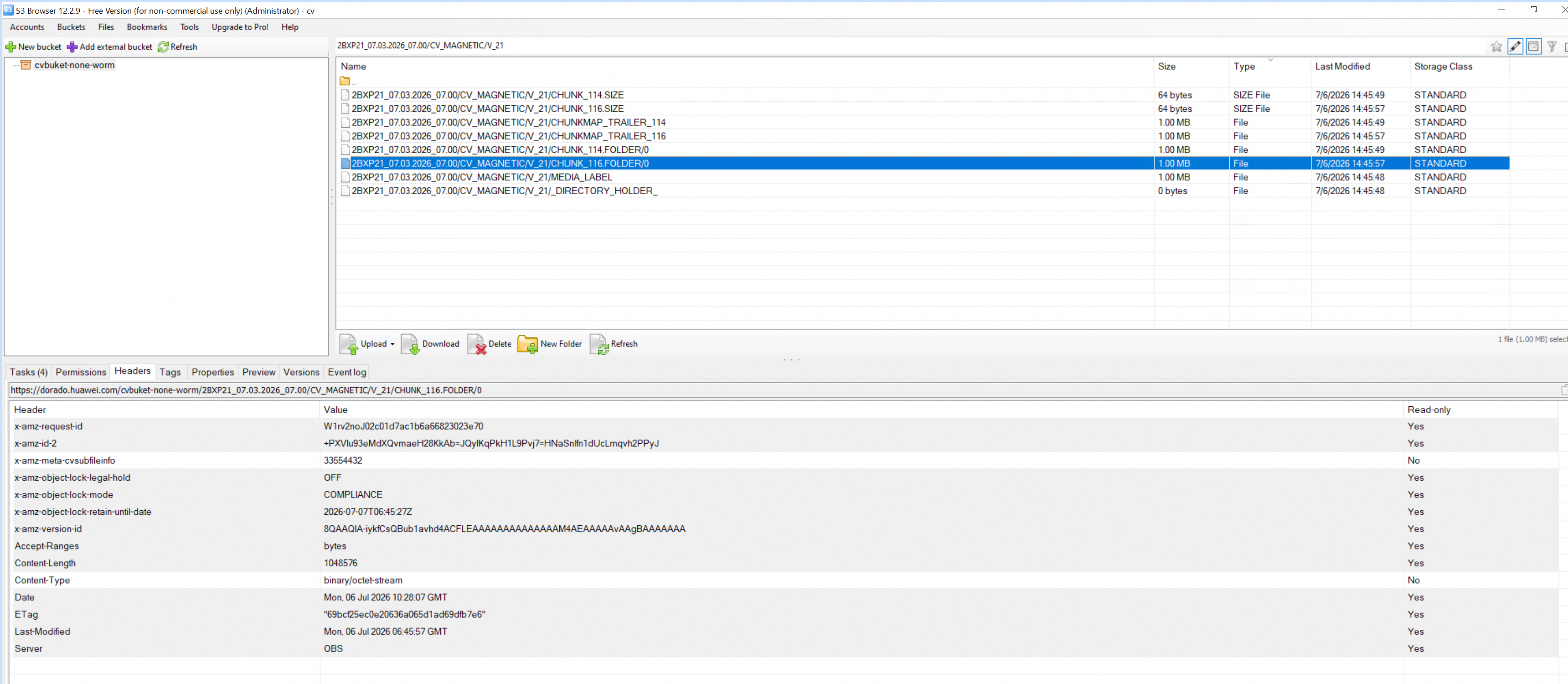
|
Test Conclusion | Passed |
3.6 Incremental Intellisnap back up VM to the immutable Cloud storage
Test Purpose | To verify that the backup server can Incremental Intellisnap back up the VM to the immutable cloud storage. |
Network Diagram | Reference to Figure 1.1 |
Prerequisites |
|
Test Procedures | Step 1: Modify and record the VM data and state. Step 2: From the Command Center navigation pane, go to Protect > Virtual machines. Click the VM group. Click Back up. Step 3: Select Backup type of Incremental, and check the option of Create a backup copy immediately. Click Submit. Step 4: Check the Incremental backup job status on the backup server. Step 5: Check the storage snapshot created by Commvault. Step 6: After the full backup job is complete, check the size of backup files through the S3 Browser. |
Expected Results |
|
Test Results |
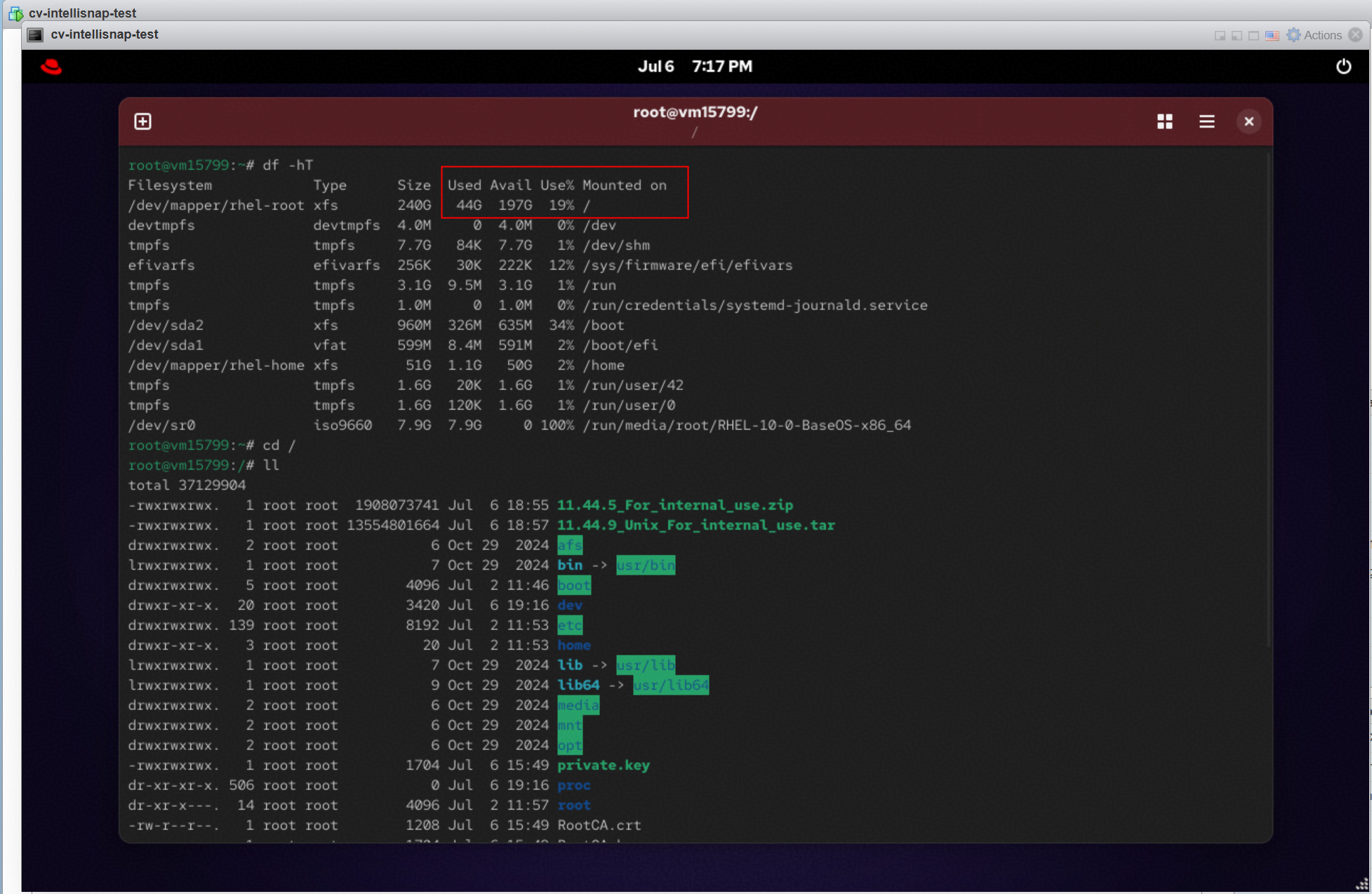
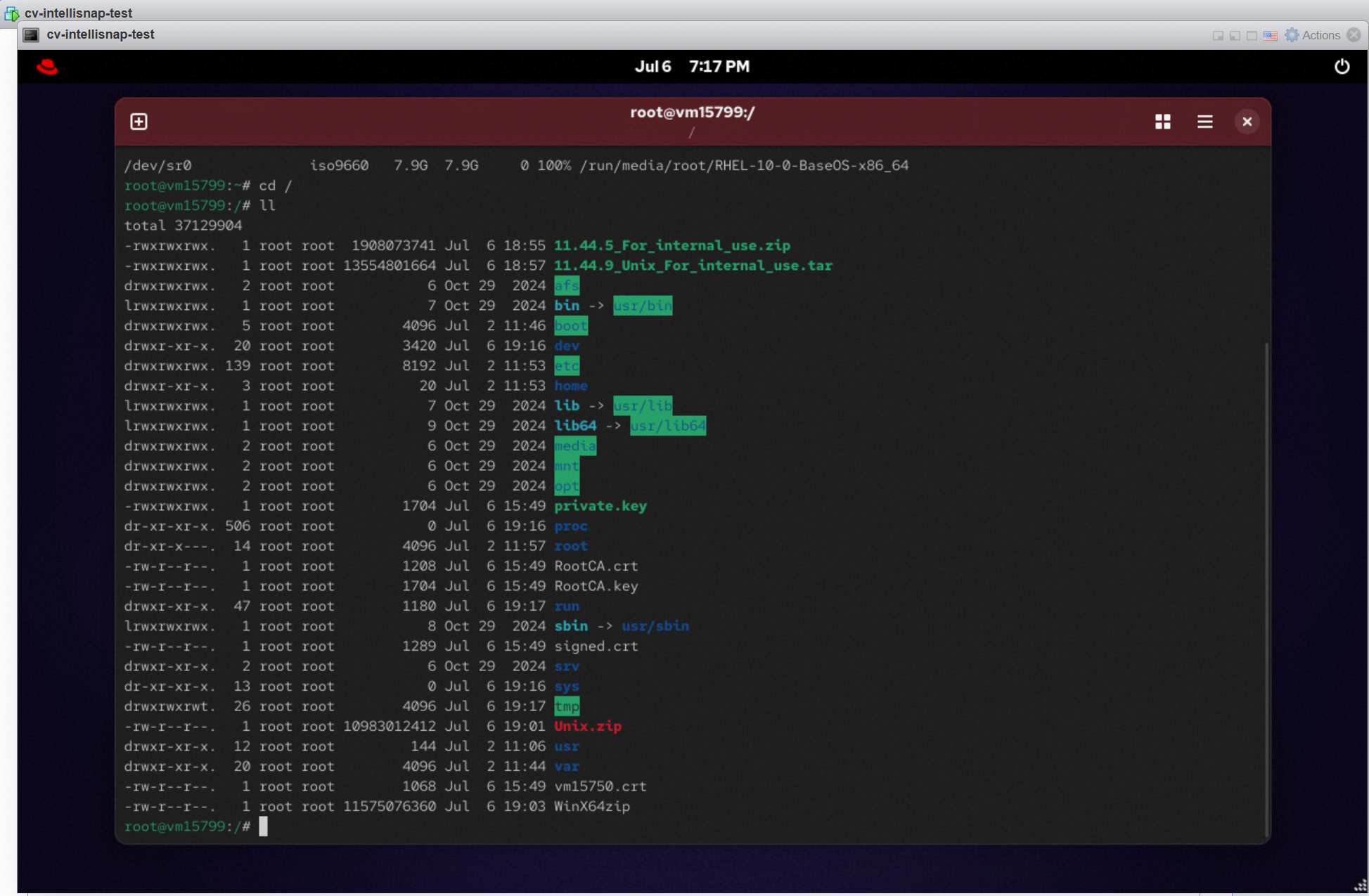
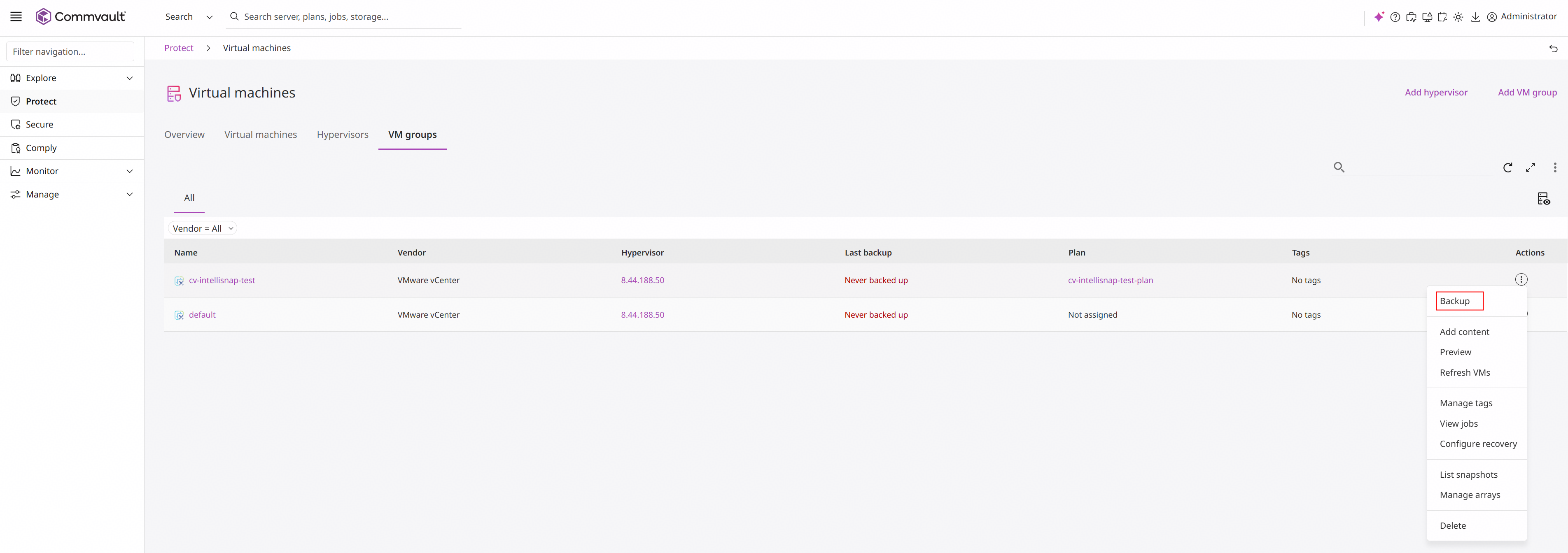
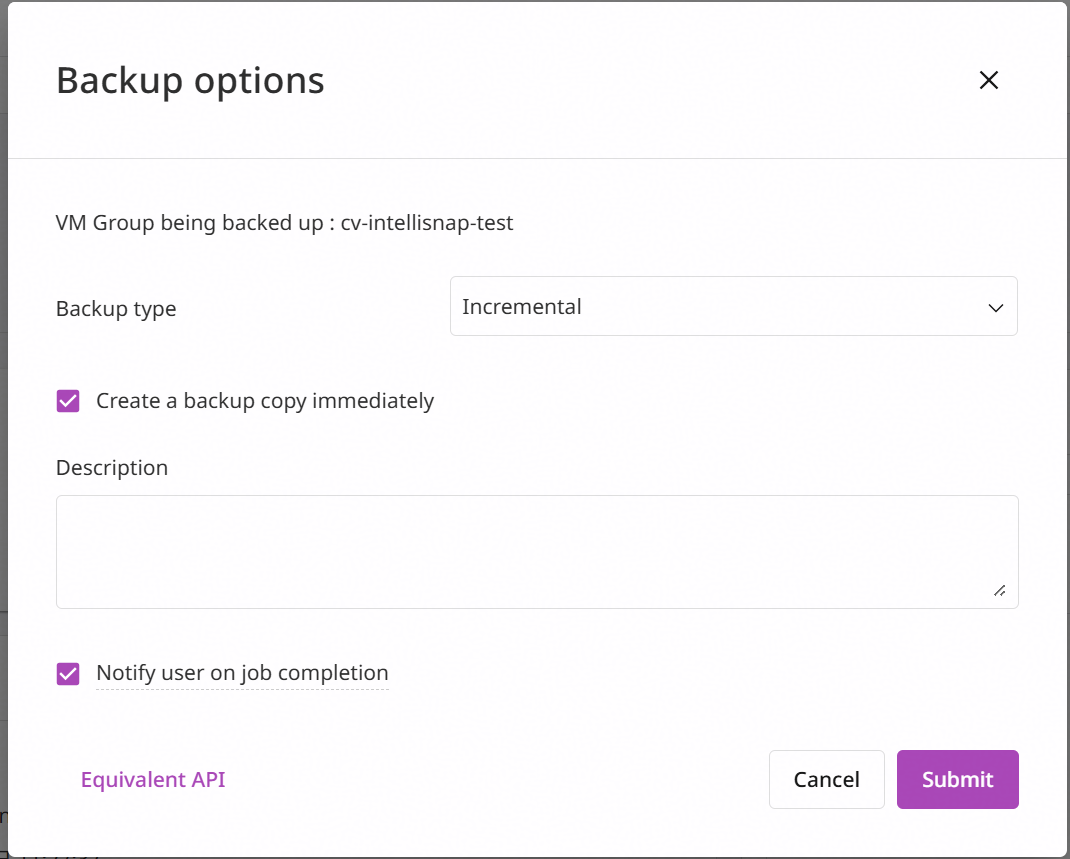
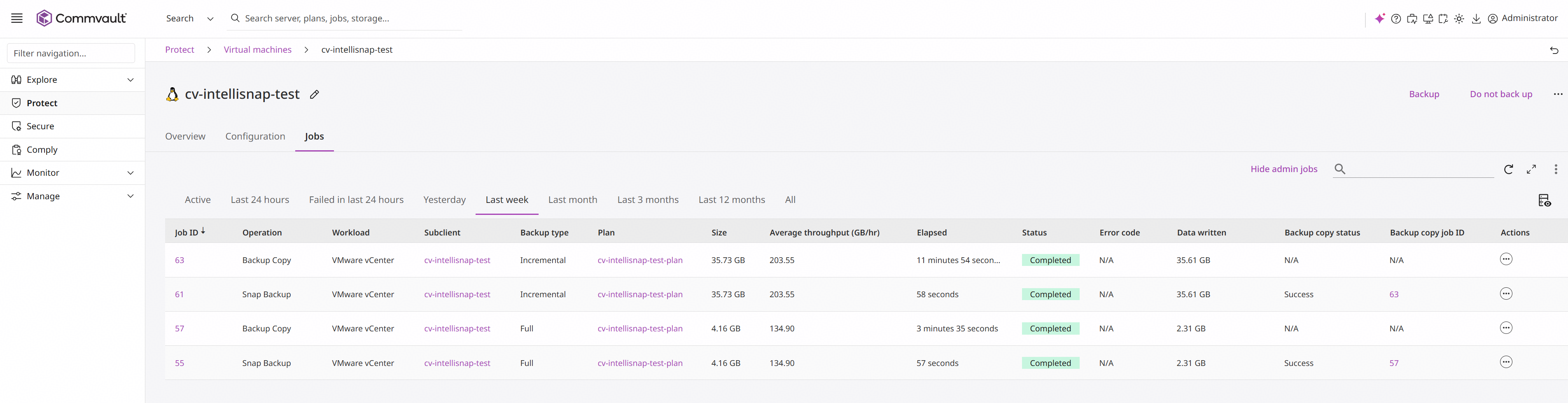
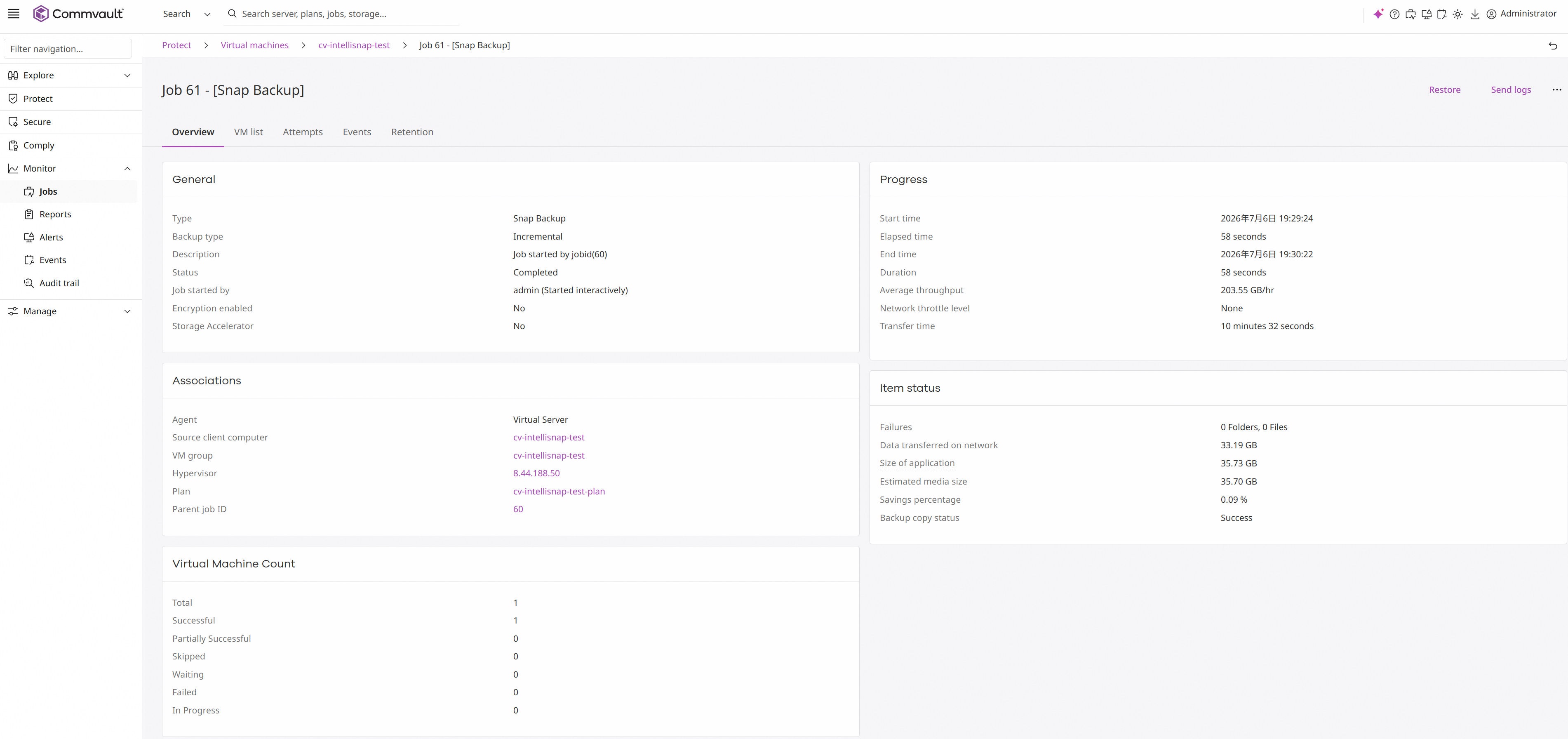 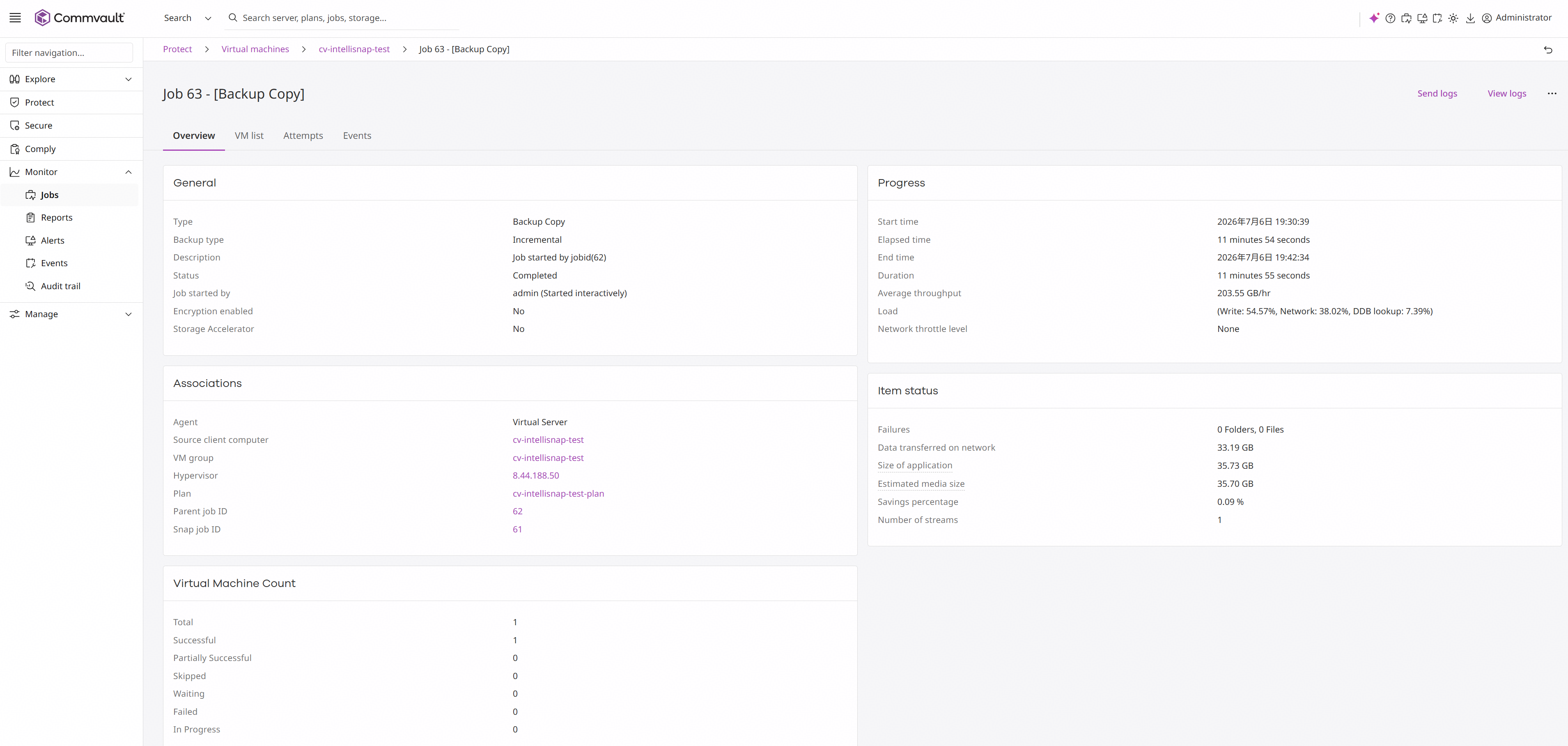
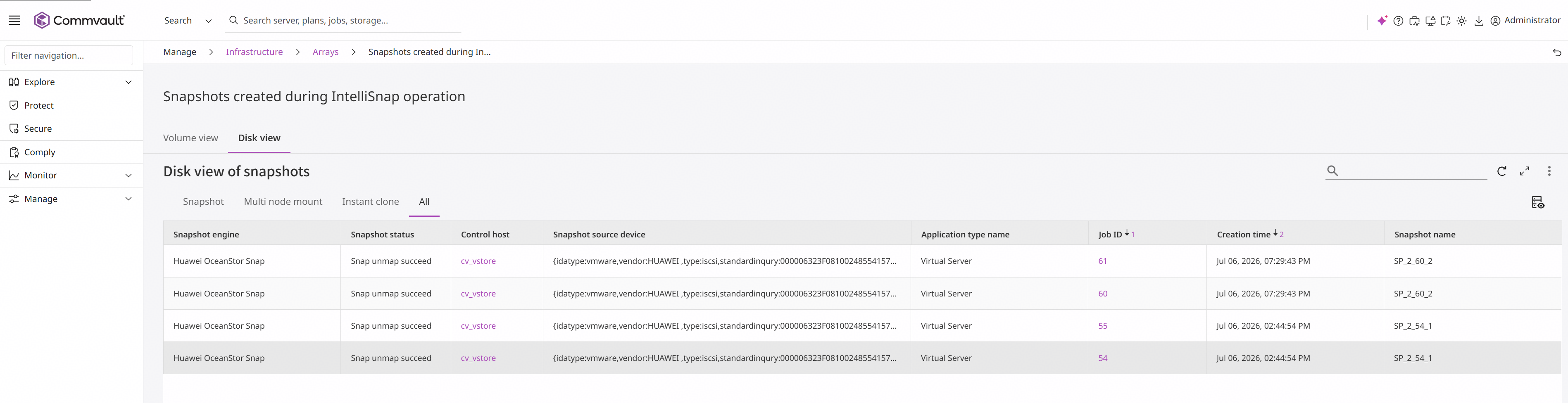 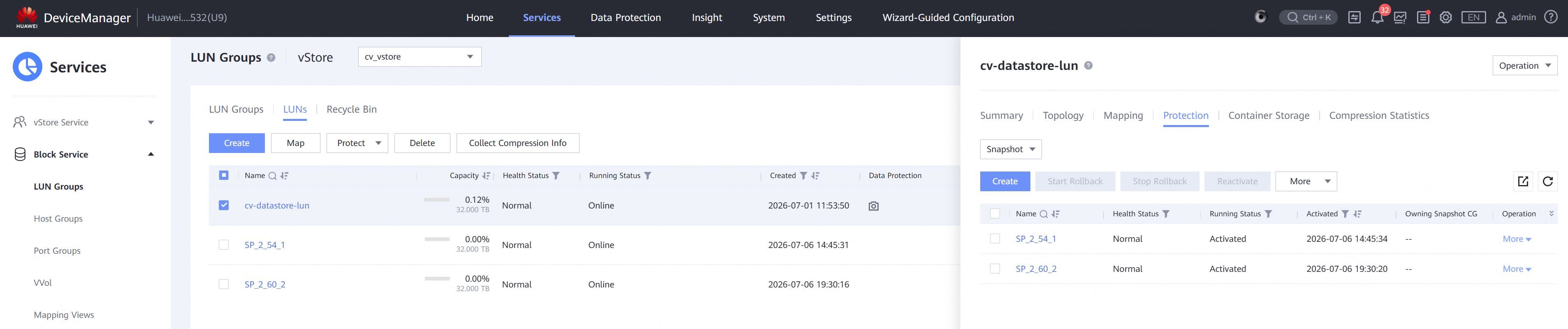
 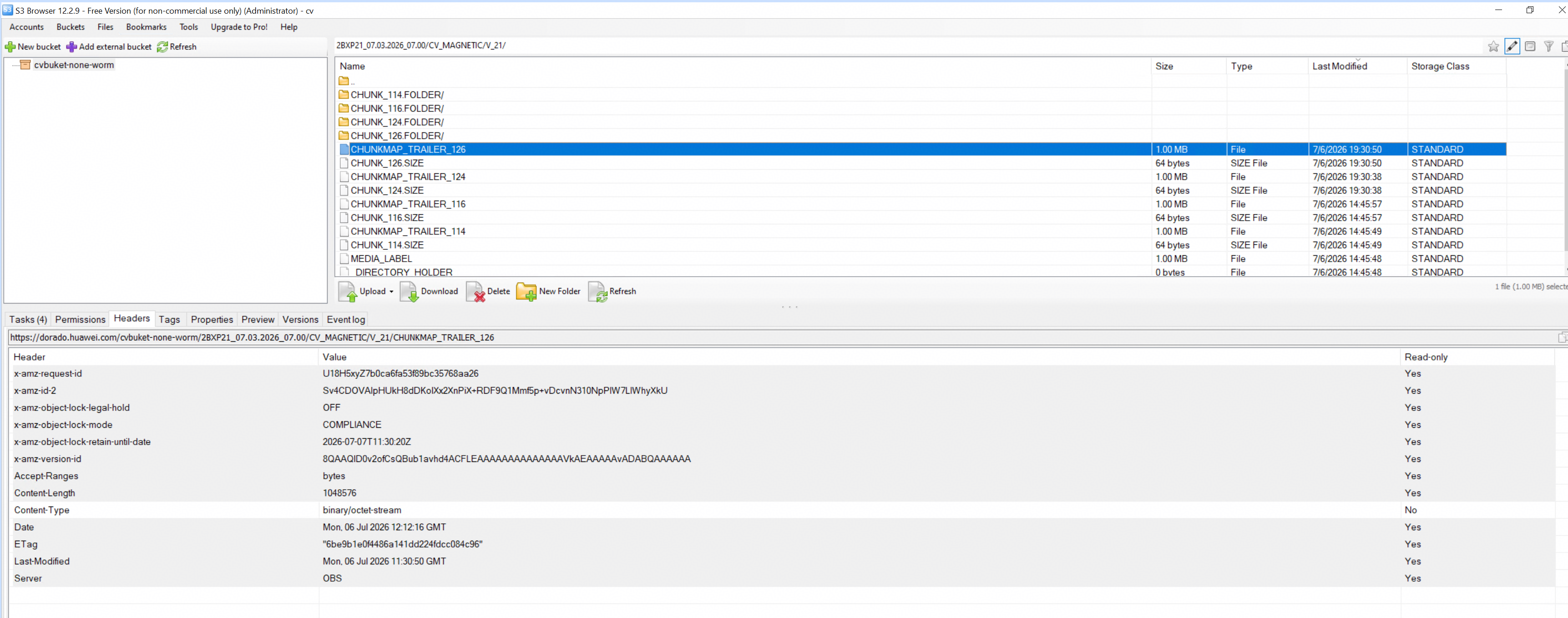
|
Test Conclusion | Passed |
3.7 Restore the VM from the storage snapshot
Test Purpose | To verify that the backup server can restore the VM from the storage snapshot. |
Network Diagram | Reference to Figure 1.1 |
Prerequisites |
|
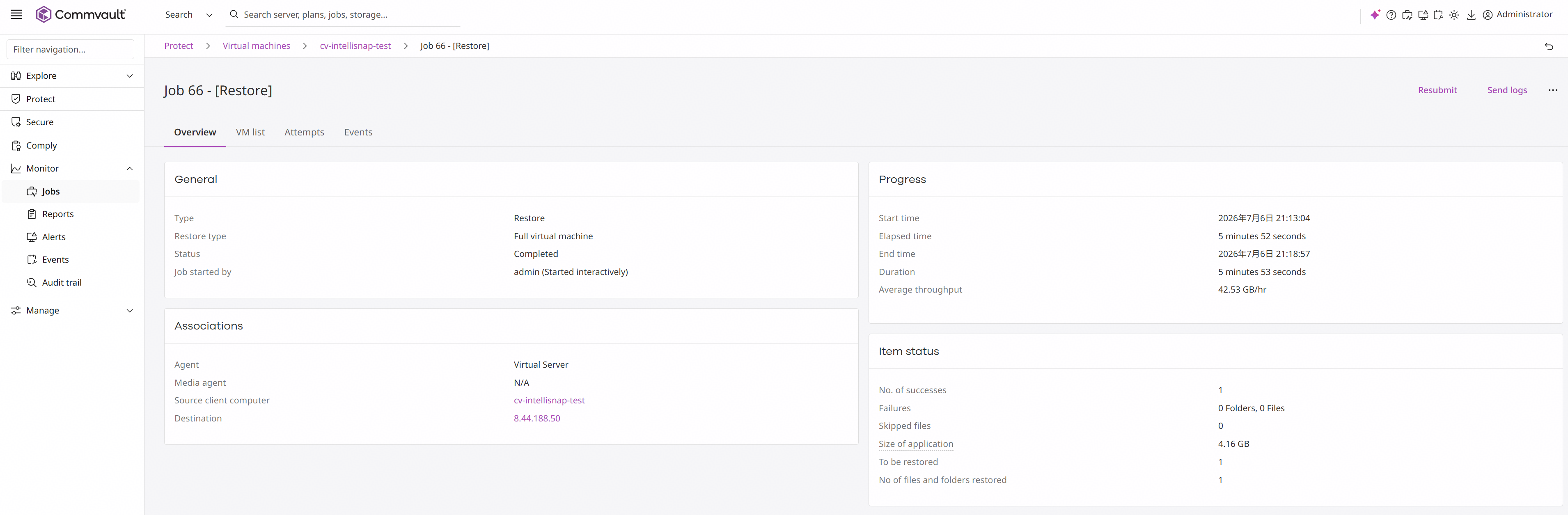
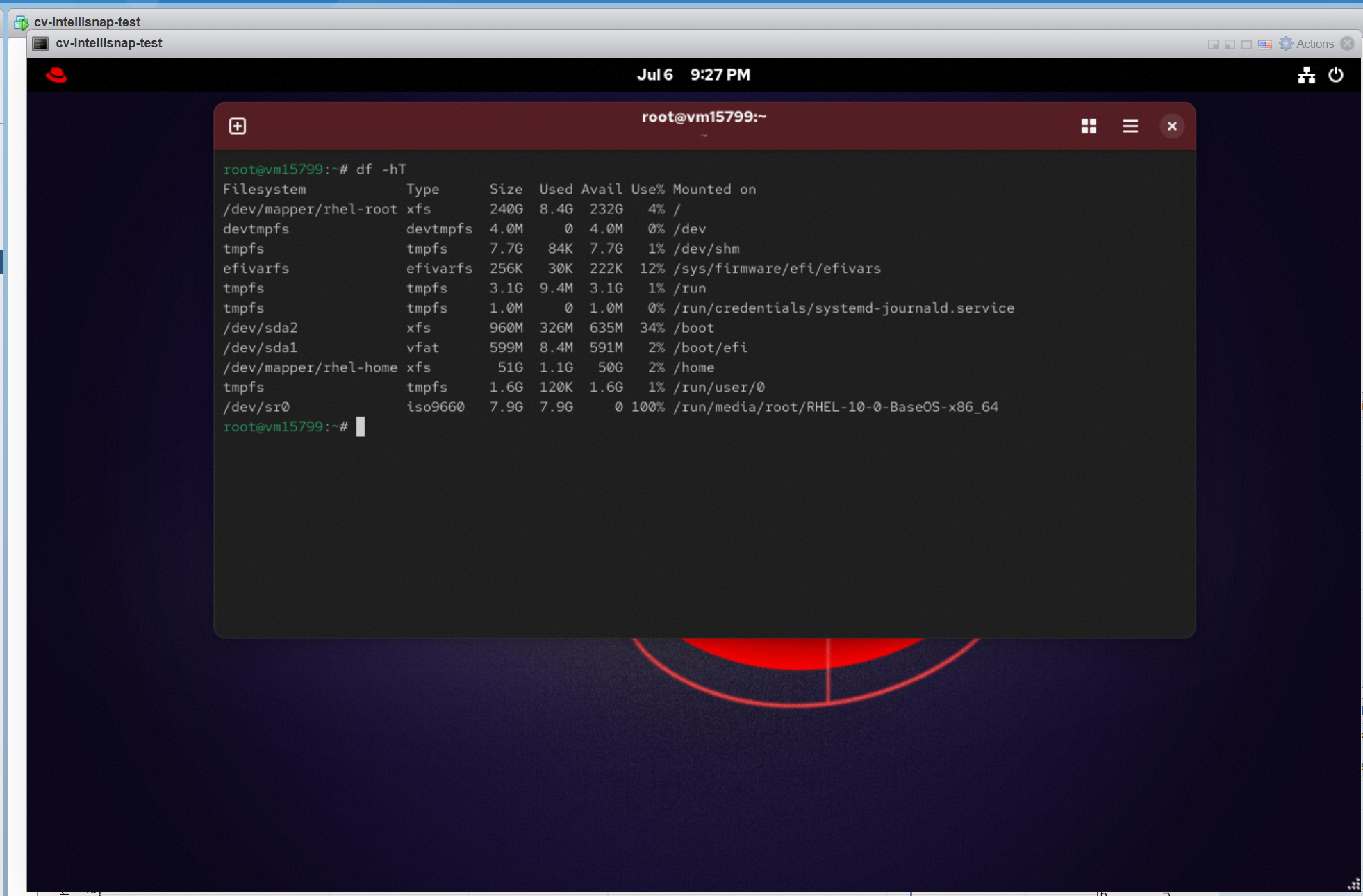
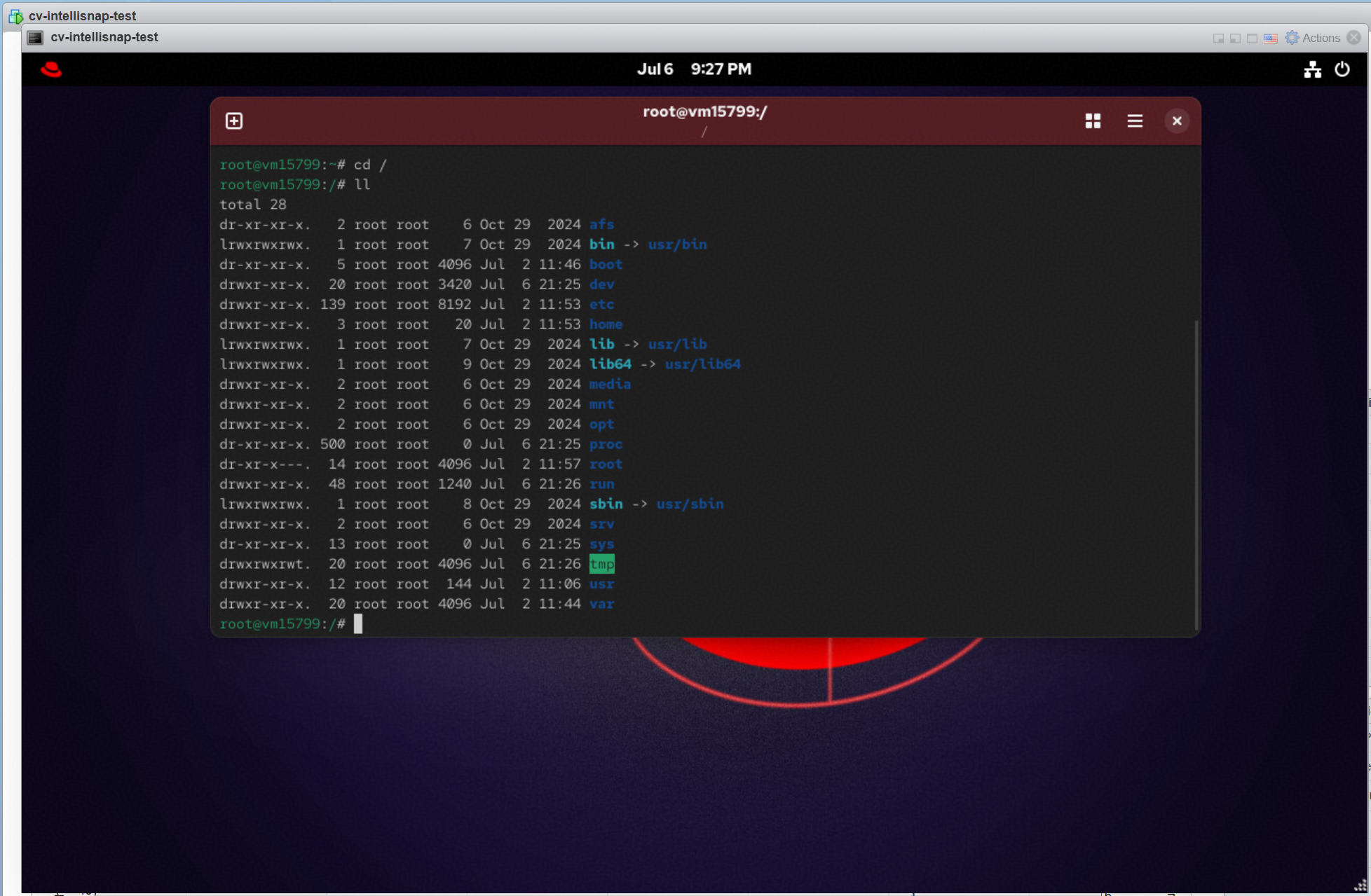
Test Procedures | Step 1: From the Command Center navigation pane, go to Protect > Virtual machines, click the VM. Step 2: On the Jobs tab, select the performed Full Snap Backup job in section 3.5 and click Restore. Step 3: Click Change source and select primary snap in Restore from copy box, and then click Full virtual machine. Step 4: Click In place, leave the default values, and then click Next. Step 5: Select the checkbox for the VM. Review the overwrite warning, and then click Next. Step 6: On the Summary page, review the settings. Click Submit. Step 7: Check the restore job status on the backup server. Step 8: Check the restored VM status. |
Expected Results |
|
Test Results |

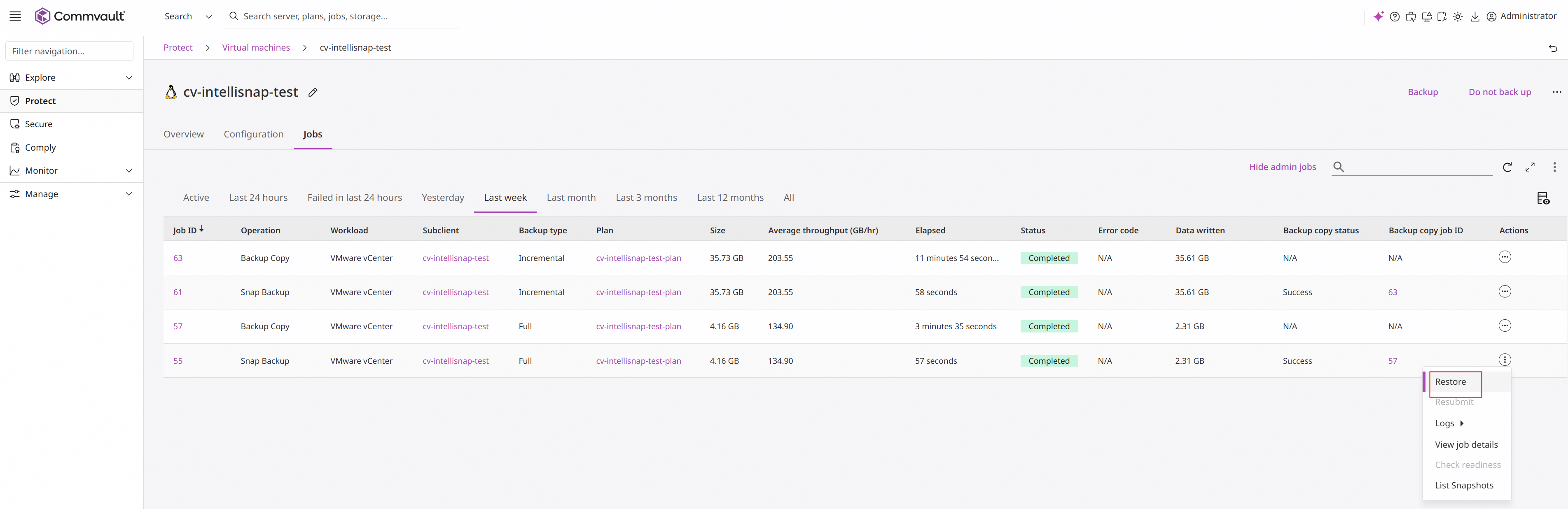
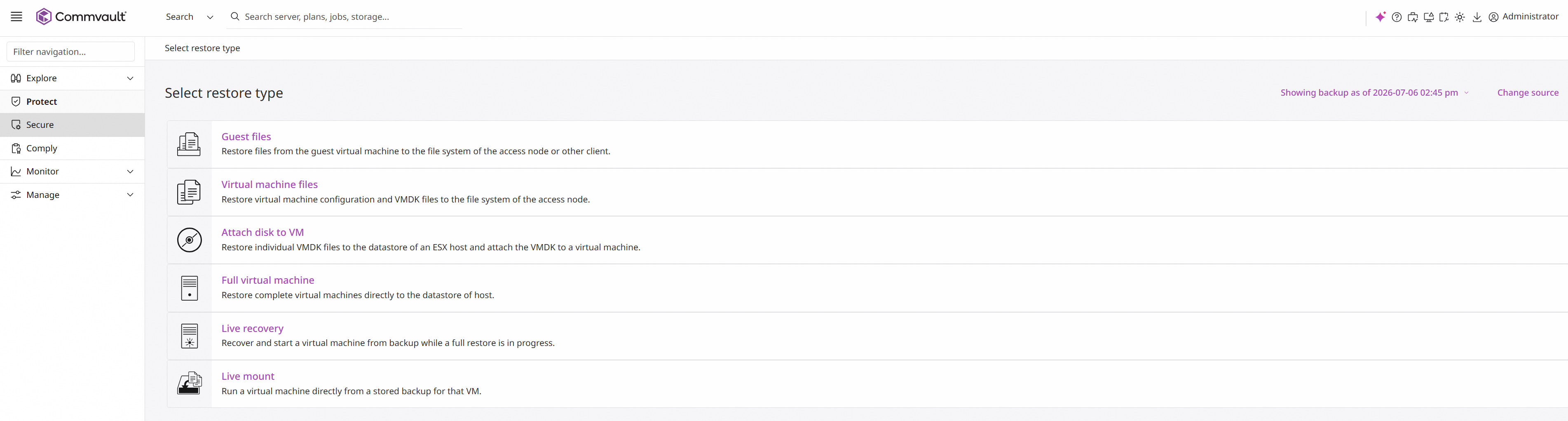 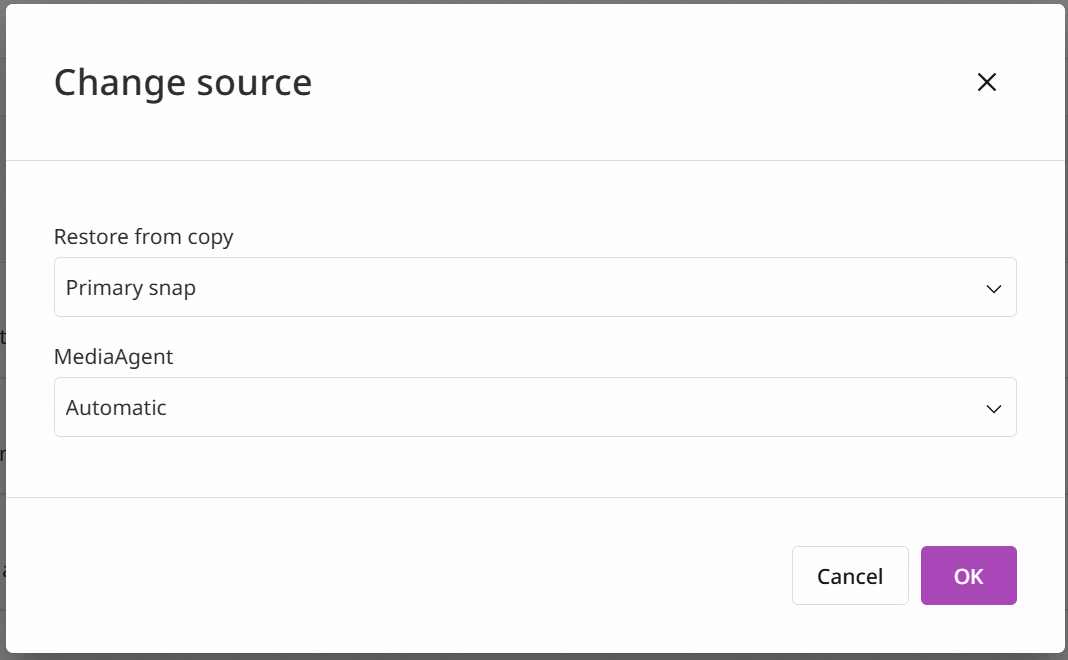
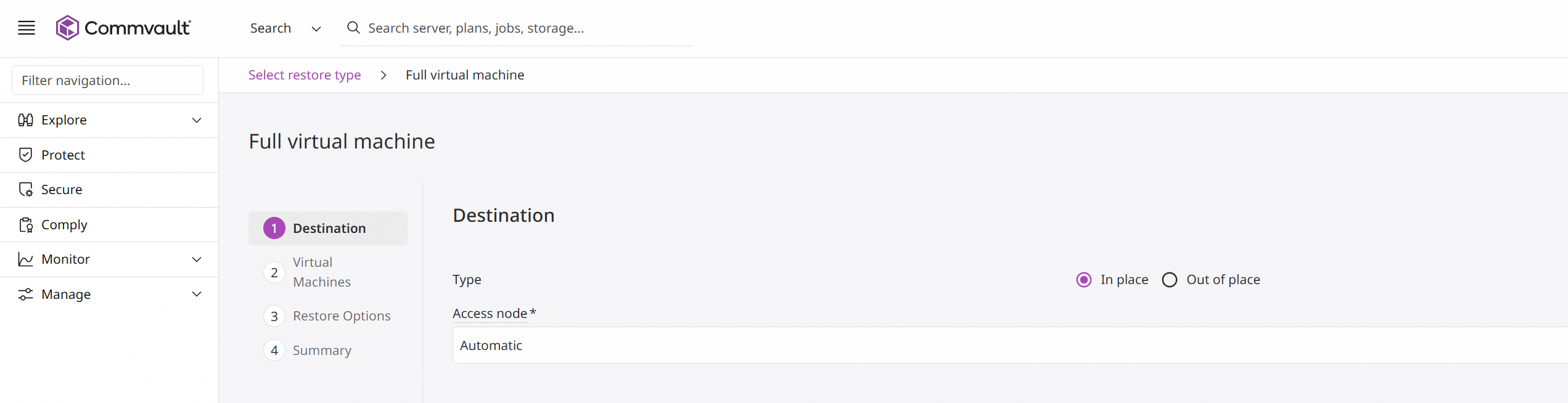 
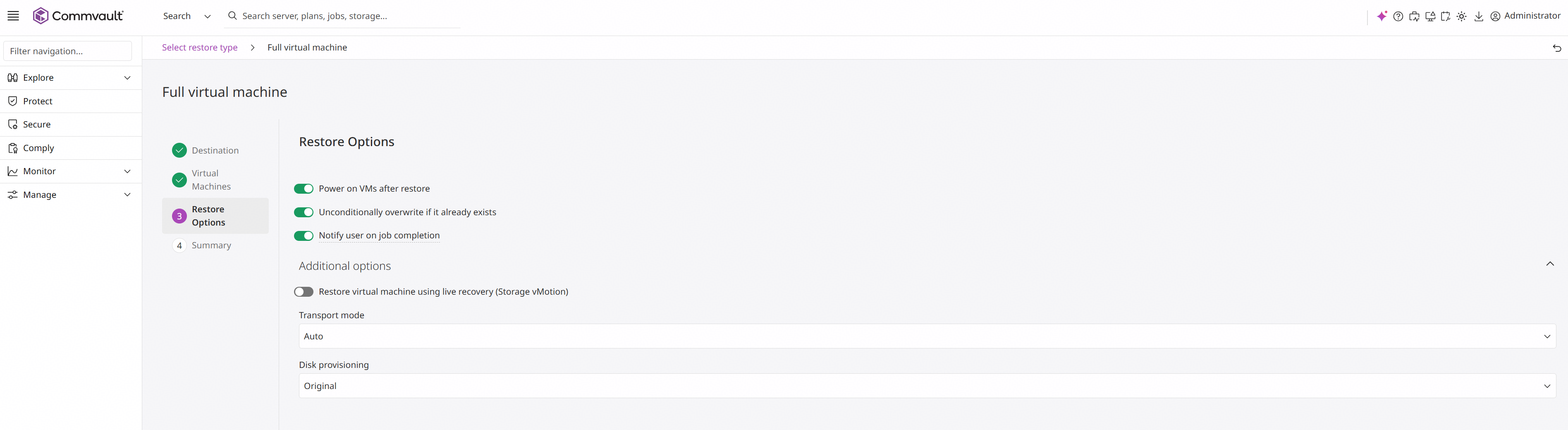
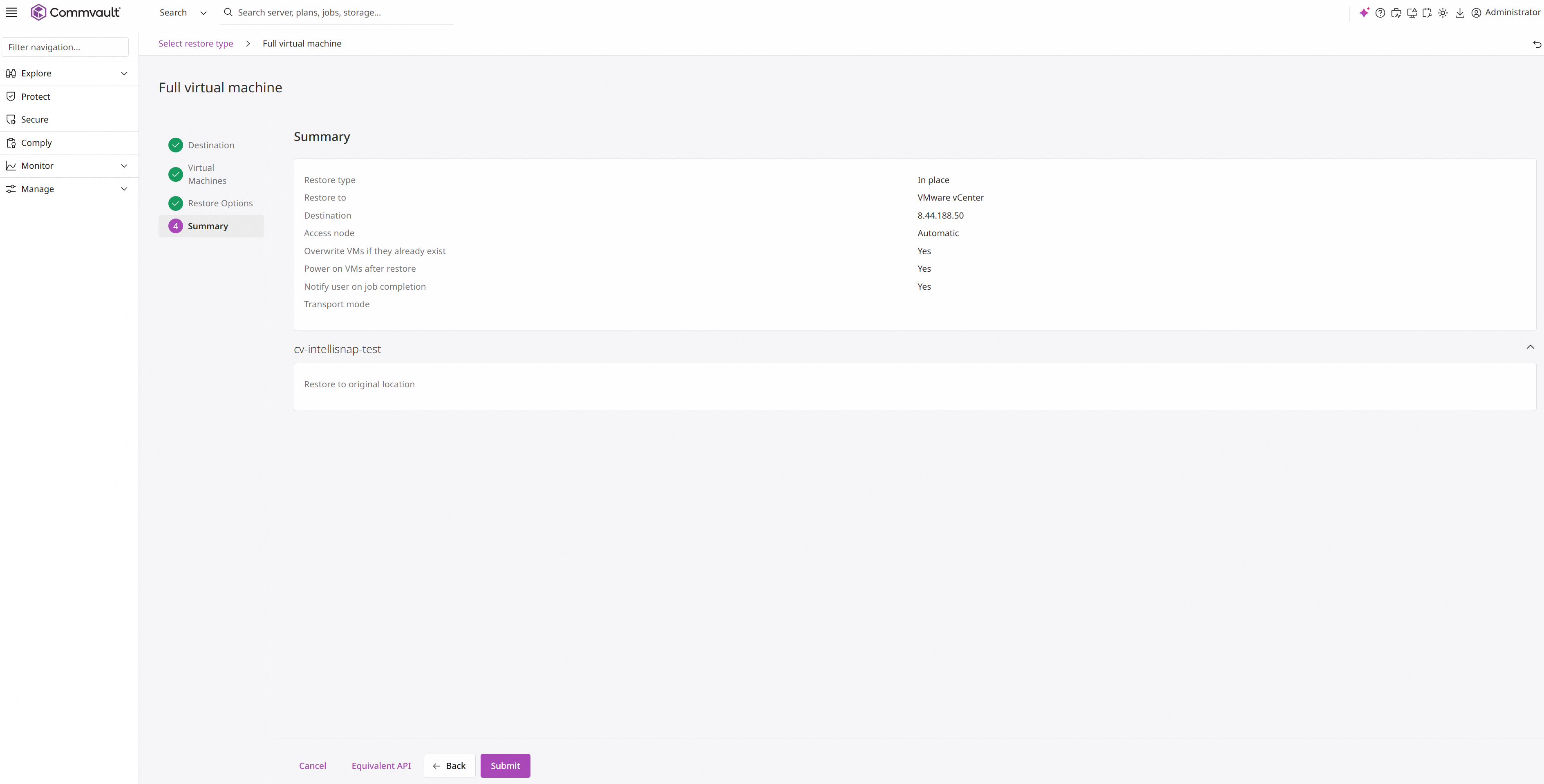
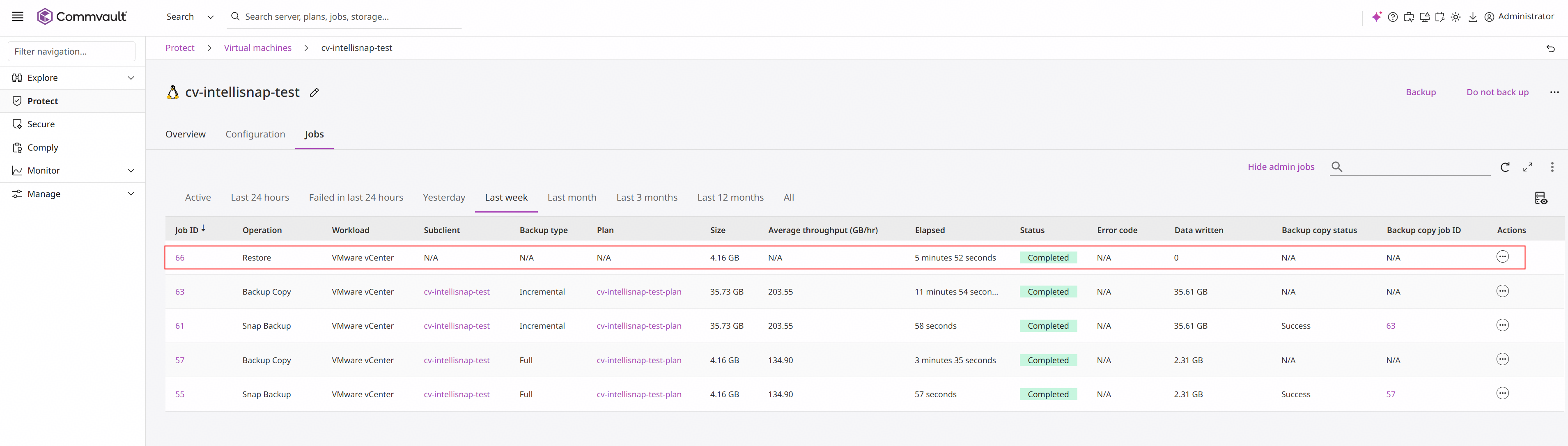 
|
Test Conclusion | Passed |
3.8 Restore the VM from the immutable cloud storage
Test Purpose | To verify that the backup server can restore the VM from the immutable cloud storage. |
Network Diagram | Reference to Figure 1.1 |
Prerequisites |
|
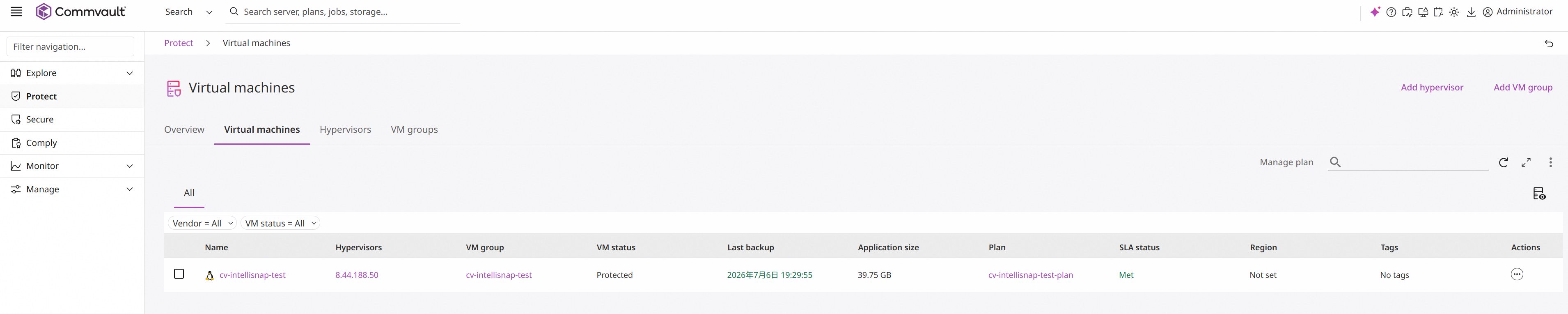
Test Procedures | Step 1: From the Command Center navigation pane, go to Protect > Virtual machines, click the VM. Step 2: On the Jobs tab, select the performed Incremental Snap Backup job in section 3.6 and click Restore. Step 3: Click Change source and select primary in Restore from copy box, and then click Full virtual machine. Step 4: Click In place, leave the default values, and then click Next. Step 5: Select the checkbox for the VM. Review the overwrite warning, and then click Next. Step 6: On the Summary page, review the settings. Click Submit. Step 7: Check the restore job status on the backup server. Step 8: Check the restored VM status. |
Expected Results |
|
Test Results |
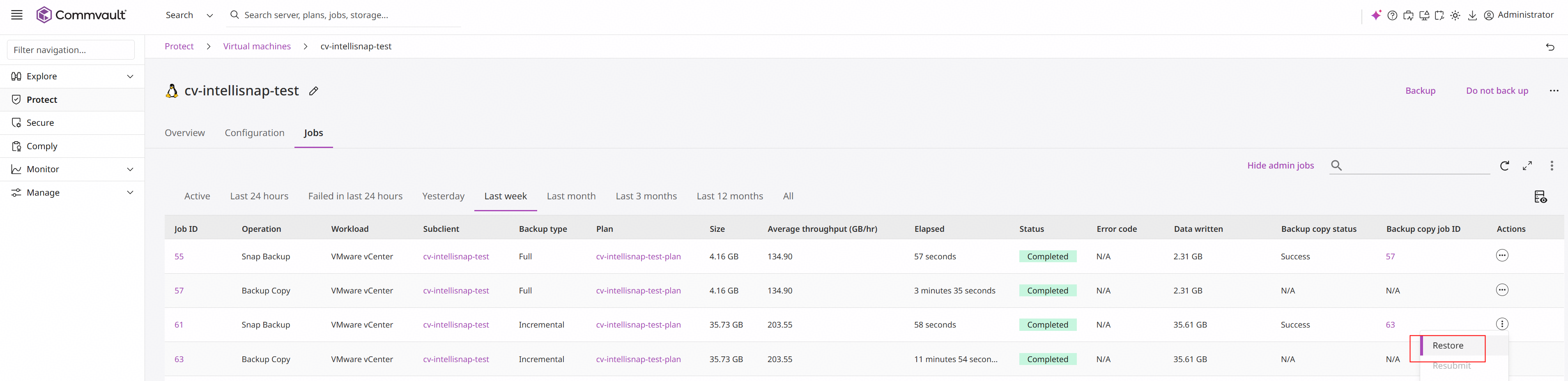
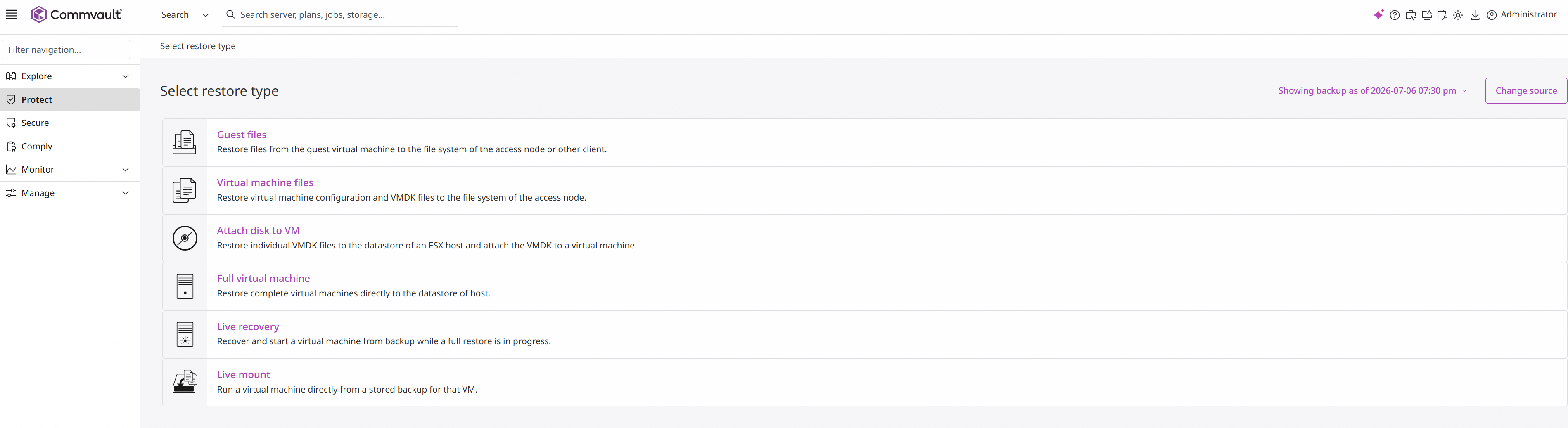
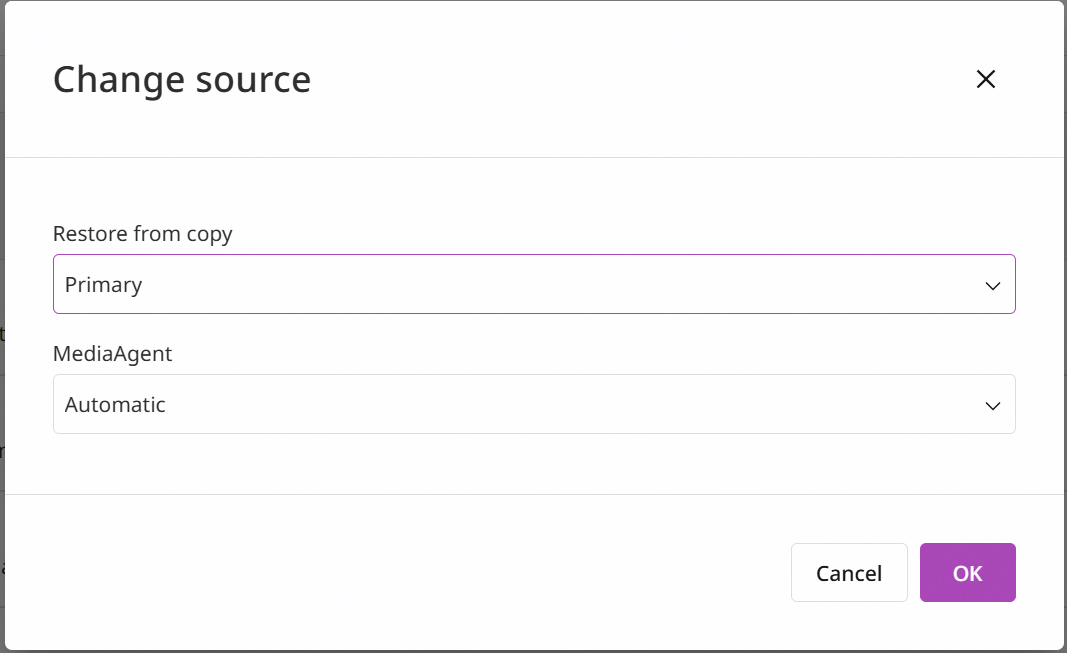

 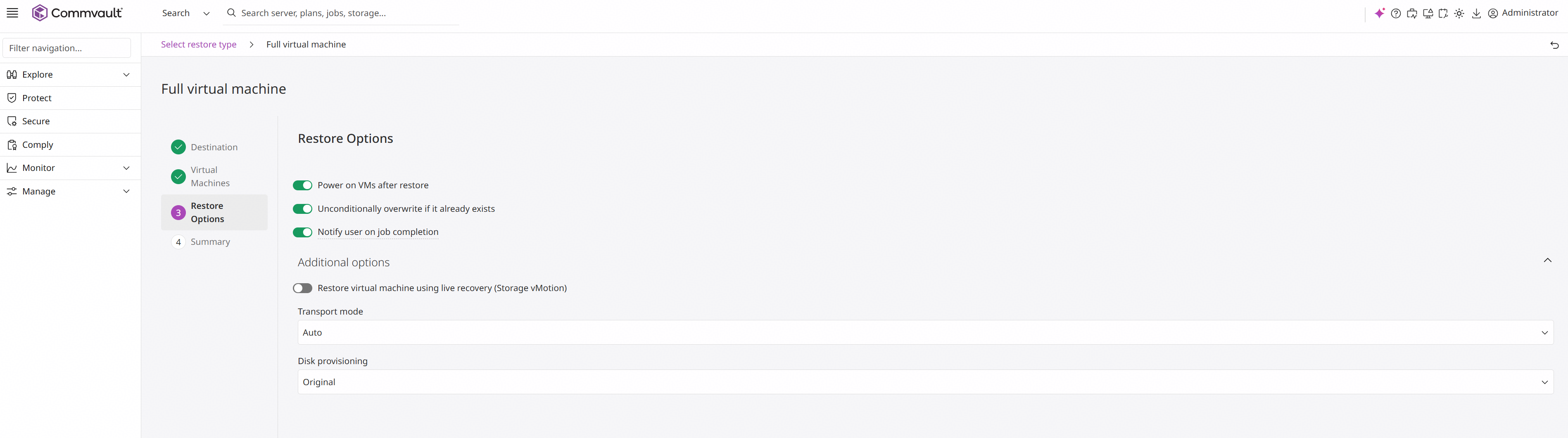
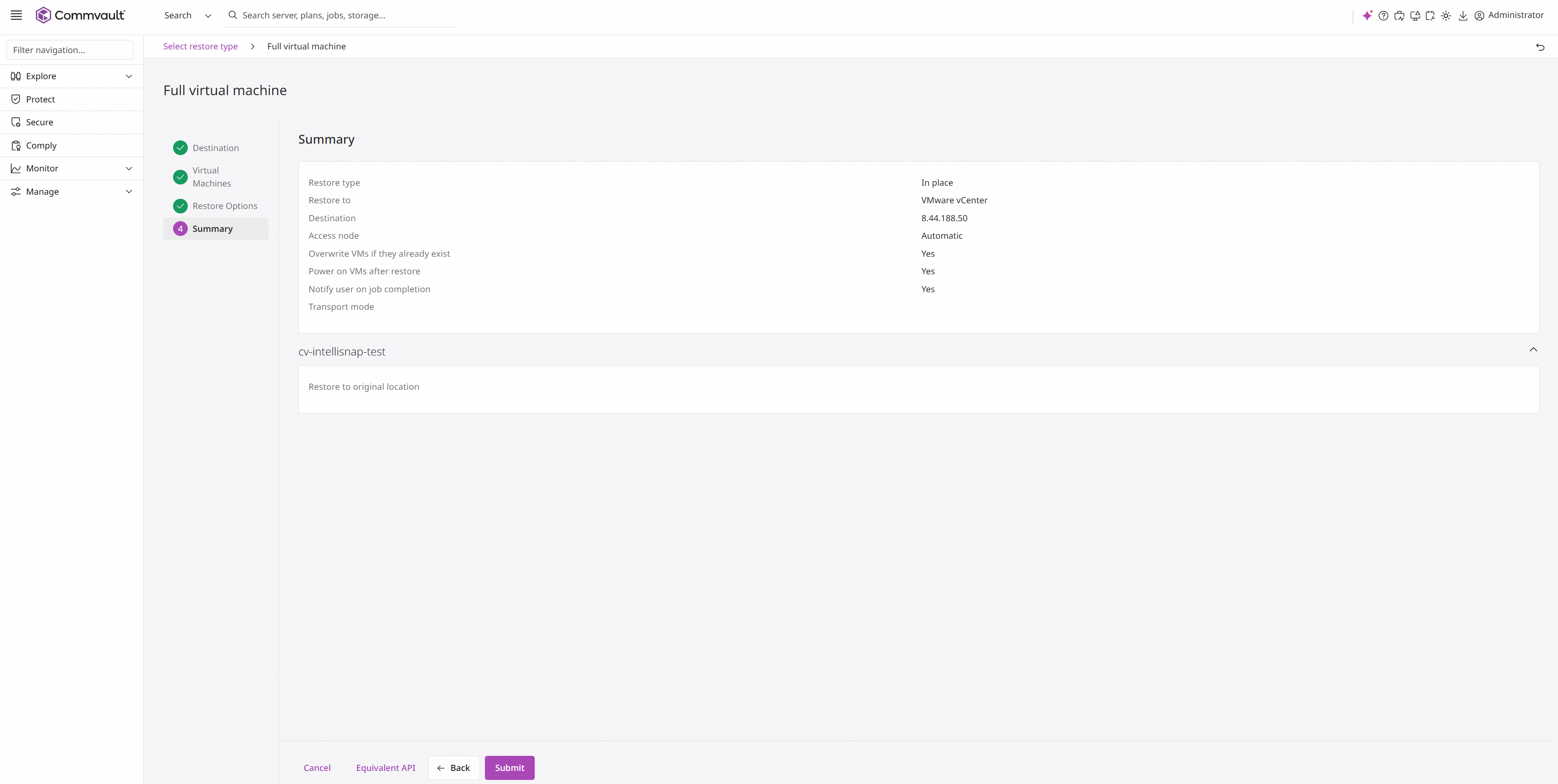

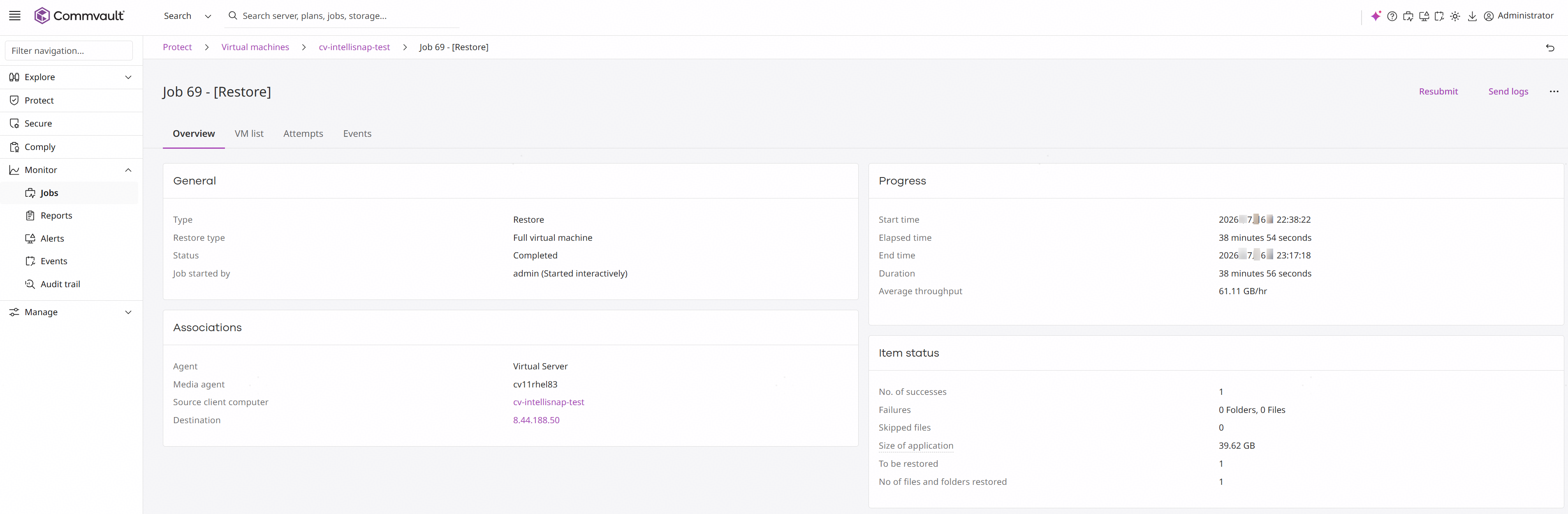
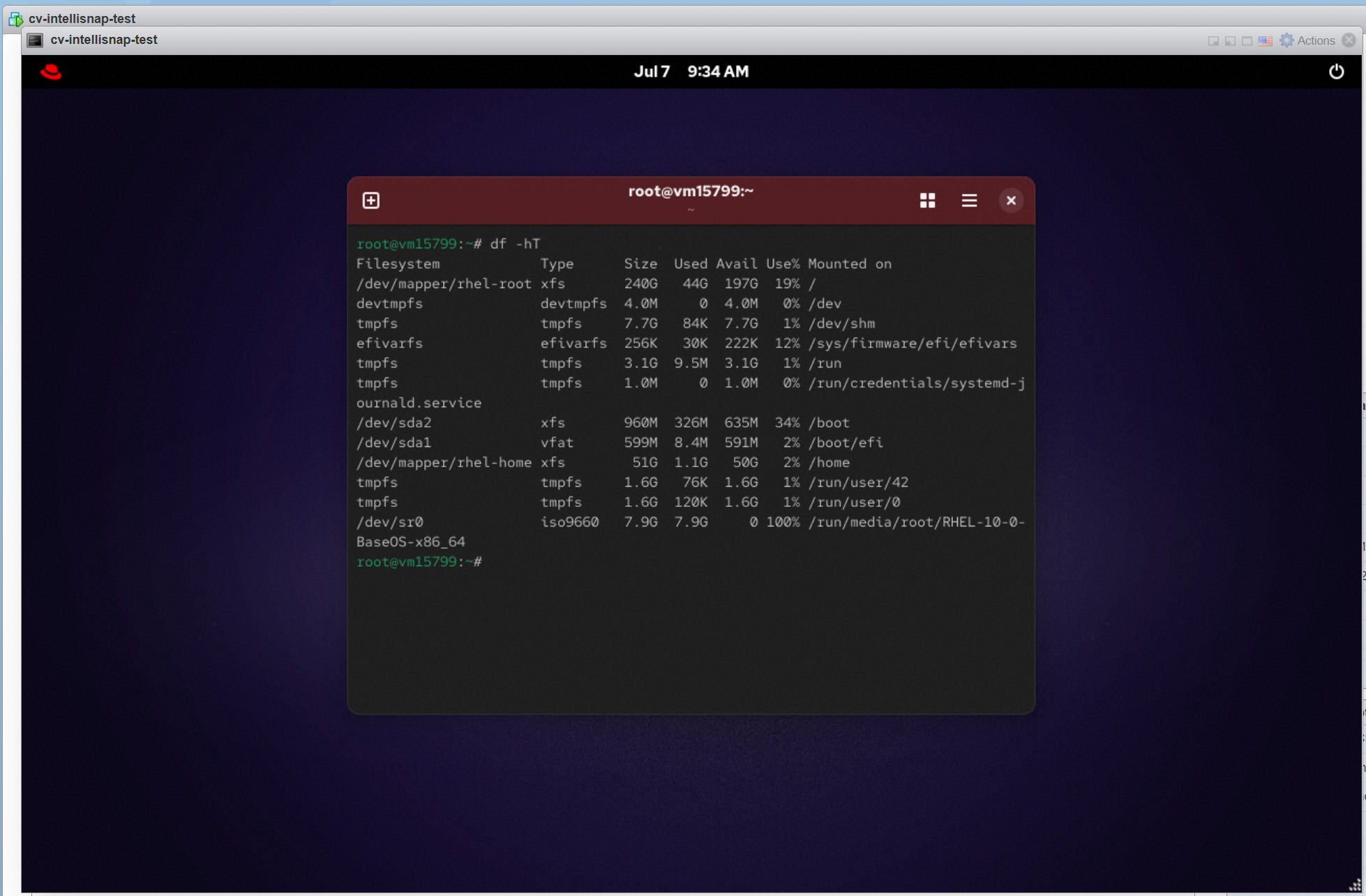 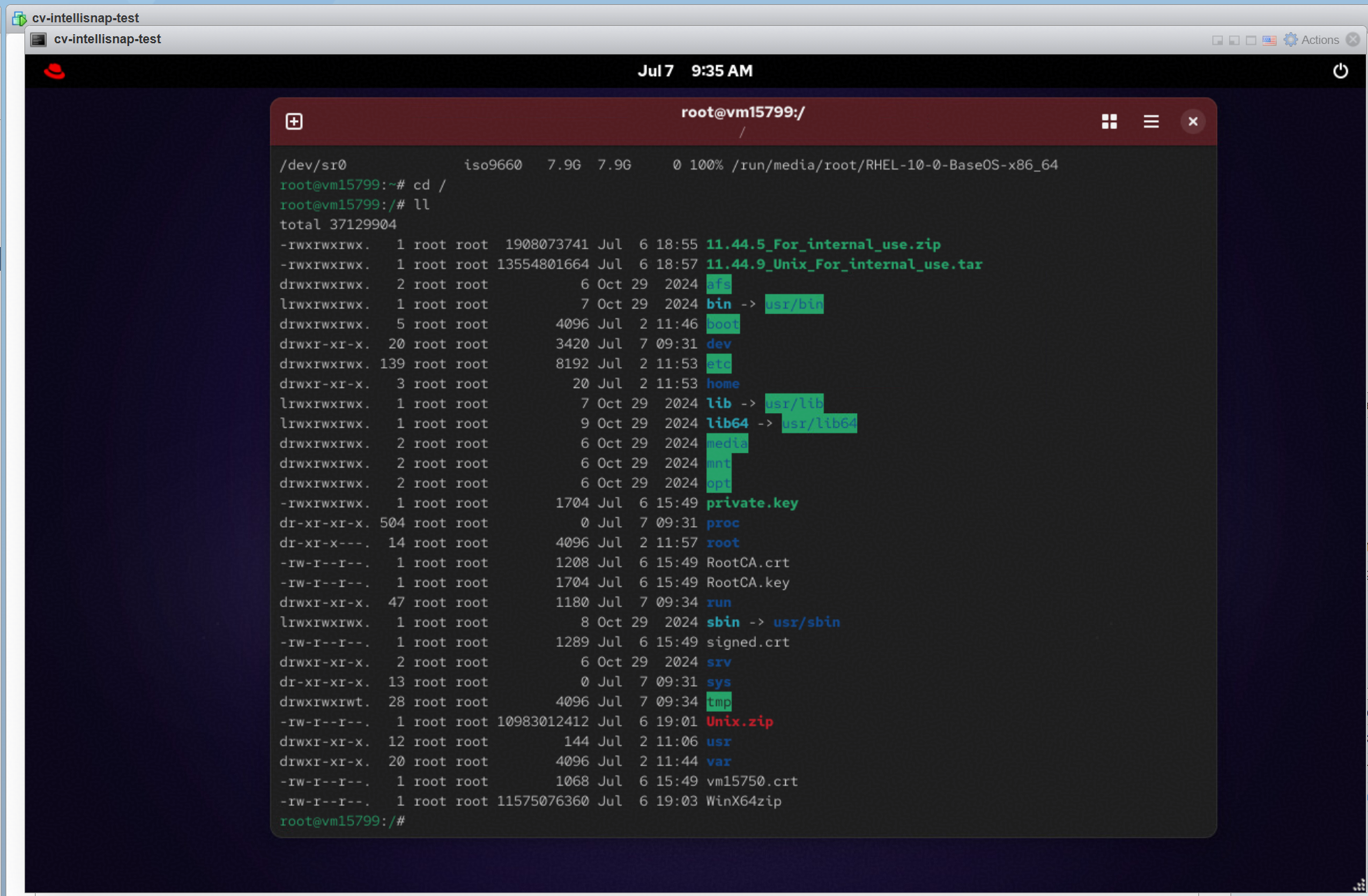
|
Test Conclusion | Passed |
3.9 Verify Retention Period of immutable cloud storage
Test Purpose | To verify that the retention period is supported when the Huawei OceanStor Dorado All-Flash Storage is used as immutable Cloud storage. |
Network Diagram | Reference to Figure 1.1 |
Prerequisites |
|
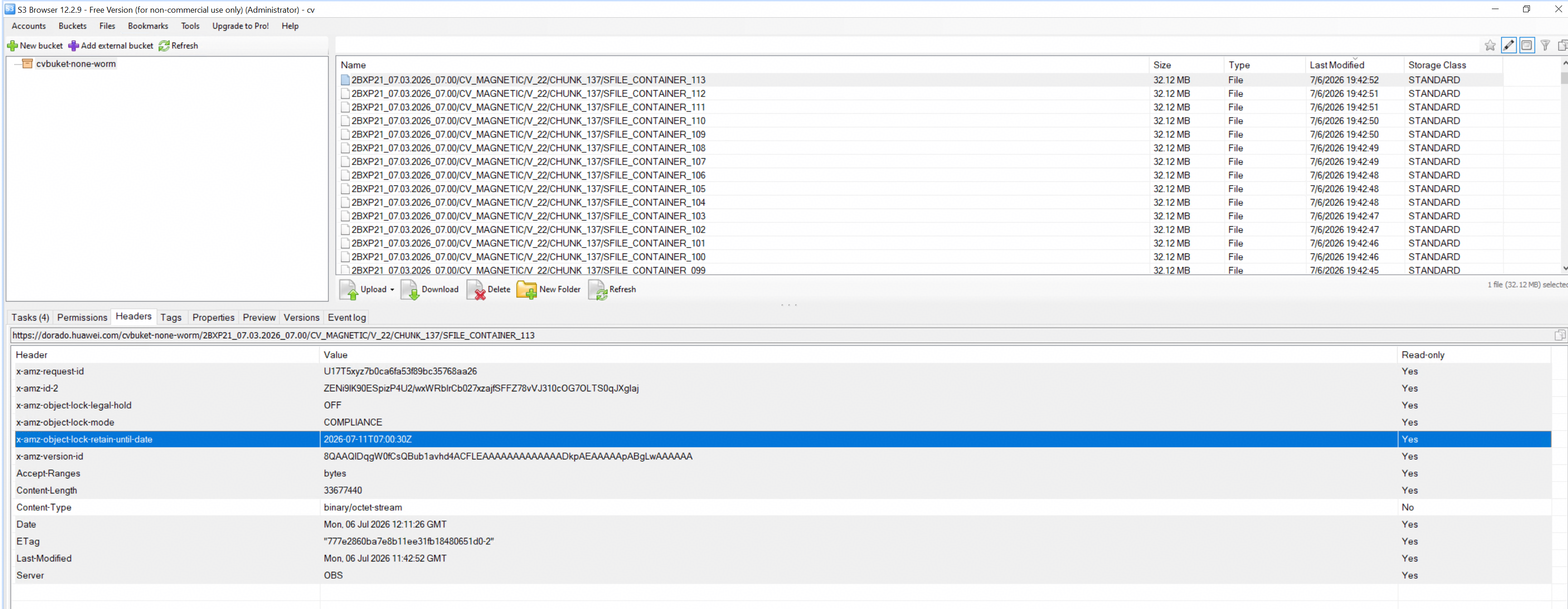
Test Procedures | Step 1: Check the headers of the backup files on the s3 Browser. Step 2: Delete the backup files within the retention period on the backup server. Step 3: Delete the backup files within the retention period on the s3 Browser. |
Expected Results |
|
Test Results |
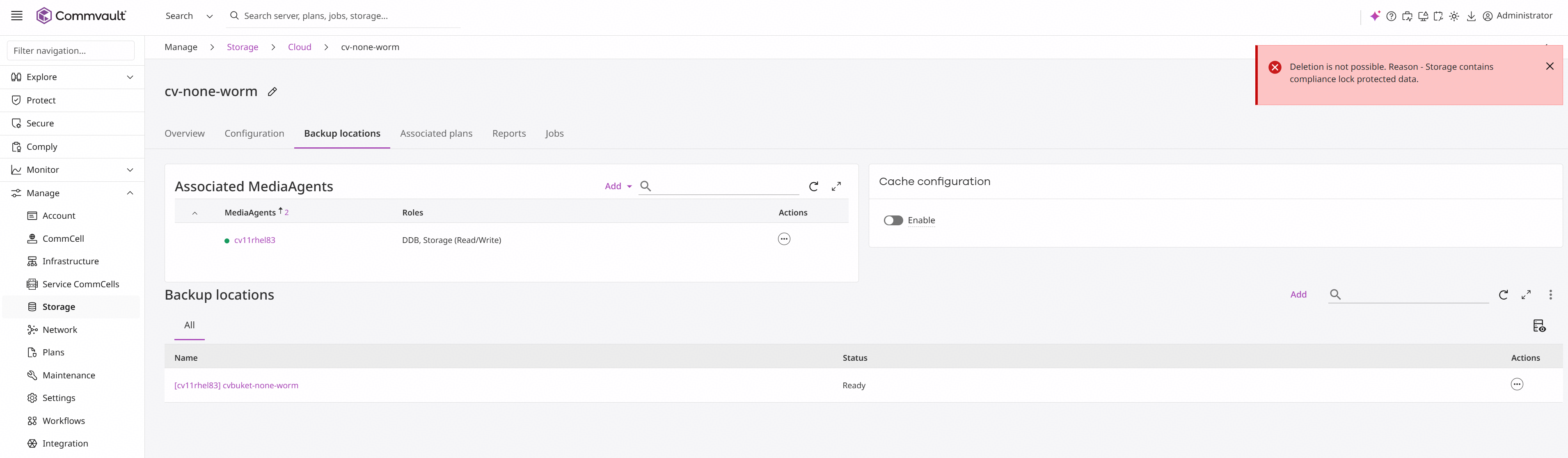
1.1 On the S3 browser, the headers of the full backup files on the storage contain the ‘x-amz-object-lock-mode’ and the value is COMPLIANCE. And the headers of the full backup files on the storage contain the ‘x-amz-object-lock-retain-until-date’ and the value is 2026-07-11T07:00:30Z. 1.2 On the S3 browser, the headers of the incremental backup files on the storage contain the ‘x-amz-object-lock-mode’ and the value is COMPLIANCE. And the headers of the incremental backup files on the storage contain the ‘x-amz-object-lock-retain-until-date’ and the value is 2026-07-11T07:00:30Z. 2. The backup files could not be deleted on the backup server within the retention period (2026-07-11T07:00:30Z UTC+0/2026-07-11T15:00:30Z. UTC+8).
The backup files could not be deleted on the s3 browser within the retention period (2026-07-11T07:00:30Z UTC+0/2026-07-11T15:00:30Z. UTC+8). The error is reported: Failed – AccessDenied: Operation not permitted. 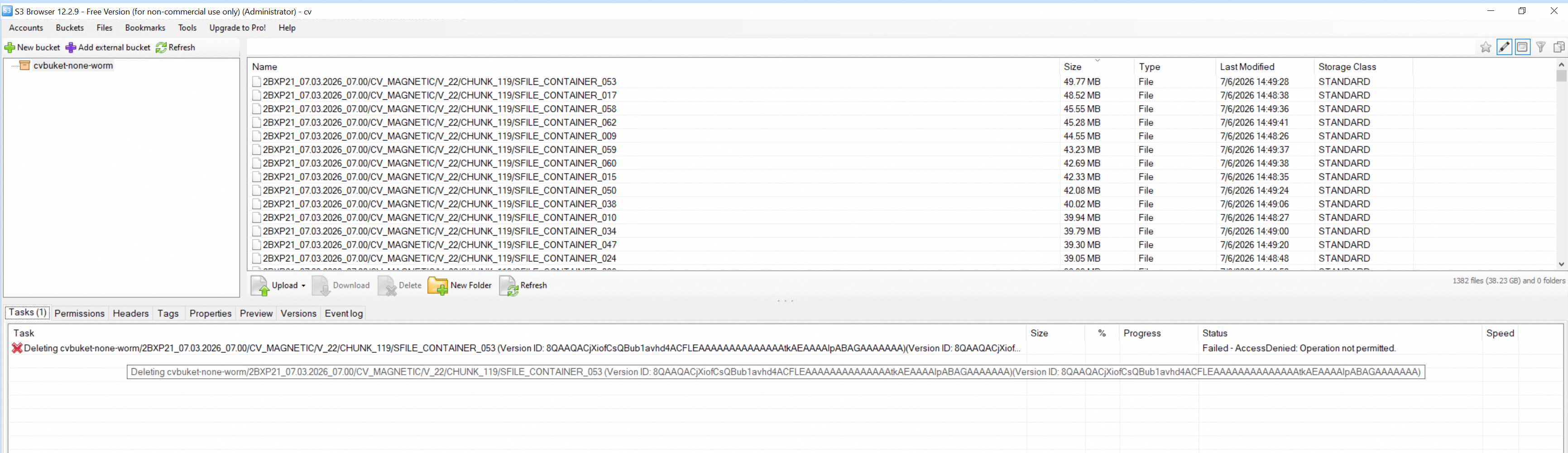 |
Test Conclusion | Passed |
4.Reference
4.1 Commvault User Guide
https://documentation.commvault.com/11.44/software/getting_started_with_intellisnap.html
https://documentation.commvault.com/11.44/software/cloud_storage.html
4.2 Huawei OceanStor Dorado All-Flash Storage User Guide
https://support.huawei.com/hedex/hdx.do?docid=EDOC1100489522&id=public_path_object_base_config_003
